SearchLift

Google Search Console

Google Search Console, read the way an SEO strategist reads it

Search Console holds the only honest numbers about your Google traffic, and almost nobody reads it. SearchLift connects to it and reads the whole thing for you, turning Google’s own data into a short list of things worth doing this week.

searchlift · console
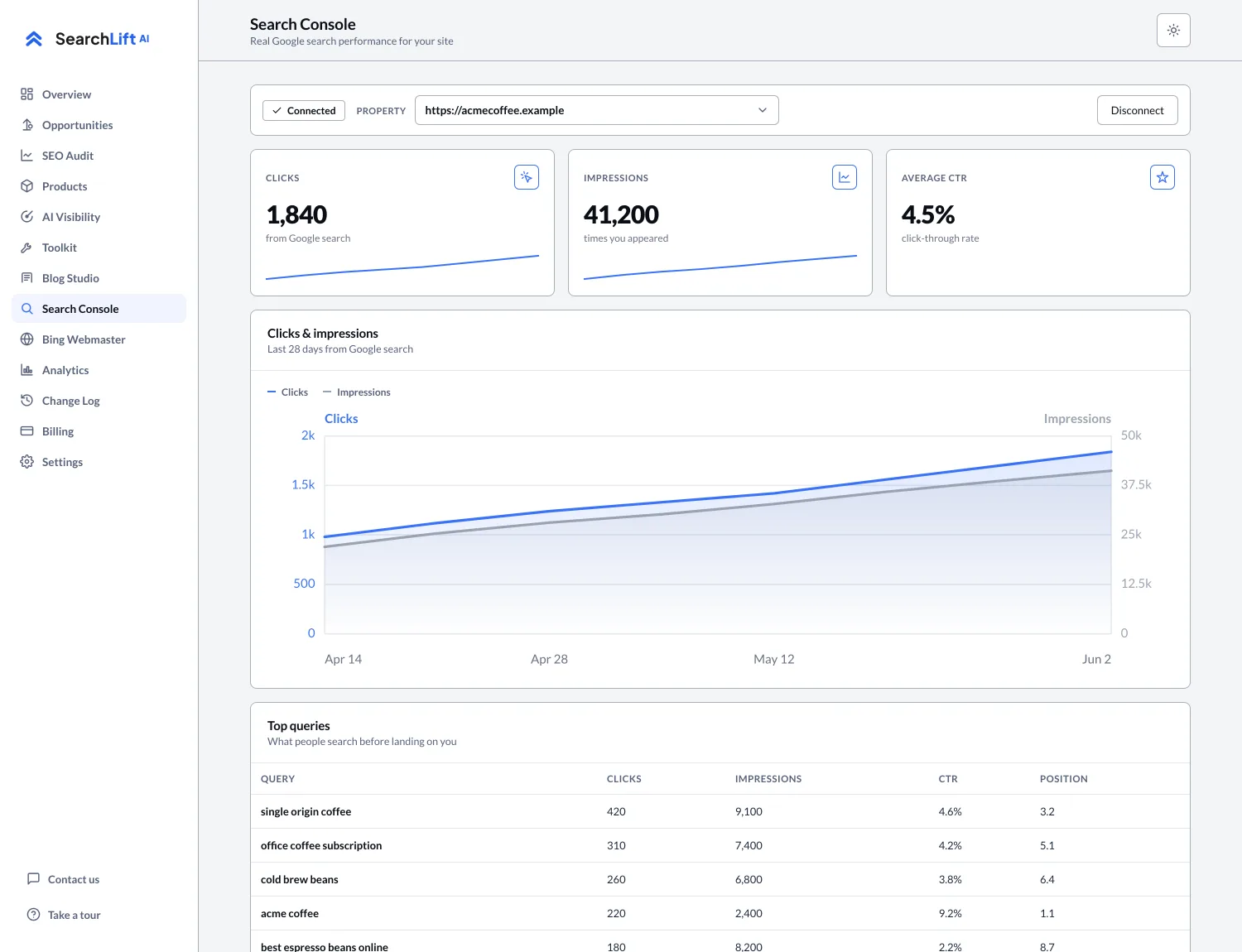
The SearchLift Search Console suite listing striking-distance queries and pages with click-through below their position.

Almost ranking

Real queries where you already sit at positions 8 to 20 with real impressions. Moving one of those onto page one is the best-value work in SEO, and every row is Google’s own data, never an estimate. For each, SearchLift reads the live page and drafts a title and description based on the page’s real top queries.

Pages under-earning their position

A page ranking third that gets the click-through rate of a page ranking ninth does not need a better ranking; it needs a better title. SearchLift compares every page’s click-through with what its position should earn and lists the ones losing clicks they have already won.

Index health, page by page

The list of URLs is built from your sitemap plus every page Google has really served, then each URL is checked against Google’s URL Inspection verdicts in small batches. Pages that quietly dropped out of the index, and new pages Google has not found yet, are shown as a list rather than left for you to discover.

Decay and cannibalization

Content decay flags pages whose score fell, whose content is getting old without review, or whose clicks and impressions are trending down. The cannibalization finder groups your own pages that compete for the same query, names the one to keep, and writes the steps to merge the rest. Both are fully deterministic: every flag is computed from the numbers and can be reproduced.

A work order, then a receipt

Any set of findings exports as one self-contained PDF or CSV work order a developer can carry out without SearchLift access. Each exported item becomes a watch: the nightly check re-reads the live page, notices when the change was really made, and only then starts a 14-day before-and-after measurement on that exact URL. Exported, done, proven, with nobody ticking boxes.

Queries become questions

Query mining turns the searches people already use to find you on Google into tracked AI visibility questions and article topics, so your Google SEO and your AI SEO work from the same demand.

Questions

About search console suite.

What do I need to connect?

A Google account with access to the Search Console property for your site. SearchLift asks for the Search Console permissions at connection time and can add the property and submit your sitemap if they are not there yet.

Are the numbers estimates?

No. Every figure on the Search Console screens is read from Google’s Search Analytics or URL Inspection APIs for your property. Where Google has no data for a page in a window, SearchLift says so rather than showing a zero.

Can it request indexing or remove pages?

Deliberately not. Google’s Indexing API accepts those calls for ordinary pages and discards them, and the Removals tool has no public API. SearchLift shows you Google’s verdict and gives you the honest next step instead.

Who is the work order for?

Whoever edits your site. It groups findings page by page with exact before and after values, so an agency or freelance developer can do it in one pass. Work orders are available on the Enterprise and Platinum plans.

How does Search Console help with AI SEO?

The queries people already use to find you on Google are the closest thing to the questions they ask ChatGPT, which is where ChatGPT SEO starts. SearchLift turns them into tracked AI visibility questions and article topics, so the two halves of search work from the same evidence.

Run it on your site today.

The free plan includes a real AI SEO audit and one tracked AI visibility question. No card.