An AthenaHQ alternative is worth considering when you need to track a few buying questions, inspect the sources behind an AI answer and act on a page issue without buying a large credit pool. AthenaHQ may be the better fit when your team needs broad model coverage, unlimited prompt topics or organization controls. Decide from the questions, sites and people you actually have, then compare the published limits. A lower price alone cannot tell you which tool will produce useful evidence.
This comparison uses the vendors’ public plan pages read on 18 October 2026. It does not test answer quality, customer support or a claim of ranking improvement. Those outcomes are not public and cannot be inferred from a feature list. The broader AI SEO platform price comparison covers more vendors; here the decision is specifically whether AthenaHQ’s scope matches a smaller team’s job.
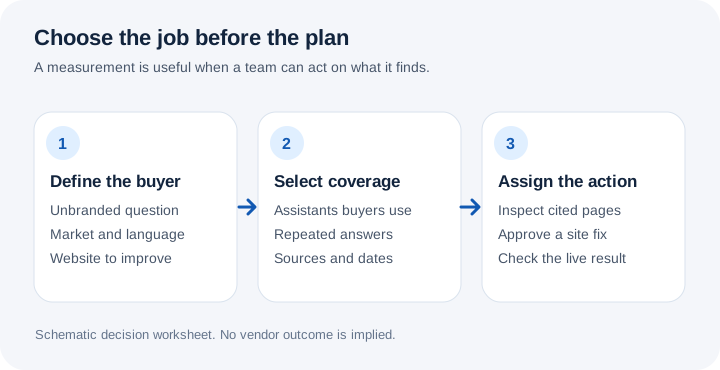
An AthenaHQ alternative starts with the question you will track
Write down the exact question a buyer would ask without your brand name. Record its market and the page on your site that should answer it. Then list the assistants your buyers use. A system that can query eleven models is valuable only if you will review their answers and have a reason to act on differences between them. A tool that checks five assistants is insufficient if a sixth is central to your audience. The plan should follow the observation you need, not a logo count.
For an agency, do this separately for each client and identify who may approve an edit to the client site. A prompt dashboard is not a substitute for that owner. The agency reporting workflow shows how to keep the question, source page, dated answers and approved change together. For one business, the same record can fit on one sheet. Do not use a branded prompt as the main test: an assistant describing a business you named is a different event from recommending it to an unprompted buyer.
| Decision input | Write down before buying | Why it changes the plan |
|---|---|---|
| Buyer questions | Exact unbranded wording, market and language | Defines what you must repeat |
| Assistants | The named services your buyers use | Determines required model coverage |
| Sites and people | Website count, reviewer and editor | Determines workspaces and approval flow |
| Next action | Page owner and change you could actually make | Separates a report from a fix |
AthenaHQ publishes credits, models and an enterprise path
AthenaHQ’s plans page, read 18 October 2026, lists Essential as Free with a $25 credit and 300 credits. It names ChatGPT, Perplexity, Google AI Overviews, Gemini and Copilot on that tier. The page does not say clearly whether the Essential credit allocation renews, so ask before treating it as an ongoing monthly allowance. The label Free and the initial credit are distinct facts.
The same page lists Starter at $295 a month with 3,600 credits, and says one credit equals one AI response. It lists visibility across eleven models, unlimited topics and prompts, competitor analysis, CSV export, integrations and on-page and off-page actions. It also says API access and extra credits are paid add-ons. Enterprise is custom and includes items such as SSO, multi-region support and organization audit logs. Those are meaningful differences for a team managing multiple markets or approval roles.
Do not turn 3,600 credits into a fixed number of questions without the actual prompt design. A question across several models, variants and markets can consume several responses. The public page gives the unit, not a promise about how many comparisons your team will find useful. Ask a vendor to show the exact debit for one of your own repeated questions before projecting a monthly bill.
Compare the published offers without equating their meters
A smaller plan may fit a smaller measurement job. SearchLift’s pricing page, read 18 October 2026, lists a continuing Free plan with one tracked question on Gemini, Plus at $8.99 a month with two questions on Gemini and Perplexity, and Premium at $17.99 a month with three questions across ChatGPT, Claude, Perplexity, Gemini and Grok. One plan covers one connected website. The page also lists page-audit and fix allowances. A tracked question is not the same unit as AthenaHQ’s response credit, so the two numbers cannot be divided into a fair cost-per-answer without usage data.
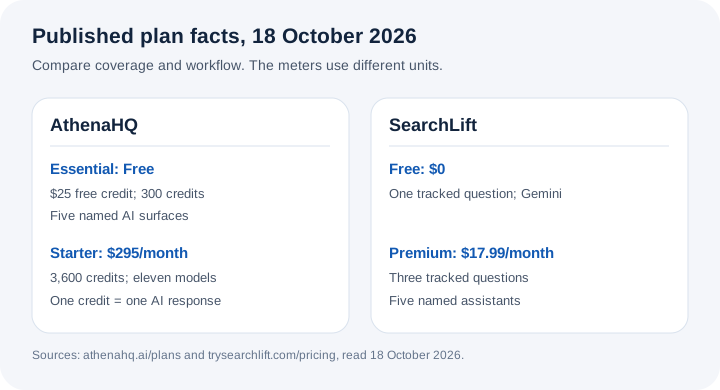
AthenaHQ’s Starter plan covers more models and lets a team define unlimited topics and prompts within its credit allocation. SearchLift’s Premium plan caps the number of tracked questions but includes the five assistants listed above, an audit of up to 100 pages and 50 AI fixes a month. If you need a wide research programme, an eleven-model system can be rational. If you need a short list of buyer questions and a route to correcting a site issue, the narrower plan can be enough. Check the live plan table when you buy because these limits can change.
Tracking and changing the site are separate jobs
A missing mention is only a dated observation. Read the cited pages in the answer, then inspect the page you expected to be cited. Is the claim visible, current and specific? Can the relevant crawler reach it? Is a different source answering the buyer more directly? Neither platform can make an unsupported product claim true. Your team still has to decide whether the gap calls for a page edit, a source correction or no action at all.
Google’s AI features guidance, read 18 October 2026, says a page must be indexed and eligible for a snippet to appear as a supporting link in Google AI Overviews or AI Mode. It says there is no special AI markup requirement. That is a Google eligibility rule, not a guarantee for ChatGPT or any other assistant. Check Search Console for the page’s status before buying a tool to improve copy that Google cannot serve.
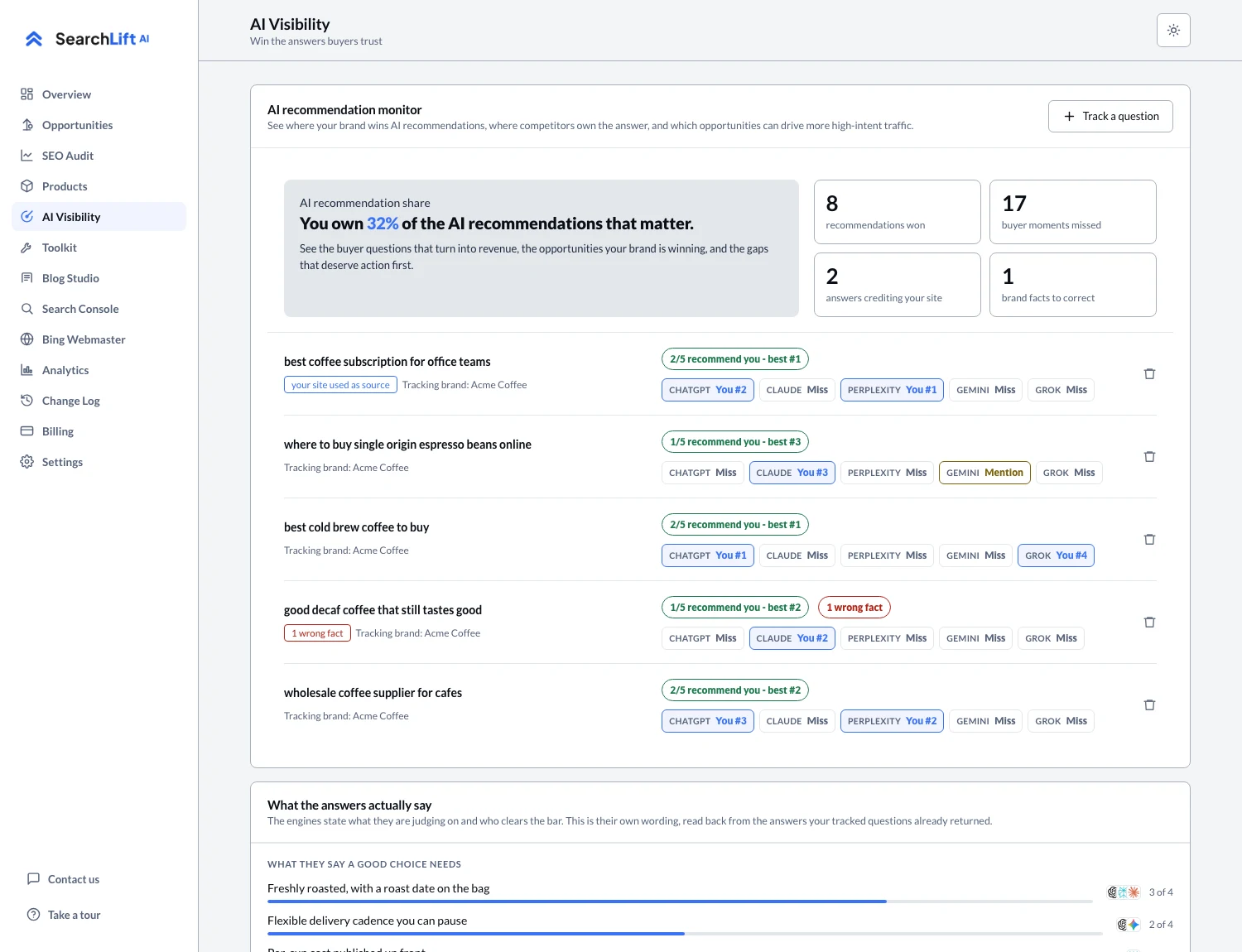
SearchLift’s AI visibility screen records the named businesses and sources for tracked questions, while its page audit offers supported fixes for approval on connected platforms. AthenaHQ publishes its own content recommendations and on-page actions. The difference to test in a demonstration is what each product can write to your website, what remains a manual instruction, and how the previous value can be recovered. Ask to see one real page problem travel from observation to a reviewed live change.
Choose with one question and one page, then test the limits
Before paying for either platform, take a question your buyer actually asks and the public page that should answer it. On each tool, check the assistants included, where the cited URLs appear, whether the answer is saved with a date, and which page change a person can approve. Then check the plan meter after that test. This reveals more than a generic dashboard tour because it uses the task you will repeat after purchase.
The published pages cannot establish which provider will give a more accurate answer, cause more recommendations or create more customers for your site. They can tell you the price, coverage and limits to verify. If you are managing a large multi-region programme, test AthenaHQ’s broader model and enterprise controls. If you manage one site and a few buyer questions, test whether a smaller AI SEO plan covers the assistants and page work you need. Keep the decision tied to a real buyer question and a page someone is ready to improve.
Common questions
- 01What is a practical AthenaHQ alternative for a small site?
- A tool that covers the assistants your buyers use, saves dated answers and sources, and fits the number of questions and pages you will actually review. SearchLift is one lower-priced option with a continuing Free plan and paid plans that add tracked questions and page fixes. Test the same buyer question in both products before deciding.
- 02How much does AthenaHQ Starter cost?
- AthenaHQ’s public plans page listed Starter at $295 a month on 18 October 2026, with 3,600 credits and visibility across eleven models. It says one credit equals one AI response, while additional credits and API access are paid add-ons. Verify the live page before purchasing.
- 03Is AthenaHQ Essential an ongoing free plan?
- AthenaHQ labels Essential Free and lists a $25 free credit with 300 credits. Its public page does not clearly say whether those credits renew. Ask the vendor before assuming a recurring allowance.
- 04Are AthenaHQ credits comparable to SearchLift tracked questions?
- No. AthenaHQ meters AI responses in credits, while SearchLift publishes a limit on tracked buyer questions and names the assistants included with each plan. You need an actual repeated prompt workflow to compare the cost and coverage.
- 05Will changing tools make my business appear in AI answers?
- No vendor can guarantee that. Use a tool to observe a specific buyer question, inspect the cited sources and identify a truthful page fix. Check the answer again after a live change, but do not treat one result as proof that the tool caused it.