AI SEO for SaaS starts with a feature page that answers a real buying question and can be checked against the product. Choose one capability a prospect asks about, such as exporting an audit to their team. Put the answer, limits and proof on a public page. Then check that Google and search crawlers can reach it, and measure whether an assistant names or cites it. Publishing another broad post before doing those checks adds a page without resolving the buyer’s question.
A SaaS buyer often moves between a feature page, documentation, an integration page and a trial. These pages can contradict one another when a product changes. The practical unit of work is one claim across those surfaces, not a site-wide “AI optimization” score. Use the worksheet below to find the claim that needs a correction.
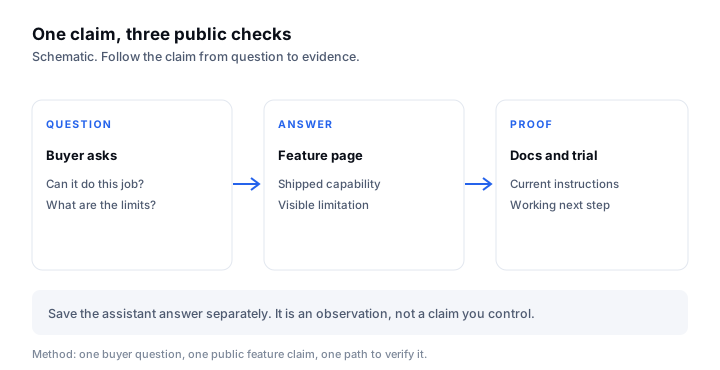
AI SEO for SaaS begins with one buyer question
Write the question in a prospect’s words, without your product name. “Can this SEO tool send a fix to my Webflow site?” is more useful than “What is our AI platform?” The first question has a decision behind it: supported integration, permission, the exact type of edit and a way back if the edit is wrong. The second invites a generic answer. Record the query, the feature page that ought to answer it and the evidence that would make the answer true.
A feature page deserves the query when it describes a shipped capability. A documentation page can carry configuration steps and limits. An integration page can explain where an API permits a write and where the user must make a manual change. A blog post is useful when the buyer needs a method or comparison that would overload the feature page. Keep the factual answer on the page closest to the purchase decision, then link to the detailed proof.
| Buyer needs to know | Public page should show | Verify against |
|---|---|---|
| What the feature does | One direct sentence and a realistic input | Current product behavior |
| Where it works | Supported platform and permission | Integration documentation |
| What it cannot do | A visible limit or manual step | API and current app behavior |
| What happens next | Trial or contact route | The live destination |
Align the feature claim with the product and its documentation
Open the feature page and the current product in separate views. Take the page’s main promise literally. If it says “publishes to your CMS”, test which content types the connector can publish. If it says “automatic”, identify the approval or scheduling condition. If a trial user would meet a manual handoff, say so on the page. A precise limitation can qualify a buyer; an unqualified promise sends the wrong buyer into a trial.
Check the documentation for the same feature name, platform and limit. Link from the marketing sentence to the relevant public instructions, not to a documentation homepage that makes the buyer search again. Where a capability is private or available only after sign-in, describe only the part a visitor can verify publicly. Do not add a customer quote, outcome or benchmark to bridge an evidence gap.
Google’s SEO Starter Guide, read 15 October 2026, advises unique, useful, current content and descriptive links between relevant pages. For a SaaS site, that means an integration page should be reachable from the feature it supports, and its anchor should name the integration. A generic footer link is less useful to the buyer reading the capability.
Let Google and AI search crawlers reach the same answer
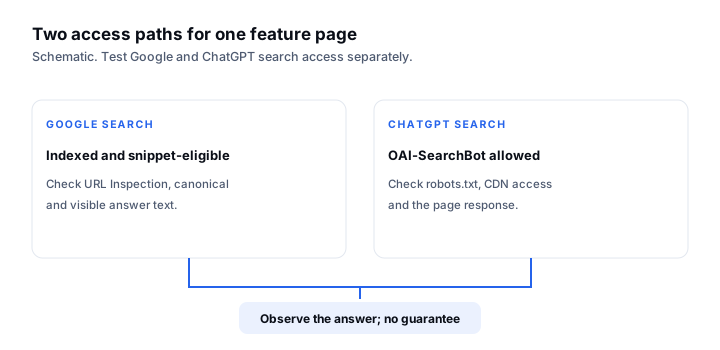
Inspect the public feature URL without signing in. Save its HTTP status, canonical, title, visible answer, internal links and rendered text. Google’s AI features guidance, read 15 October 2026, says a supporting link in AI Overviews or AI Mode must come from a page indexed and eligible for a Google Search snippet. It also says there is no special AI file or markup requirement. A valid schema block does not substitute for a page Google cannot index.
Test ChatGPT search separately. OpenAI’s crawler documentation, read 15 October 2026, names OAI-SearchBot for search and GPTBot for model training. Their robots controls are independent. Review robots.txt and any CDN rule for OAI-SearchBot; do not infer search access from a training-bot rule. If the page’s key answer appears only after client-side code runs, compare the raw HTML and rendered page before blaming an assistant. The JavaScript crawler test shows that check.
Link the proof from the feature page to a real next step
After the answer and its limit, give the buyer two next actions: read the relevant documentation or integration details, then try the capability. Check that the trial link lands on a working page and that any prerequisite is visible before sign-up. This is ordinary navigation, but it is also how a crawler discovers the related evidence. Google explicitly lists internal links and text it can access among its AI feature best practices.
For a custom SaaS site, edits may need a developer review rather than a CMS write. SearchLift’s Next.js and custom-site connection makes that boundary explicit with a crawl audit and signed webhook handoff. Its article studio can draft a deeper explanation from a real question once the feature claim is settled. The workflow is still to verify the product behavior, publish the page or documentation change, and check the live destination. A draft is not evidence that the capability exists.
If you need a longer page rewrite method, use the one-page ChatGPT answer worksheet. It records the question and the cited source before suggesting an edit. On a SaaS site, the same worksheet should also name the version or plan restriction behind the claim. That prevents a page from answering an old product state confidently.
Measure mentions, citations and trial visits separately
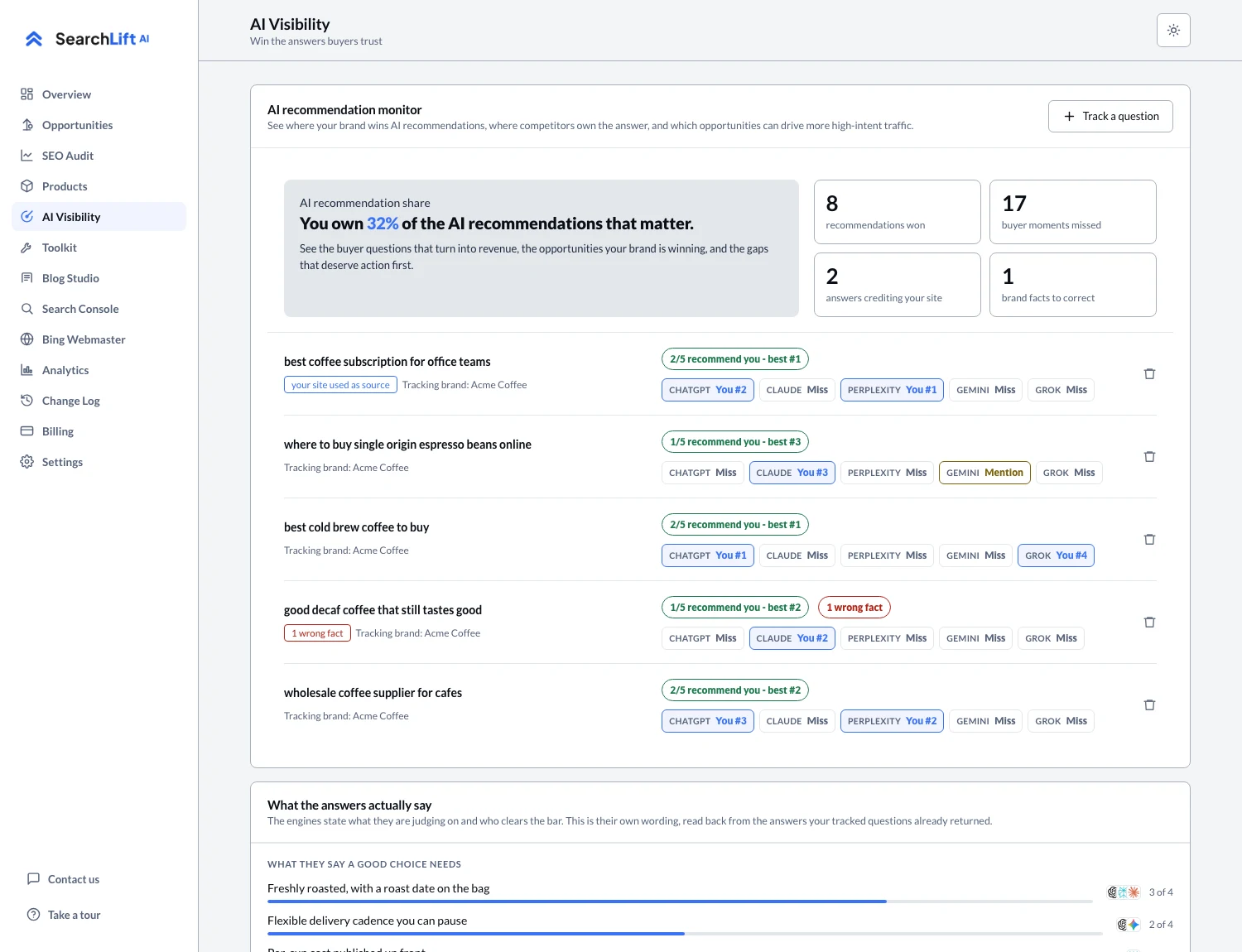
Run the same unbranded buyer question in the assistants your prospects use. Save the assistant, prompt, date, region context, products named, sources shown and the destination URL of each source. A mention is the product name in an answer. A citation is a source link. A visit is a person arriving on the site. One can occur without the next, and one test cannot establish a stable percentage of recommendations.
Google says AI Overviews and AI Mode traffic is included in the overall Web performance report in Search Console. That report alone does not tell you every assistant mention or every trial started after an AI answer. Keep the saved answer beside analytics visits and trial events, then inspect what changed after a specific page edit. If the feature page is not mentioned, revisit access, the answer and the third-party source the assistant used before publishing another broad article.
SearchLift’s AI visibility screen automates the repeatable question check across the assistants included on a plan and records names and cited sources. It is a measurement tool, not a promise of inclusion. A SaaS team still needs to choose a genuine buying question, correct the product claim and review any published fix.
If you report this work across client accounts, the AI SEO for agencies reporting workflow shows how to preserve the question, approved page change and three outcome signals in one client deliverable.
Common questions
- 01What is AI SEO for SaaS?
- It is the work of making a SaaS product answerable and verifiable on public pages, keeping those claims consistent with the product and documentation, and checking how search engines and AI assistants surface them. Start with one buying question and one feature page.
- 02Does SaaS software need special schema to appear in Google AI Overviews?
- No. Google says there is no special markup requirement for AI Overviews or AI Mode. A supporting page must be indexed and eligible for a Search snippet, and its structured data should agree with visible content.
- 03Should a SaaS feature page or a blog post answer the buying question?
- Put a shipped capability, its limits and the path to try it on the feature page. Use documentation for setup details and a blog post for a method or comparison that needs more room. Link the pages with descriptive anchors.
- 04Will allowing OAI-SearchBot make ChatGPT recommend my product?
- No. It permits a search discovery path that OpenAI documents, but does not guarantee an answer, mention or citation. Test a buyer question, save the sources and repeat after a specific change.
- 05How can I tell whether AI search creates SaaS trials?
- Keep assistant mentions, source citations, referral visits and trial events as separate records. Compare them over time using the same buyer question and a named page change; do not infer a trial from a mention alone.