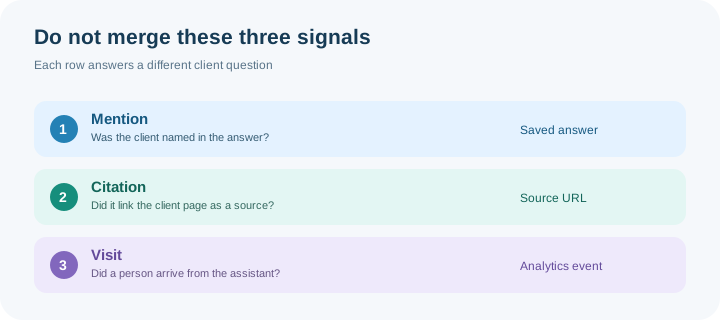
AI SEO for agencies needs a report a client can audit, not a screenshot of one favourable ChatGPT answer. Start with a buying question, identify the client page that should answer it, record what the assistants actually said, and document the change you made. Keep a mention, a source citation and a site visit in separate columns. They are different events, and none proves the others occurred.
This is a workflow for an agency that edits client sites with approval. It works whether the client sells software, products or a local service. The industry changes the buyer question and the facts to verify; the evidence chain stays the same. For a single SaaS feature page, the companion guide on AI SEO for SaaS goes deeper into product claims and documentation.
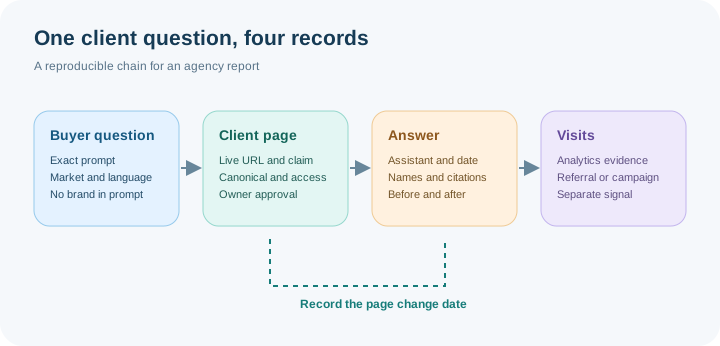
Start with a buyer question and an accountable page
- 01Choose one unbranded buyer question and write down its market, language and exact wording.
- 02Assign the client page that should answer it, then verify the public claim, canonical, indexing and crawler access.
- 03Save the assistant answer, named businesses and cited URLs before editing anything.
- 04Get client approval for one supported page change, publish it and record the live date.
- 05Repeat the same prompt and report mentions, citations and measured visits in separate columns.
Ask the client which question a qualified prospect asks before contacting them. Write it without the client’s brand. “Which payroll system handles contractors in two countries?” has a purchase decision and a factual constraint. “Tell me about our company” does not test whether the brand would be recommended to a buyer who has never heard of it. Save the wording, market, language and the client page that should answer it.
Use the client’s own Search Console queries as one input. Google’s Performance report guide, read 16 October 2026, explains the queries, pages, clicks, impressions and position available there. A query with impressions and a weak page is a useful candidate, but Google query data does not tell you what ChatGPT said. Select the question because it matches a buyer and a real client capability, then test the assistant answer separately.
Assign one public URL as the source of truth. If the answer requires a plan limit, service area or integration, that page must state the current fact and its limits in visible text. Ask the client owner to sign off on the claim before changing it. An agency cannot repair an uncertain product fact with more persuasive copy. The Search Console suite can surface query and page gaps, while the page audit identifies crawl and metadata issues on the candidate URL.
| Record | Client evidence | Decision |
|---|---|---|
| Buyer question | Exact unbranded prompt, market and language | Would a qualified prospect ask it? |
| Source page | Canonical URL and current visible claim | Can the client verify the claim? |
| Search demand | Search Console query and date range | Does the site already receive impressions? |
| Owner | Person who approves the page fact | Who may authorize the edit? |
Check eligibility before interpreting an assistant miss
Fetch the exact client URL and check its canonical, status, visible content, internal links and indexing state. Google’s AI features guidance, read 16 October 2026, says a page must be indexed and eligible to show a snippet to appear as a supporting link in AI Overviews or AI Mode. It also says there is no special AI markup or file requirement. That describes Google surfaces; it is not a promise of placement in any assistant.
For ChatGPT search, read the live robots.txt and access rules separately. OpenAI’s crawler documentation, read 16 October 2026, identifies OAI-SearchBot for search results and distinguishes it from the training crawler GPTBot. A client may choose different rules for the two. If an assistant misses a page that the crawler cannot reach, fix that access problem before treating copy as the cause. The token-by-token method is in AI crawlers and robots.txt.
Build a prompt-level baseline the client can repeat
Run the unbranded question in a fresh assistant session with web search available. Save the date, prompt, assistant, region context, answer text, named businesses and every visible source URL. Repeat the same question at a defined interval. Do not turn one answer into a market-share percentage: answers can vary between runs, and a fixed set of prompts is a sample chosen by the agency. The manual setup in how to check what assistants say about a business explains why branded questions and personalised sessions give misleading baselines.
For each answer, mark three distinct events: the client was named, the client URL was cited, or an analytics visit arrived from an assistant. A citation can point to a third-party directory even when the client is named; a click can arrive without a prominent recommendation. Google says AI Overviews and AI Mode traffic is counted within overall Search Console web performance in its measurement guidance. Do not label all Search Console clicks as AI referrals. Keep assistant referrers or campaign-tagged visits in the analytics column when they are available.
Approve one page change and mark the date
Read the sources in the missed answer before editing the client’s homepage. If the assistant cites an industry directory, a comparison article and a forum, note which of those contains a factual gap the client can address. If it cites the client page but misses a critical specification, make that specification explicit near the relevant purchase action. Do not manufacture a comparison, customer claim or ranking to fill a blank. The task is to make a true answer easier to verify.
Write the proposed before and after text, identify its public source, get client approval, publish, and save the live URL and timestamp. A single controlled change is easier to evaluate than publishing six posts and changing every title at once. SearchLift’s audit work order can express page fixes as exact before and after values; where a platform cannot take an automatic write, the editor applies the instruction. Its article studio is useful when the missed buyer question needs its own explanation, but the client still checks each product or service fact.
Report outcomes, limits and the next action
At the next interval, run the same prompt and record the same fields. Compare the answer, citation and visits with the baseline, while keeping the page change date visible. A better answer after the edit is encouraging, but it is not proof of causation from one run. If the client asks what changed, show the live page diff and the dated responses. If the question still misses, the cited sources and competing names tell you which evidence to inspect next.
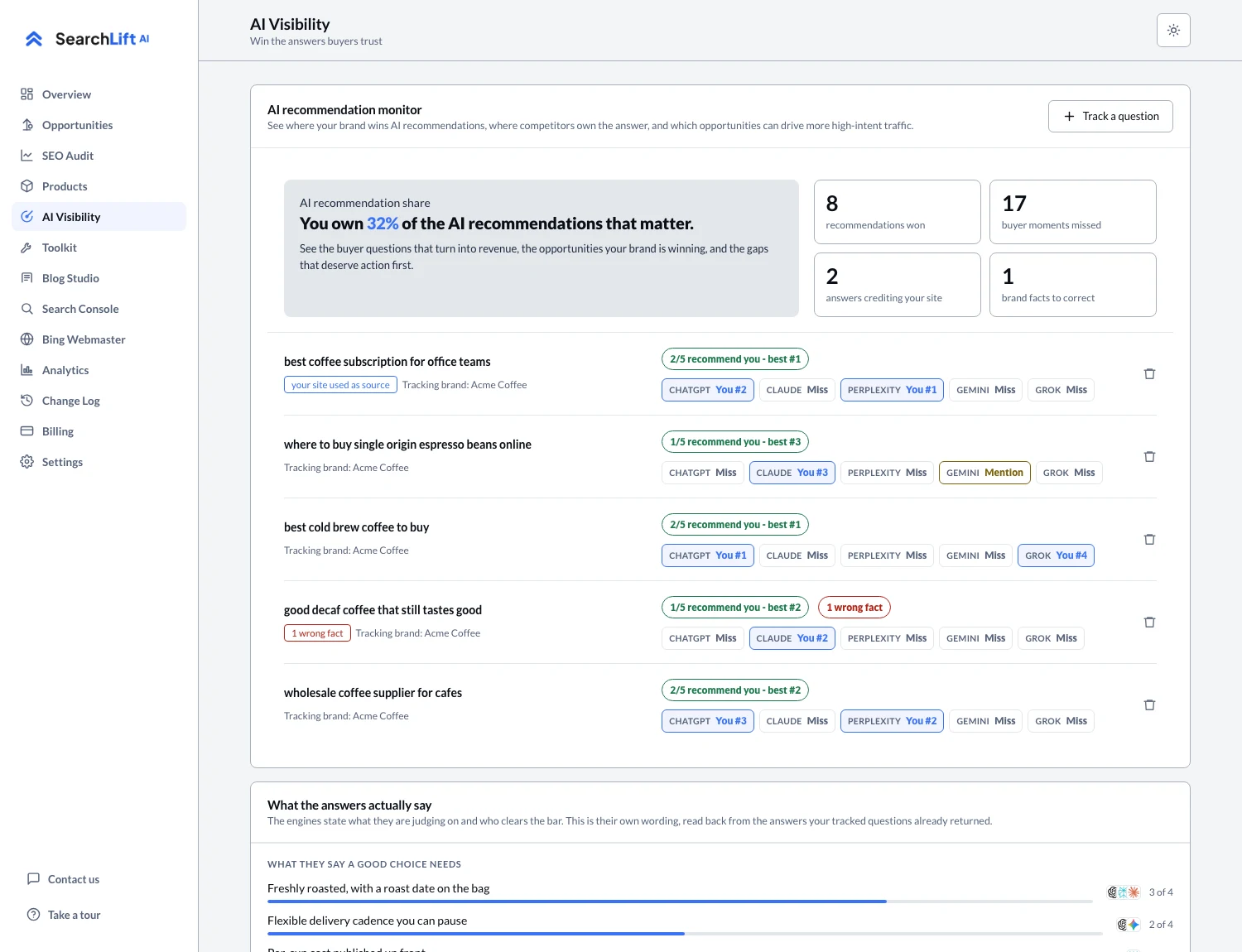
Deliver one page per buyer question: the prompt and market, the source URL, eligibility checks, baseline and follow-up answers, the approved page change, the three separate outcome signals, and a next action with an owner. That is a service a client can understand and an agency can repeat. The AI visibility monitor keeps the questions, named competitors and cited sources in one screen; check current plans for the number of tracked questions and assistants available. Software shortens collection time, but the agency remains responsible for the buyer question, source accuracy and approval.
Common questions
- 01What is AI SEO for agencies?
- It is a repeatable client workflow that makes a relevant page findable and answerable, checks how search systems and assistants describe the client, and reports the result with dated evidence. A mention, citation and visit should be measured separately.
- 02How should an agency report ChatGPT visibility?
- Save the exact unbranded buyer prompt, market, date, assistant answer, brands named and cited URLs. Repeat the same check after an approved page change, and keep any measured assistant visits in a separate column.
- 03Can Search Console show every ChatGPT recommendation?
- No. Search Console reports Google Search performance. It can supply real queries and Google search outcomes, but a ChatGPT recommendation needs a separate observation of the answer.
- 04Does structured data guarantee an AI citation?
- No. Google says there is no special markup required for its AI features, and neither Google nor OpenAI promises that a page with structured data will be cited. Start with accurate visible facts and crawl access.
- 05What should an agency change first after a missing mention?
- Check whether the intended page is reachable and indexed where relevant, then read the sources the answer used. Propose one factually supported page change, get client approval, publish it and compare later answers using the same prompt.