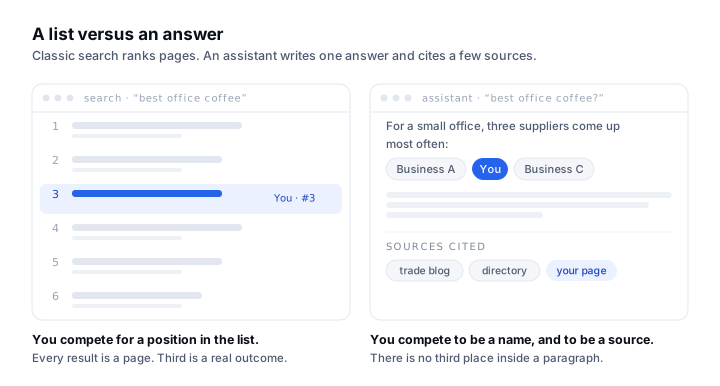
AI SEO is the work of making a business more likely to be named and cited when an AI assistant such as ChatGPT writes an answer. Researchers call it generative engine optimization, usually shortened to GEO; you will also see “ChatGPT SEO” and “AI visibility” used for parts of it. It is not another name for SEO, and it is not a replacement for it. It is the second half of a job that used to have only one half.
Where the term comes from
The phrase was coined in an academic paper, “GEO: Generative Engine Optimization” by Aggarwal, Murahari, Rajpurohit, Kalyan, Narasimhan and Deshpande, published at KDD 2024. The authors built a benchmark of user queries across many domains, together with the web sources that answer them, and tested which edits to a page changed how much of it appeared in a generated answer.
The abstract’s headline claim is that GEO “can boost visibility by up to 40% in generative engine responses”. The more useful finding is inside the paper: the edits that worked were not keyword edits. Adding quotations, adding statistics, and adding citations to sources moved visibility. Keyword stuffing, the old SEO reflex, did not.
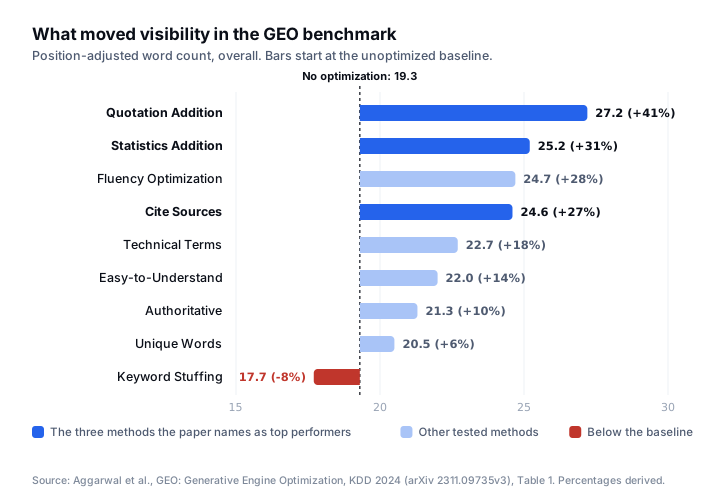
| Method | Position-adjusted word count | Subjective impression | Change in word count |
|---|---|---|---|
| No optimization (baseline) | 19.3 | 19.3 | baseline |
| Quotation Addition | 27.2 | 24.7 | +41% |
| Statistics Addition | 25.2 | 23.7 | +31% |
| Fluency Optimization | 24.7 | 21.9 | +28% |
| Cite Sources | 24.6 | 21.9 | +27% |
| Technical Terms | 22.7 | 21.4 | +18% |
| Easy-to-Understand | 22.0 | 20.5 | +14% |
| Authoritative | 21.3 | 22.9 | +10% |
| Unique Words | 20.5 | 20.4 | +6% |
| Keyword Stuffing | 17.7 | 20.2 | −8% |
What Google says it requires
It is worth reading Google’s own guidance before buying anything, because it is unusually direct. Google’s documentation on AI features in Search says that to appear in AI Overviews and AI Mode a page must simply be indexed and eligible to show with a snippet, and that “you don’t need to create new machine readable files, AI text files, or markup to appear in these features”. It adds that there is “no special schema.org structured data that you need to add”.
So for Google’s own AI surfaces, the entry ticket is ordinary technical SEO: be indexed, be snippet-eligible, and keep any structured data consistent with the visible text. That is a strong argument for treating AI SEO as an extension of SEO rather than a separate job.
Where it genuinely differs
Three things change once the output is an answer rather than a list.
- 01Extractability replaces ranking. A page can rank first and still be useless to an assistant if nothing on it states a direct answer. The research above found that direct answers, quotations, definitions and comparisons were the properties that moved citations. A page built as a wall of marketing copy has none of them.
- 02Access is a separate question from indexing. Google’s AI features use the ordinary Googlebot, but the other assistants run their own crawlers and fetchers, each with its own robots.txt name. A site can be perfectly indexed by Google and invisible to Perplexity because someone blocked
PerplexityBottwo years ago. See our guide to the AI crawler names. - 03The sources are often not you. When an assistant answers “best X for Y”, it often builds the answer from a trade blog, a directory, a marketplace listing or a Reddit thread rather than from any vendor’s site. Winning the answer can mean winning a mention on the page the assistant already trusts, which is a different job from editing your own.
What a page needs, concretely
Taking the published research and Google’s guidance together, the properties worth engineering into a commercial page are short and unglamorous:
- A direct, one-paragraph answer to the question the page exists to answer, placed near the top.
- Definitions and comparisons in plain sentences. The research found these “informational features” beat keyword tricks.
- Explicit prices, dates and specifications where you have them, rather than “contact us”.
- Structured data that matches the visible text: Product, Article, FAQPage, Organization, as appropriate. Not because AI Overviews demand it, but because it removes ambiguity for every reader, machine or human.
- A title and meta description that state what the page is, in the words a buyer would use.
- Nothing in robots.txt that blocks the crawler tokens of the assistants you want to be cited by.
The measurement problem
The hardest part of AI SEO is not the writing. It is knowing whether anything changed. There is no Search Console for ChatGPT. An assistant’s answer varies with the wording of the question, the day, and whether it searched the web before answering. A single manual check tells you almost nothing.
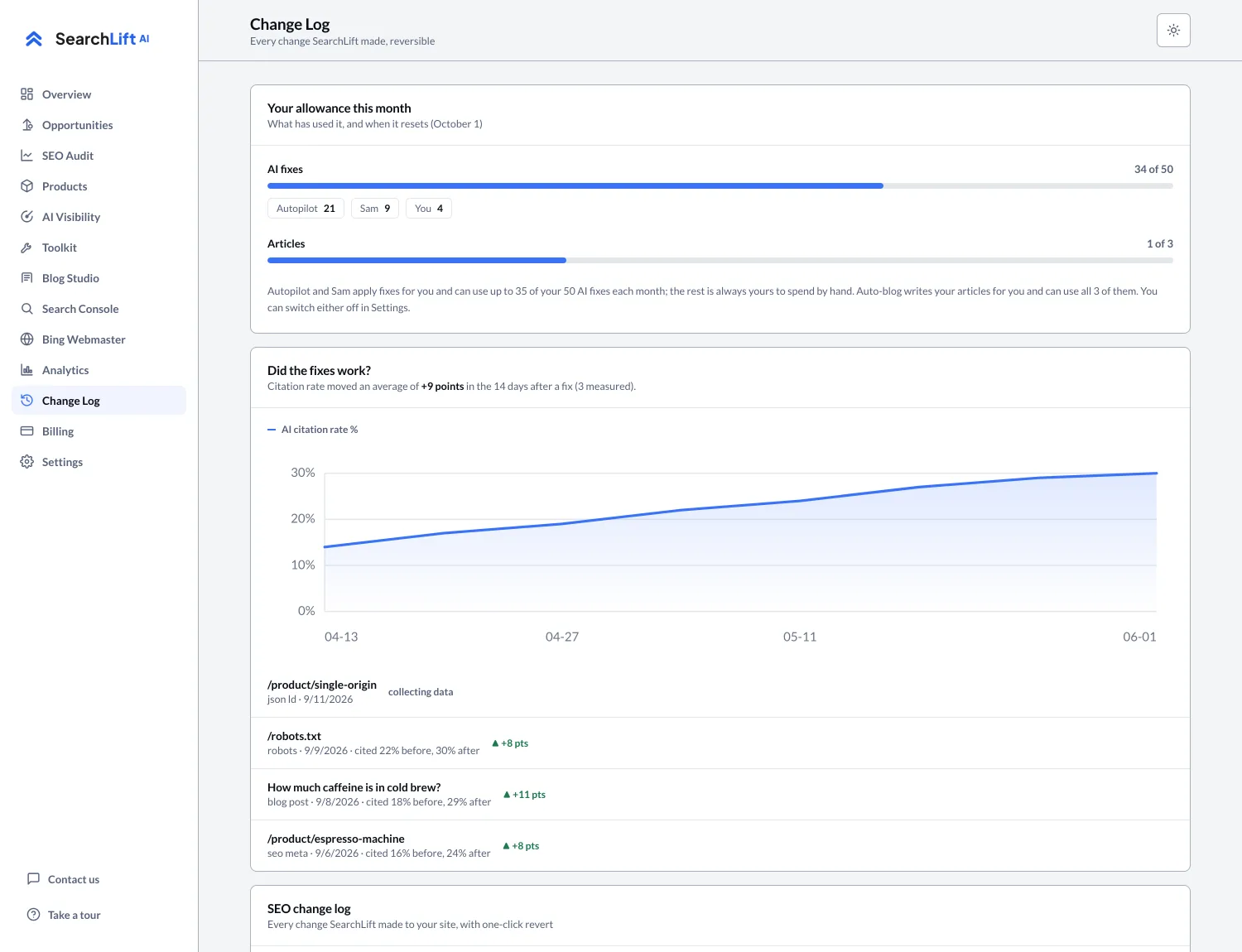
The honest method is the boring one: fix a small set of buyer questions, put them to each assistant on a schedule with web search on, and record whether you were named, in what position, who was named instead, and which pages the assistant cited. Then watch the series move against the dates of the changes you made. That series is your AI visibility. It is what SearchLift’s AI visibility tracker automates, and it is also what you can do by hand for one question if you want to see the shape of the data first.
AI SEO and classic SEO, side by side
| Classic SEO | AI SEO (GEO) | |
|---|---|---|
| What you compete for | A position in a list of links | A name, and a citation, inside one written answer |
| Who decides | One ranking system per search engine | Each assistant, using its own web search and its own crawler |
| Entry requirement | Indexed and eligible for a snippet | Indexed, snippet-eligible, and reachable by that assistant’s crawler |
| What moves the needle | Relevance, authority, technical health | Direct answers, quotations, statistics, definitions, structure |
| How you measure | Rankings, clicks, impressions | Named or not, position in answer, sources cited, referral visits |
| Where the fix lives | Mostly on your own site | Your site, and the third-party pages the assistant trusts |
If you are weighing up the tools that do this work, every published price in the category is compared in best AI SEO platforms in 2026, read off each vendor’s own pricing page on a single day.
Common questions
- 01What is AI SEO?
- AI SEO is the work of getting a business named and cited when an AI assistant such as ChatGPT, Claude, Perplexity or Gemini writes an answer. Researchers call it generative engine optimization (GEO). It covers three things classic SEO never measured: whether an answer can be lifted out of your page, whether each assistant’s crawler can reach it, and whether the pages the assistant trusts mention you.
- 02Is AI SEO just SEO with a new name?
- No, but it shares the entry ticket. Google says AI Overviews need nothing beyond being indexed and snippet-eligible. After that, AI SEO cares about whether an answer can be lifted out of your page and whether each assistant’s crawler can reach it, which SEO never had to measure.
- 03What is the difference between AI SEO, GEO and ChatGPT SEO?
- They describe the same work at different widths. GEO is the academic name for the whole discipline. AI SEO is the plain name for it. ChatGPT SEO is the same job aimed at one assistant, ChatGPT, which is the one most businesses ask about first. AI visibility is the measurement: how often the assistants name you.
- 04Do I need an llms.txt file to appear in AI answers?
- Not for Google. Its documentation says no AI text files or special markup are required for AI Overviews or AI Mode. Other assistants do not require one either; the file is a convenience for agents that fetch it. See our separate article on llms.txt.
- 05Does keyword density matter for AI SEO?
- The KDD 2024 study found keyword stuffing did not improve visibility in generated answers, while adding quotations, statistics and citations did.
- 06How do I know if it is working?
- Track a fixed set of buyer questions across the assistants on a schedule, with web search on, and record who was named and which sources were cited. Compare the series against the dates of your changes. One-off manual checks are too noisy to tell you anything.