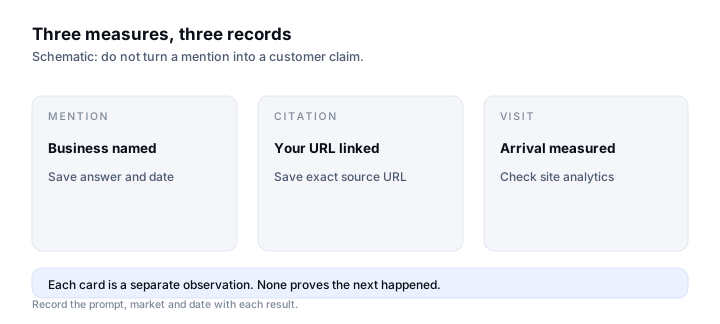
AI SEO for small business starts with a customer question, not a new acronym or a pile of articles. Pick one question a buyer asks before calling or buying. Make sure your own page answers it accurately. Then check whether Google can show the page and what ChatGPT actually says when asked the same question. A mention, a citation and a visit are three different outcomes; record each one.
This is a small first project for a business owner with limited time. If you run a restaurant, the venue and menu checklist handles changing dining facts. If you sell a service in one area, use the local service page guide for Business Profile details. The method below works before you choose an industry-specific page or software.
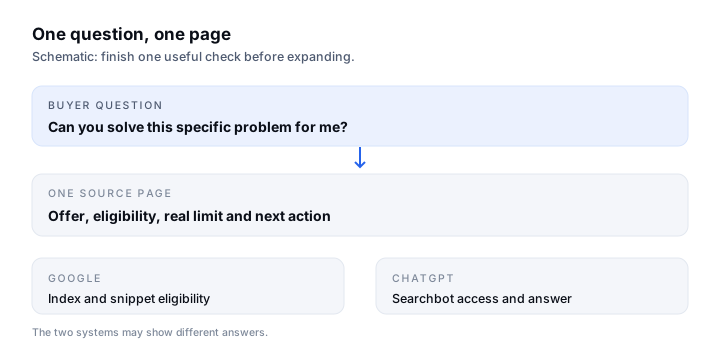
Choose one buyer question you can answer truthfully
- 01Write an unbranded buyer question with one real constraint such as location, compatibility, delivery area or budget.
- 02Choose the page on your site that should answer it and verify every claim on that page.
- 03Check the page in Google Search Console and test whether ChatGPT search can reach it.
- 04Save a dated assistant answer, every business named and every URL cited.
- 05Fix one factual or technical gap, then repeat the same question and record any measured visit separately.
Ask a person who handles sales or support which question a qualified customer repeats. “Can this repair company work on a flat roof in my town?” is useful because the answer depends on a real service and place. “What is the best company?” is too broad to diagnose. Write down the exact wording, market and language. Do not insert your company name into the main test: that checks recognition after you supplied the answer, not discovery by a new buyer.
Look at the page a buyer should reach. Its first screen should name the offer, who it fits, a meaningful limitation and a clear next action. A list of buzzwords cannot answer a compatibility or service-area question. If the fact depends on a person, branch or stock record, confirm it with the owner of that information before publishing. A truthful limit is more useful than a broad promise that fails after someone contacts you.
AI SEO for small business needs an answerable page
Make the answer visible in ordinary page text. Give a specific service, product or location its own page when the details differ; link it from a relevant navigation or overview page. Google’s AI features guidance, read 25 October 2026, recommends that important content be in text and that pages be findable through internal links. It does not require a special AI file or schema type. A machine-readable file will not rescue a page that never states the answer.
Use a small fact table before editing. If the buyer asks about service area, write the actual boundary and link the contact path. If the buyer asks whether a product works with another system, name the supported version and any prerequisite. If a price is not public, say how to get a quote rather than inventing a range. Write for the decision the buyer is making, not for a bot to repeat a keyword.
| Buyer asks | Page must show | Check before publishing |
|---|---|---|
| Can you do this here? | Named service and genuine area | Does the team actually serve it? |
| Will it work for me? | Supported use and material limit | Has the product owner confirmed it? |
| How do I start? | Working contact, booking or purchase link | Does the destination load on a phone? |
| What is the evidence? | A public, current source for any claim | Can a reader verify it? |
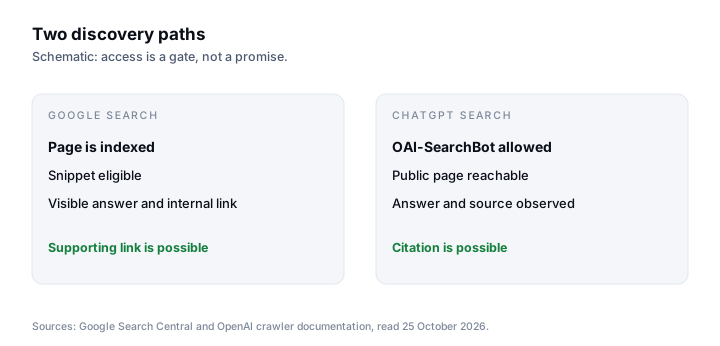
Check Google and ChatGPT through their own paths
In Search Console, inspect the exact URL rather than the homepage. Confirm that it is indexed, has the intended canonical and is eligible for a snippet. Google’s published requirement for AI Overviews and AI Mode, read 25 October 2026, is that a supporting page be indexed and eligible to appear with a snippet in Google Search. Meeting that requirement does not guarantee Google will show it. The Search Console screen can bring query and index checks into the same review queue.
For ChatGPT search, read the site’s robots.txt and test the page’s public response. OpenAI’s crawler documentation, read 25 October 2026, identifies OAI-SearchBot for search and GPTBot for model training. Those are independent controls. OpenAI says a site that opts out of OAI-SearchBot will not be shown in ChatGPT search answers, though a navigational link can still appear. ChatGPT-User is a separate user-triggered agent and is not the automatic search crawler. A successful fetch is eligibility evidence, not a ranking promise.
Measure what happened, not what a dashboard implies
Run the saved question with web search available. Save the date, assistant, market context, exact answer, named businesses and source URLs. A business can be mentioned without its page being cited. Its page can be cited without a person visiting it. If the assistant answers from a directory, read that cited page before changing your own copy. The more detailed one-page ChatGPT method explains how to turn that observation into a page fix.
Use analytics for visits and your own sales records for enquiries. Google’s Search Console Performance guide, read 25 October 2026, defines impressions, clicks and average position for Google Search queries. Those numbers do not count every ChatGPT answer. Google says its AI features are included in overall Web performance data, but that is still Google data. Keep an assistant-answer sheet beside the Search Console report instead of adding incompatible measures together.
Use software when the manual record becomes repetitive
A spreadsheet is enough for the first question. When you need to repeat several questions across assistants, SearchLift’s AI visibility screen records tracked questions, named businesses and cited sources for the assistants included with your plan. It also shows when another business is named instead. Use that evidence to select a page for review, then keep a human check on the underlying business facts. A tool can shorten observation and find a page issue; it cannot make an unsupported claim true or promise an answer will change.
Repeat the original wording after a specific live change and annotate its date. Do not quietly edit the prompt, region and page at the same time: you would not know which difference you were observing. If the page is sound and the assistant still does not cite it, compare the actual sources used, decide whether another page answers the question more directly, and leave the result as unresolved when the evidence does not identify a fix. The next question should come from customer demand, not from a list of AI buzzwords.
Common questions
- 01What is AI SEO for small business?
- It is the work of making a real customer question answerable from an accurate, reachable page, then checking what search systems and AI assistants actually show. Start with one question and one page; record mentions, citations and visits separately.
- 02Can I do small business AI SEO without paying for a tool?
- Yes. Pick a buyer question, inspect the page and Google index status, check ChatGPT search access, then save the answer and cited URLs. Use your own analytics to see whether anyone visited.
- 03Does Search Console show my ChatGPT visibility?
- No. Search Console reports Google Search performance. Save ChatGPT answers and citations separately, then compare them with site analytics visits when those are available.
- 04Do I need a special AI schema or llms.txt file?
- Google says no special AI markup or file is required for AI Overviews or AI Mode. OpenAI documents OAI-SearchBot access for ChatGPT search. Accurate page text, internal links and crawler access are the first checks.
- 05Will an AI SEO tool get my business recommended?
- No tool can guarantee a recommendation. It can help you observe repeated questions, find source and page gaps, and verify a published change. Keep the result tied to the exact buyer question and date.