An AI SEO audit is useful only if it ends with a page you can improve, a reason to improve it and a way to check what happened. Start with one question a customer asks before choosing a provider. Find the page that ought to answer it. Then check that page in this order: does it say the right thing, can Google index it, can a search assistant reach it, and what did the buyer actually see? A dashboard score is not a substitute for any of those observations.
This is an audit for an owner or marketer who needs a short fix queue, not a list of every possible SEO setting. The manual visibility check explains how to ask an assistant the first buyer question. Here we follow the question back to the page and decide what to fix first. The method works whether you use a spreadsheet or an AI SEO platform.
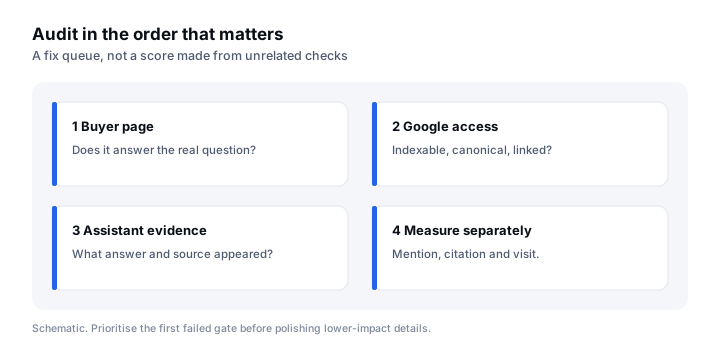
What should an AI SEO audit check?
- 01Choose one unbranded buyer question and the single page that should answer it.
- 02Read the page as a buyer and verify its offer, location or use case, limits and next step.
- 03Inspect that exact URL for Google indexing, canonical selection and internal links.
- 04Check search crawler access, then save the assistant answer and cited sources.
- 05Make one verified fix and measure mentions, citations and visits on separate lines.
A good question includes a real constraint. “Which payroll system handles contractors in my country?” can be mapped to a page and checked. “What is the best software?” cannot. Do not add your brand to the question. That would test whether the assistant recognises a name you supplied, rather than whether it can find your offer for a buyer. Record the exact question, language and market so later checks are comparable.
Read the intended page before opening a crawler report. It should state the product or service in visible text, who it serves, a relevant limitation and a working way to enquire or buy. If the page never answers the question, an indexable URL is still a weak answer. Do not fill gaps with a guessed price, location, compatibility claim or customer result. Ask the person who owns the fact, or say it is not public.
Check Google eligibility on the exact page
Google’s generative AI guidance, read 29 October 2026, says its AI features build on core Search systems. An eligible supporting link needs an indexed page that can appear with a snippet. Google does not ask for a separate AI-only markup file. Check ordinary search eligibility before adding special AI copy or schema.
In Search Console, inspect the intended URL. Compare its declared and selected canonical, index status and live response. Check that a relevant navigation or older page links to it. Google’s Page indexing report guide, read 29 October 2026, says some excluded URLs are correctly excluded, including duplicates and deliberately removed pages. An excluded checkout or old redirect is not the same problem as your main service page being unavailable.
| Finding | First action | Owner |
|---|---|---|
| Buyer page has no answer | Add verified offer, fit and limit in visible text | Content owner |
| Main URL is not indexed | Inspect exact URL, canonical and response | Site owner |
| Page is isolated | Link from a relevant service or overview page | Site owner |
| Assistant cites another source | Read it, compare its facts with your page | Content or partnerships owner |
| Citation appears but no visits | Check analytics before claiming traffic | Analytics owner |
Check assistant access and the answer it gave
Google eligibility and ChatGPT search access are different tests. OpenAI’s crawler documentation, read 29 October 2026, distinguishes OAI-SearchBot, which is used for ChatGPT search, from GPTBot, which is used for model training. If a page is absent from search answers, check the live robots rule and served response for the search crawler. The crawler guide explains the tokens. Access makes a page available for consideration; it does not promise a mention.
Now run the saved buyer question with web search available. Save the complete answer, date, names and source URLs. Open each source that supports a claim about your category. OpenAI’s ChatGPT search guide, read 29 October 2026, says responses may cite sources and that those sources can be incomplete or outdated. If a directory carries an old address, correct that record. If your own page is cited but the answer misses a service limit, make that limit easier to see on the page.
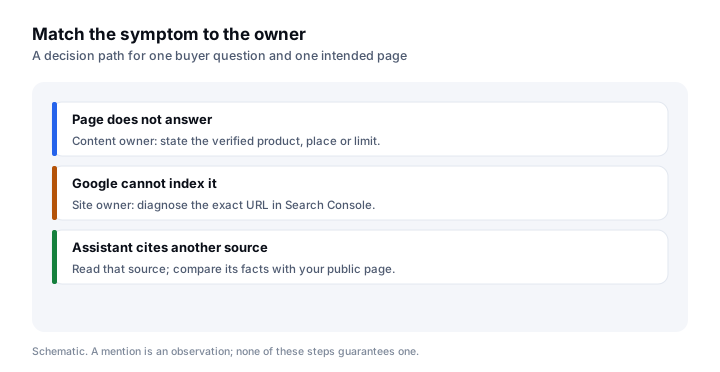
Rank fixes by buyer impact
Put a missing or misleading answer to a high-intent buyer question above a minor wording preference. Put an inaccessible or non-indexable main page above an extra FAQ on a page already reachable. If the public page says the wrong fact, fix the underlying business record before producing more articles that repeat it. A useful work order names the URL, observed problem, proposed change, owner and a test that can prove the change went live.
Google’s guidance on third-party SEO tools, read 29 October 2026, asks site owners to check advice against official Search documentation. Apply the same standard to an AI SEO audit tool. Ask to see the actual page response, crawler rule and assistant source before approving a fix. Reject a recommendation that depends on an invented customer result or a guarantee of ranking.
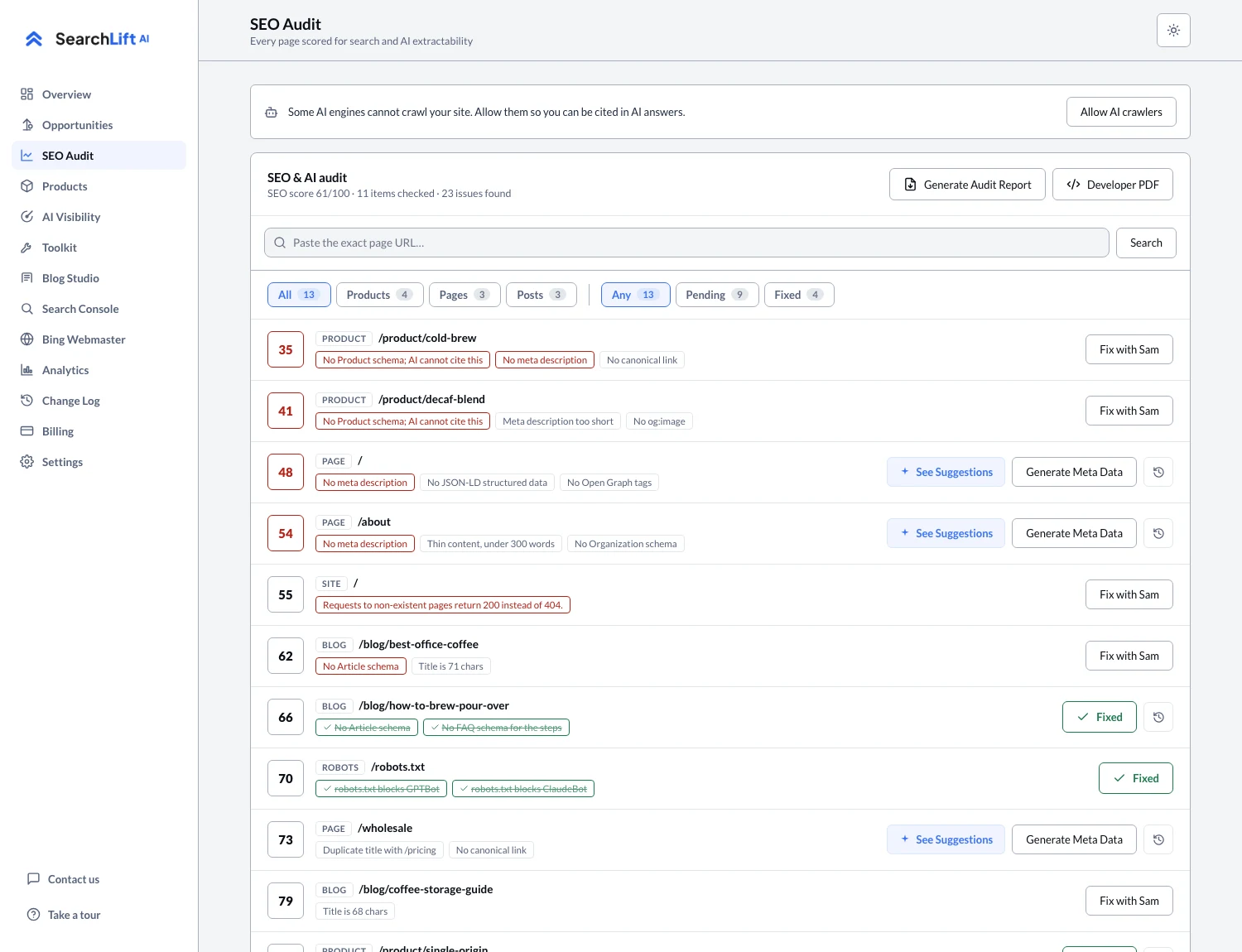
SearchLift’s SEO audit puts page findings into an approval queue and can apply certain reversible fixes. Its AI visibility screen keeps tracked buyer questions and cited sources with the answers, while the Search Console suite helps prioritise existing Google demand. You still need a human to confirm business facts and decide whether a suggested change makes sense for the customer.
Measure the result without mixing signals
After the fix is live, repeat the exact question with the same market and search setting. Record whether your business was named, whether your own URL was cited and whether a person visited your site. These are three different events. Google Analytics’ Traffic acquisition guide, read 29 October 2026, explains where session source data appears. A citation in an assistant answer does not itself count as a referral session.
Keep the before and after answer, but be careful with the conclusion. A changed answer after your edit is an observation, not proof that your edit caused the change. Search sources, assistant behaviour and buyer wording can change independently. The useful outcome is a narrower fix queue, a live page you can verify and a repeatable question set. That is more useful than a score that rises without showing what changed.
Common questions
- 01What is an AI SEO audit?
- It is a review of whether your important pages answer buyer questions, can be found and indexed, can be read by relevant search crawlers, and appear accurately in AI-assisted answers. A useful audit ends with specific, verifiable page actions.
- 02Does an AI SEO audit guarantee ChatGPT recommendations?
- No. It can expose a missing answer, blocked access or outdated source and help verify a change. It cannot control future assistant answers.
- 03Should I fix every warning in an audit report?
- Start with the pages tied to real buyer decisions and the first failure that prevents a correct answer. Some exclusions and warnings are intentional, so inspect the exact URL before changing it.
- 04Is AI SEO separate from ordinary SEO?
- The same clear, accessible pages matter for Google Search and its AI features. ChatGPT search uses a distinct crawler and answer interface, so check that access and those answers separately.
- 05How do I know whether the audit worked?
- Verify that the page change is live, repeat the saved buyer question, and keep mentions, citations and analytics visits separate. Treat a changed answer as an observation rather than proof of causation.