A ChatGPT SEO tool is useful when it shows what a buyer asked, whether your business was named, which pages were cited, and what you can change on your own site. Test those four things with your actual customer questions before paying for a visibility score. A score alone cannot tell you whether a prospect found a correct answer or visited your site.
The existing AI SEO platform comparison looks at published plan coverage and prices. This guide is the trial you run after shortlisting a tool. You need a question set, a record of the answers, one page to inspect and a way to tell observation from results. You can do the first pass by hand with the manual ChatGPT answer check.
What should a ChatGPT SEO tool actually measure?
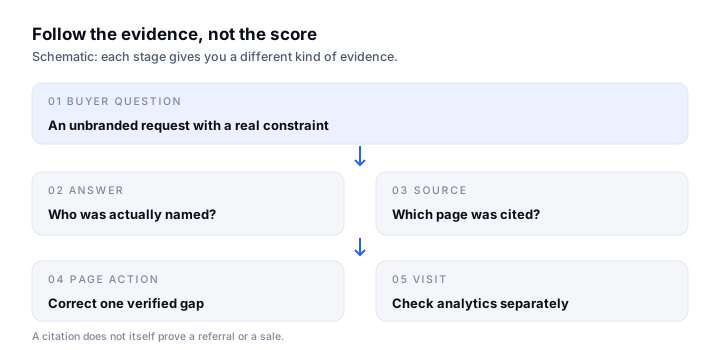
- 01Write five real, unbranded questions that a buyer asks before choosing a provider, and save their exact wording.
- 02Run the questions with web search available, saving the answer, date, market and every named business and cited URL.
- 03Check whether the tool distinguishes your business being named from your own website being cited.
- 04Select one missed question, inspect the page that should answer it, and record one factual or technical correction.
- 05Repeat the saved question after the page change and check visits separately in your analytics.
Ask a sales or support colleague for the questions people actually use. A useful prompt has a buying constraint: a location, a product compatibility requirement, a service deadline or a kind of customer. “What is the best company?” is too vague to diagnose. Do not put your brand name in the main question. That would test whether the assistant can repeat a name you supplied, not whether it can surface your business for an unbranded need.
A tool should preserve the complete answer and source list, not just a green “visible” badge. OpenAI’s ChatGPT search guide, read 26 October 2026, explains that answers using search may show citations and a Sources panel. Read the actual source page. It may be your site, a directory, a review page or another business. Those cases call for different work.
Run the same buyer questions through a trial
Keep one row per question and one row per check date. Record the exact prompt, market, language, whether search was used, the answer text, every business named and every cited URL. If a tool hides the underlying answer or cannot export the observations, you cannot audit its score. A score that changes after you edit the prompt is not a before-and-after comparison.
| Trial field | Record | Why it matters |
|---|---|---|
| Buyer question | Exact unbranded wording and market | Keeps later checks comparable |
| Answer | Saved text and check date | Lets a human catch wrong claims |
| Mention | Your name and other businesses named | Shows whether you were considered |
| Citation | Every source URL, including third-party pages | Shows what supported the answer |
| Page action | One verified change and its live URL | Turns observation into work |
| Visit | Analytics source and landing page | Checks whether someone reached you |
Run more than one question because your product may fit one situation and not another. Keep the first set fixed through the trial. Answers can vary, and neither a single win nor a single miss establishes a trend. A vendor may check assistants on its own schedule; confirm how often your plan updates before treating a fresh page edit as measured. Do not infer a manual refresh button from a dashboard that merely displays a recent date.
Separate mentions, citations and visits
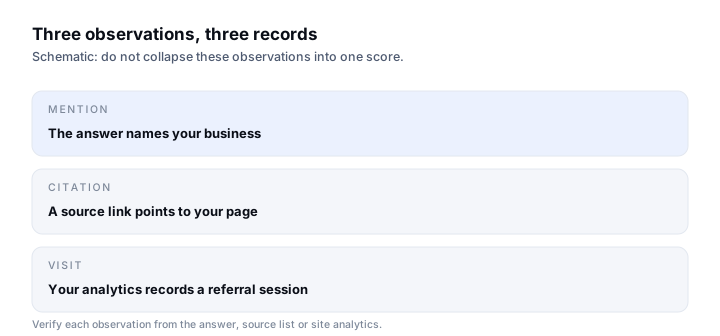
A mention means the answer names you. A citation means the answer links a source. A visit means someone reaches the site. They are not interchangeable: ChatGPT may name a provider while citing a directory; it may cite your page without sending anyone to it. Google Analytics’ Traffic acquisition guide, read 26 October 2026, describes the report’s session source dimension. Use your analytics source and landing page to check referral sessions rather than treating a citation as traffic.
Google data needs its own column. The Search Console AI features performance report, read 26 October 2026, covers Google AI features. It does not provide a count of ChatGPT recommendations. A tool that merges Google impressions with ChatGPT answers into one unnamed “AI visibility” total makes it harder to know what changed.
Check whether the tool gives you a page action
Take one missed question and open the page that should answer it. Does the page state the relevant service, constraint, place and next action in visible text? Is it reachable without a login? Does its canonical point to itself or the intended page? Read the cited competitor or directory page to see which fact the assistant had available there. Correct a real gap in your page; do not copy a claim you cannot support.
OpenAI’s crawler documentation, read 26 October 2026, identifies OAI-SearchBot as the crawler for ChatGPT search and distinguishes it from GPTBot, used for training. Check access for the search crawler when a page is absent. Access is an eligibility check, not a promise that the answer will cite you. If a tool flags a block, verify the live robots rule and the page response before changing either.
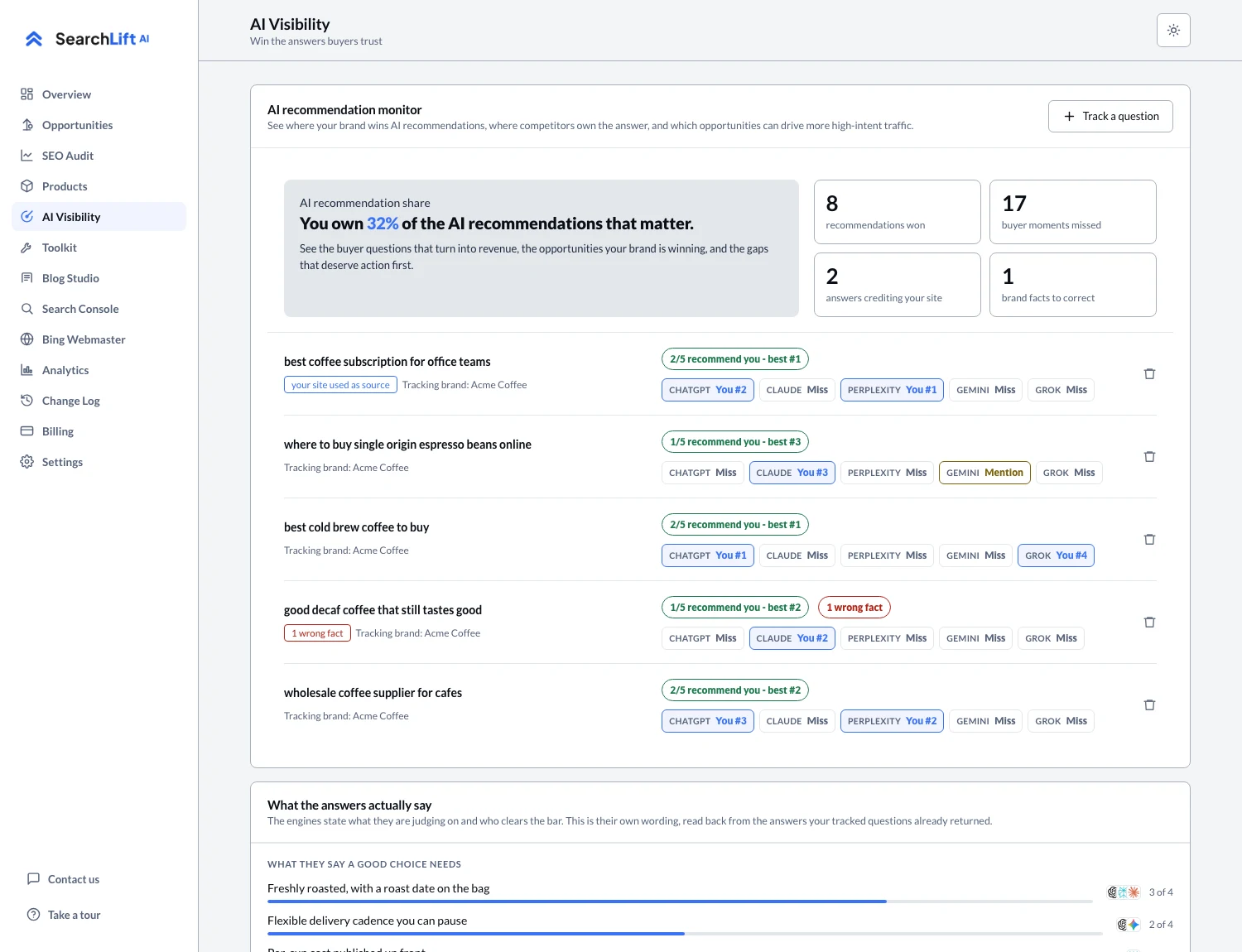
SearchLift’s AI visibility screen records tracked buyer questions, who was named, sources cited and visits from AI. Its SEO audit turns certain page findings into approved, reversible fixes. Review every suggested edit against the business facts. If the correct answer is unavailable or unpublished, software cannot safely manufacture it.
Compare plans on the work you need to repeat
After the trial, list the assistants your buyers use, the number of questions worth monitoring, the sites you manage and whether somebody will act on page recommendations. Compare those requirements with each vendor’s current public plan, including limits and any metered credits. The SearchLift plan table publishes its own limits. A cheaper tier that misses the assistant your customers use, or a tracker that leaves every fix to you, may cost more in staff time than its subscription suggests.
Keep the test honest: a visibility change after a page edit is an observation, not proof that your edit caused it. An assistant may use a new source or answer differently on its own. The useful result of a trial is a repeatable question set, a source trail you can inspect and at least one page action your team can verify. If a product cannot show those, keep the spreadsheet and keep looking.
Common questions
- 01What does a ChatGPT SEO tool do?
- It records how ChatGPT answers buyer questions about a business, including names and cited sources. Some tools also inspect the relevant website pages or track visits. Check those capabilities separately during a trial.
- 02Can a ChatGPT SEO tool guarantee that my business appears?
- No. It can observe answers, identify source or page gaps and help verify a live change. It cannot control ChatGPT’s answer or guarantee a recommendation.
- 03Is a citation the same as a website visit?
- No. A citation is a source link in an answer. A visit is a session recorded by your site analytics. Track them separately.
- 04Should I use Google Search Console to measure ChatGPT visibility?
- Search Console reports Google Search and Google AI features. Use saved ChatGPT answers and their sources for ChatGPT observations, then compare those with analytics referral sessions.
- 05How many questions should I test before paying?
- Start with five real, unbranded buyer questions that cover your main buying constraints. Keep their wording fixed so you can compare later checks. Expand only when those first questions produce work you can act on.