AI referral traffic is worth measuring now because it is arriving at retailers and, in Adobe’s U.S. retail sample, visitors referred by AI are behaving differently from other visitors. Adobe reported on 29 October 2026 that September AI referrals grew 71% year over year, converted 90% better, and generated 83% more revenue per visit than non-AI referrals. Those are relative comparisons in one dataset, not a promise for your store. The immediate task is to find out whether shoppers can discover your products in an AI answer and whether the visits that follow become orders.
A widely shared chart about AI-referred shoppers made the trend look urgent. Its underlying retail evidence matters more than the graphic: Adobe Digital Insights, published 29 October 2026, analyzed U.S. online retail visits and transactions. It does not say every AI referral converts, that every sector will follow retail, or that a tool can make an assistant recommend your brand. Use the finding as a reason to start a measurable test, not as a forecast.
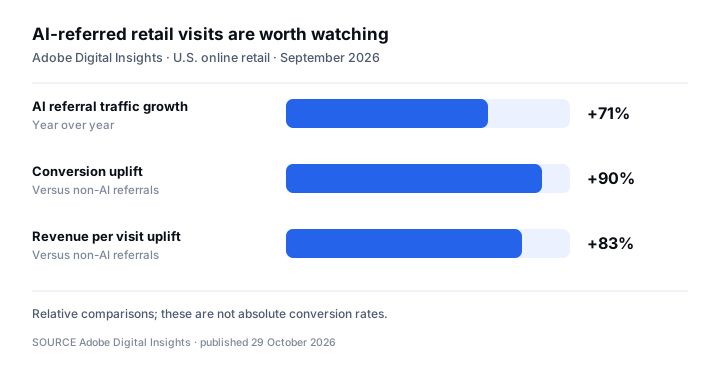
AI referral traffic is a signal, not a universal conversion rate
Adobe’s September result is a comparison of observed groups. “90% better conversion” does not mean a 90% conversion rate. For example, if a comparison group converted at 2%, a 90% relative uplift would mean 3.8%. That calculation illustrates the difference; Adobe does not publish those two example rates. The actual store result depends on its offer, audience, attribution and the questions shoppers ask.
The earlier Adobe July 2026 retail analysis, read 2 November 2026, reported AI referrals converting 60% better than non-AI referrals and spending 59% more time on the site. September’s comparison was larger, but two monthly observations do not establish an inevitable upward trend. Adobe’s October report also found 73% longer time and 25% more pages viewed for AI-referred visitors. Engagement can be useful context, but orders and revenue remain the business outcome.
| Adobe retail observation | July 2026 | September 2026 |
|---|---|---|
| Conversion uplift versus non-AI | 60% better | 90% better |
| Time on site versus non-AI | 59% longer | 73% longer |
| AI referral traffic growth | 62% year over year | 71% year over year |
A key limit is selection. A shopper who follows an assistant’s product suggestion may already be farther along in the purchase journey than a shopper from another channel. The data does not isolate what caused the difference. Do not assign the uplift to AI alone, and do not use Adobe’s U.S. retail result as a Mauritius, B2B or local-services benchmark.
The urgent gap is between an answer and an order
Most businesses can see sales in analytics but cannot show which unbranded questions make their products appear in an assistant’s answer. That missing middle is where an AI optimization effort should begin. Write a short list of questions a real buyer asks, such as a product fit, delivery area, compatible device or comparison. Ask the questions without the brand name. Save the full answer, source links, date and market. Then inspect whether the cited product page actually answers the buyer’s constraint.
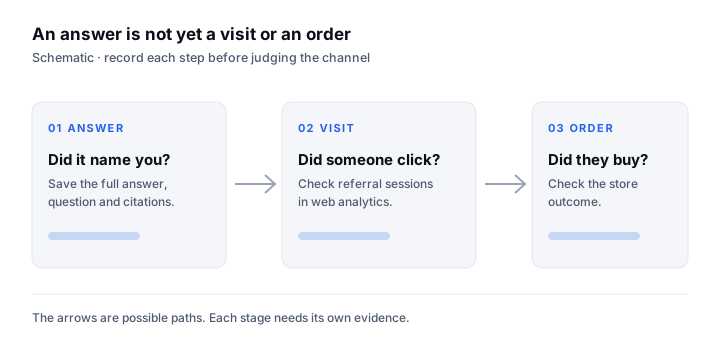
- Answer: Was the brand named, and was the intended product page cited?
- Visit: Did a person follow a link from an assistant to the site?
- Order: Did that visit lead to an order, lead or another defined outcome?
These are separate events. An assistant can mention a brand without linking to it. A cited page can receive no click. A visit can leave without purchasing. Conversely, a shopper may see the answer and return through another channel, so referral tracking can undercount the influence of an answer. Keep all three rows in the same weekly review, but do not collapse them into one “AI visibility” score.
Make important product pages usable before chasing mentions
Take one commercially important page and read it as if you know nothing about the business. It should state the product, fit, limits, location or availability when relevant, and the next step in visible text. A buyer should not need an image or a long sales call to learn the basic answer. Check its canonical URL, indexability and a working internal link from the category or service page. Fix factual omissions before adding another broad article that repeats them.
Google Search Central’s AI features guidance, read 2 November 2026, says the ordinary Search fundamentals remain relevant to AI Overviews and AI Mode and that no special technical requirements exist for those features. That guidance is about Google’s AI features. Other assistants have their own discovery paths. A page that is clear and reachable gives each system better material to evaluate, but no page structure guarantees a mention or a citation.
| Page check | Evidence to save | Action when it fails |
|---|---|---|
| Buyer answer | Exact question and the visible page sentence | Add a verified answer and any relevant limit |
| Search eligibility | Live URL, canonical and indexing result | Correct the specific access or metadata problem |
| Assistant evidence | Full answer and every cited URL | Compare cited facts with your page |
| Business result | Referral session and attributed order or lead | Check analytics and the purchase path |
Use a weekly AI referral traffic review, not a one-day spike
In Google Analytics’ Traffic acquisition report, read 2 November 2026, session source and medium help identify visits from referring sites. Review those sessions by week alongside orders or leads. Confirm which assistant domains your analytics groups together and keep tagged campaign traffic separate. The report measures website sessions; it cannot show every answer in which your brand appeared.
For each tracked question, keep the wording, market, answer, citations and page URL unchanged across reviews. Note any content or technical fix with its publication date. Then compare the next answer and the next week of referral sessions. A changed answer after a page edit is an observation, not proof of cause. This is why a small, repeatable question set beats a one-time screenshot or a large score whose inputs you cannot inspect.
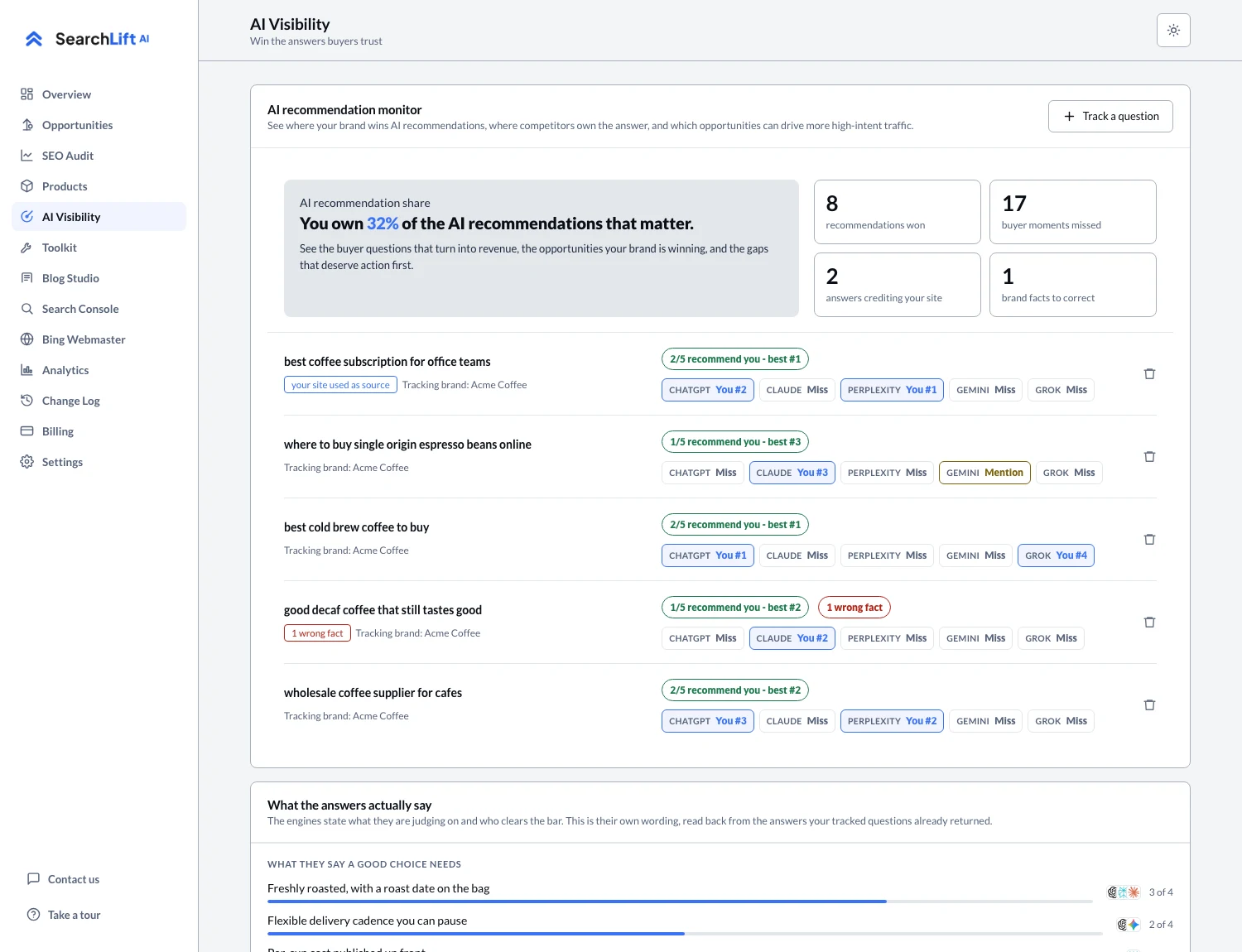
SearchLift’s AI visibility screen keeps tracked buyer questions, answer context and cited sources together; its SEO audit helps identify page issues to review. For a store, the ecommerce AI SEO guide covers the product-page details behind this measurement. Start with one question and one important page. If the answer is inaccurate, fix the fact; if the page is inaccessible, fix access; if visits arrive but do not become orders, inspect the purchase path.
Common questions
- 01What is AI referral traffic?
- It is a website visit referred by an AI assistant or AI search surface. Analytics can identify some visits by source, while a separate answer record shows mentions and citations that may never produce a click.
- 02Does AI referral traffic convert better?
- Adobe found higher conversion among AI-referred visitors than non-AI referrals in its July and September 2026 U.S. retail analyses. That is an observed relative comparison, not a universal conversion rate or a guarantee for another business.
- 03Can Search Console show ChatGPT referral visits?
- Search Console reports Google Search performance. Use a web analytics traffic acquisition report for referral sessions and save ChatGPT answers separately.
- 04How can I improve a page for AI search?
- Start with a real buyer question. Put a verified, visible answer and relevant limits on the intended page, check its access and canonical, and compare later assistant answers and sources.
- 05Will an AI optimization tool guarantee sales?
- No. A tool can help record answers, source links and page issues. Visits and orders depend on the buyer, offer and purchase path, and must be measured separately.