A ChatGPT visibility tracker is useful when it saves the buyer question, the answer ChatGPT gave, whether your business was named, and the sources it cited. A single visibility score without those records cannot tell you whether the answer recommends you, merely mentions you, or links to your site. You can test a tracker with one question before committing to a subscription.
The important distinction is between an answer someone can inspect and a number that hides its method. This guide is for the owner or marketer choosing a tool, not a claim that any tool can control what ChatGPT says. For the basic manual setup across assistants, see how to check what assistants say about your business.
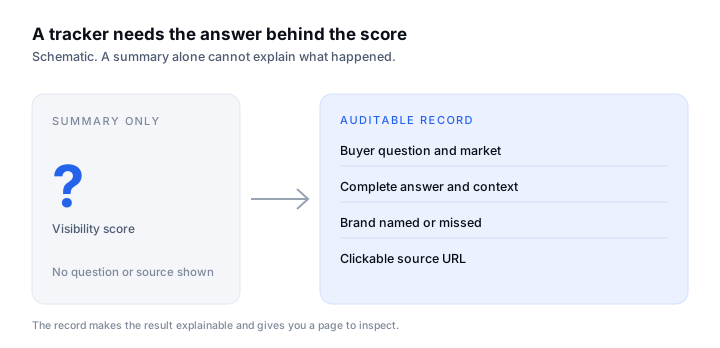
Test a ChatGPT visibility tracker with one buyer question
- 01Write an unbranded question a buyer would ask before contacting you. Include a real constraint such as market, use case or compatibility.
- 02Run that exact question in ChatGPT with search available. Record the date, market and complete answer, including the clickable sources.
- 03Enter the same question in the tracker and find its saved answer. Check whether it recorded your brand, each cited URL and any competing names.
- 04Repeat the question later with the same market and wording. Compare complete answers before comparing summary scores.
- 05Open any cited page before deciding what to change on your own site.
A question such as “Which coffee subscription serves a five-person office in Chicago?” has a category, an intended buyer and a place. “Tell me about Acme Coffee” does not test discovery because you supplied the brand. Start with one question you can explain to a colleague. Store its wording verbatim. When you change the words, the market or the assistant’s search setting, the comparison changes too.
OpenAI’s ChatGPT search guide, read 1 November 2026, says search answers may include citations and that its search can rewrite a prompt into targeted queries. It also says location and memory can influence a search. That is why a tracker should preserve the question and market beside the answer rather than treating every response as the same experiment.
A mention, a citation and a recommendation are different
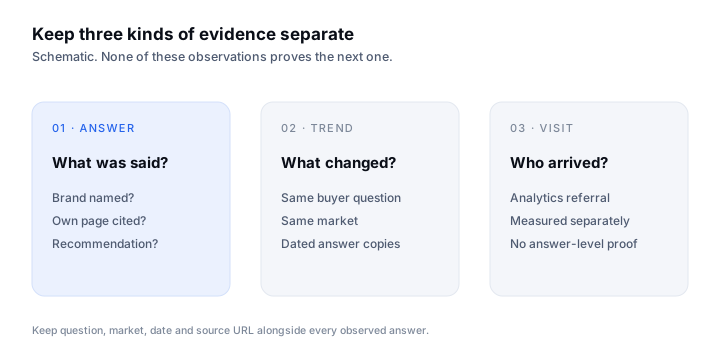
Read the answer, not just the badge. Your company can appear in a list of alternatives, in a warning, or in a direct recommendation. A URL can be cited without your brand being named in the answer. An answer can name you while citing a directory instead of your site. None of those observations is automatically a website visit.
| Signal | What the tracker should retain | What it does not prove |
|---|---|---|
| Brand mention | Exact answer excerpt and the question | That the mention was favorable |
| Recommendation | Full sentence and surrounding context | That the reader visited or bought |
| Own-site citation | Clickable source URL | That the page was the only source used |
| Competitor named | Name and place in the same answer | That a competitor is winning every market |
| Visit from AI | A separately measured referral session | That a specific answer caused it |
OpenAI warns that search results and citations can be incomplete, outdated or wrong, and advises opening sources to verify what they support. That guidance appears in its ChatGPT search help page, read 1 November 2026. If a tracker says “cited,” you still need the link itself and the paragraph in the answer. A citation count without source URLs is hard to act on.
Use the same denominator before comparing visibility scores
Ask a vendor what goes into its percentage. Is it the share of tracked questions where you were named, the share of all answer runs, or a weighted position measure? Does a passing mention count like a recommendation? Are failed runs excluded? Two tools can display different percentages for the same brand because they asked different questions or counted different events. The public method is not always published; if it is not, treat the number as that tool’s internal summary.
Keep a small observation log instead. Put the question, market, date, assistant, brand named, own-site cited and source URL in separate columns. Include a link or saved copy of the full answer. This lets you see what changed even if the vendor changes its score later. For a first no-account pass, the free AI visibility answer checker finds literal brand mentions and copied URLs in an answer you paste. It does not run a live ChatGPT query or pretend to know recommendation intent.
Check access before treating a missed answer as a content problem
If you are absent, first check that the page you expected ChatGPT to use is public and reachable. OpenAI’s crawler documentation, read 1 November 2026, identifies OAI-SearchBot as the search crawler and GPTBot as the training crawler. They are separate controls. OpenAI says a site opted out of OAI-SearchBot will not be shown in ChatGPT search answers, though it can still appear as a navigational link. Read your robots.txt and check the live page before rewriting copy.
Then read what the cited sources actually say. A directory may have an old address. Your own page may omit the service area or the compatibility detail the buyer asked about. Fix a verified factual gap, keep the old answer and note the date of the change. A later mention is an observation, not proof that the edit caused it. The crawler access guide covers the exact robots tokens if access is the problem.
Choose a tracker that helps you act on the answer
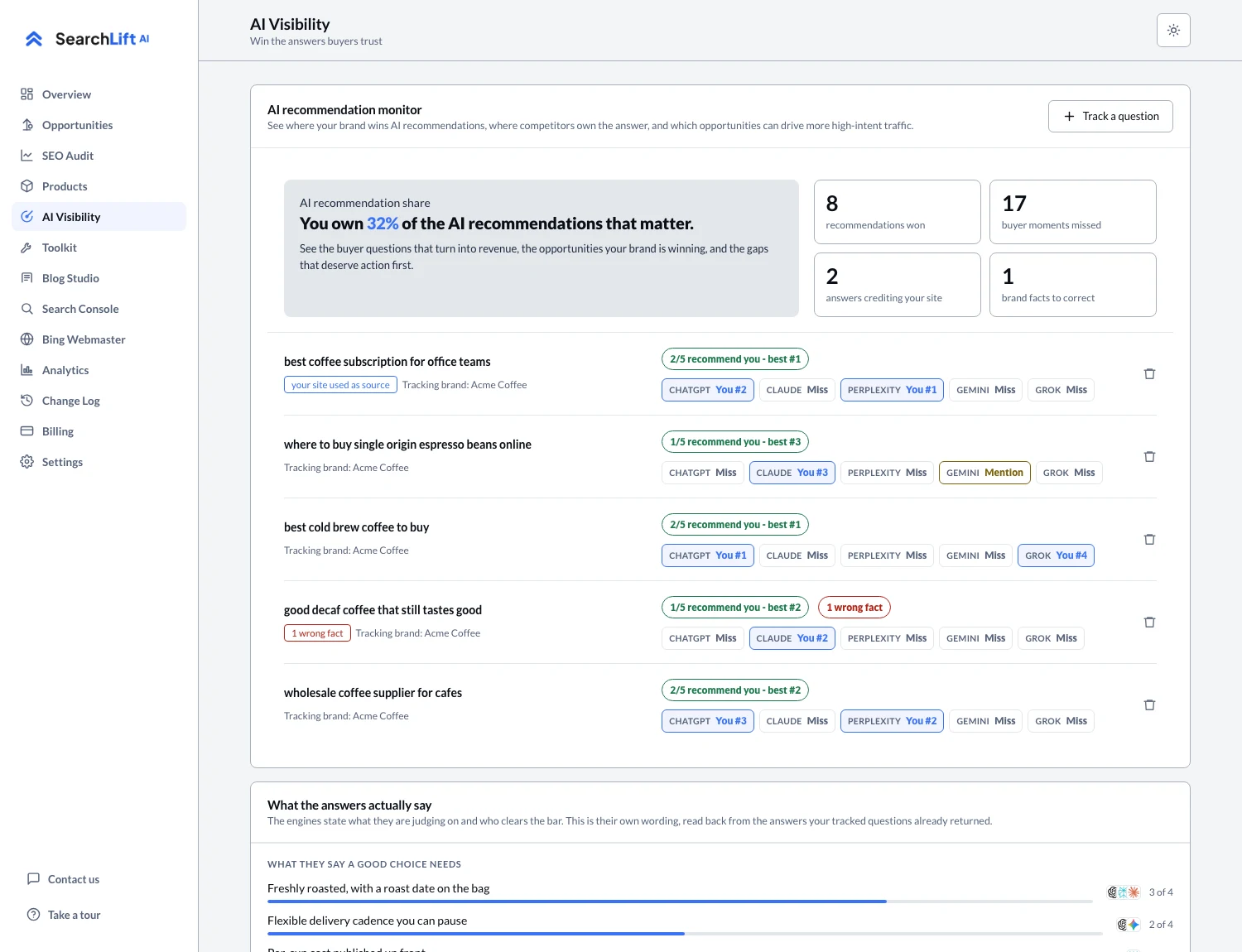
A useful trial ends with a specific page or source to inspect. Ask whether the tool retains full answers, source URLs, market and question wording; whether you can compare the same question over time; and whether you can export the observations. The SearchLift AI visibility screen records tracked buyer questions, names, cited sources and competitor mentions. Its Free plan tracks one question on Gemini; ChatGPT coverage begins on Premium. Compare those limits with your actual question set before paying.
Google Search Console is still useful, but for a different job. Its Performance report documentation, read 1 November 2026, describes Google Search queries, impressions, clicks and average position. Those are Google Search measurements, not a log of ChatGPT answers. Review them alongside the tracker when choosing which buyer questions to monitor, and keep the resulting datasets labeled.
Common questions
- 01What does a ChatGPT visibility tracker measure?
- It observes how ChatGPT answers a set of tracked questions, including whether a brand is named and which sources appear. Check the saved answers and the vendor’s counting method before treating a summary score as comparable across tools.
- 02Can I check ChatGPT visibility for free?
- Yes. Ask a real buyer question in ChatGPT, save the answer and inspect it yourself. The free SearchLift answer checker can find literal brand matches and copied URLs in text you paste; it does not send a live ChatGPT query.
- 03Is a ChatGPT mention the same as a citation?
- No. A mention is your name in the answer. A citation is a source link. You can have one without the other, and neither proves a website visit.
- 04Why can two trackers disagree?
- They may use different questions, markets, run times or definitions of a mention. Compare saved answers for the same question before comparing their scores.
- 05Does Search Console show ChatGPT visibility?
- No. Its Search results Performance report covers Google Search activity. It can help identify buyer queries, but you need observed ChatGPT answers to measure ChatGPT mentions and citations.