AI SEO for restaurants starts with an ordinary diner decision: where can I eat this dish, in this neighborhood, at this time, and how do I book or order? Give each real location a page that answers those constraints, keep its menu and Business Profile consistent, and check what AI assistants actually say. No file, schema type or prompt can guarantee a recommendation. An accurate, reachable answer gives both the diner and a search system something to verify.
This guide is for an independent restaurant or a small group with multiple venues. A restaurant has moving facts that a generic local-service page does not: menus, service hours, dietary details, reservation links and location-specific availability. The broader local-service AI SEO checklist covers service areas; here the unit of work is one dining location and one unbranded guest question.
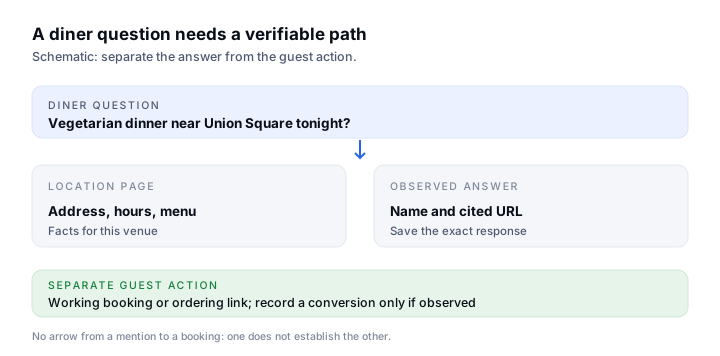
AI SEO for restaurants begins with a location, not a slogan
- 01Write one unbranded diner question with a neighborhood, meal or dietary need, and intended action.
- 02Choose the real location page that should answer it and compare its address, hours, menu and action link with that location’s Business Profile.
- 03Check the public page’s status, canonical and visible text; review crawler access only after the page itself is correct.
- 04Save the dated answer from the assistants your guests use, including named venues and cited URLs.
- 05Correct one verified fact or broken path, then repeat the same question and record mentions, citations and visits separately.
A useful question is specific enough to reveal an actual choice: “Where can I book vegetarian dinner near Union Square tonight?” The answer depends on a real menu, a location, opening hours and booking availability. A broad prompt such as “best restaurant” mixes cuisines, budgets and neighborhoods and gives you little to fix. Ask staff what callers clarify before booking, then turn one recurring clarification into the first test. Record the city and language with the exact wording so a later check is comparable.
Start with the page that serves that location. A chain-wide homepage may mention every city but answer none of them. For each venue, put the address, opening hours, current menu link, reservation or ordering route and relevant constraints in readable page text. If the kitchen changes by location, do not reuse a single menu as though it applies everywhere. A diner must be able to confirm the answer without guessing which branch an assistant meant.
One profile and one factual page should describe each real venue
Google’s Business Profile guidelines, read 23 October 2026, say not to create more than one profile for a location. They also ask chains to keep names and categories consistent where the real-world business is the same. For a restaurant group, this is a practical audit: list every actual venue, its public page and its Business Profile. Flag a profile with an old address, a branch page that names another neighborhood, or two profiles for one dining room. The goal is faithful representation, not more profile entries.
| Guest fact | Location page | Business Profile |
|---|---|---|
| Identity | Real venue name and address | Same real-world name and accurate pin |
| Visit window | Current hours and exceptions | Current regular and special hours |
| Food | Menu that applies here | Representative menu and dish details |
| Action | Working booking or ordering route | Correct action link when available |
| Limit | Dietary, access or service condition you can verify | Only attributes this venue actually offers |
Google says local results are mainly based on relevance, distance and prominence in its local ranking guidance, read 23 October 2026. You can improve factual relevance and accuracy; you cannot change a guest’s distance to a venue. Reviews and links are among Google’s prominence inputs, but that does not make a review count a published threshold for ChatGPT or Gemini. Avoid treating a local ranking factor as a proven AI recommendation rule.
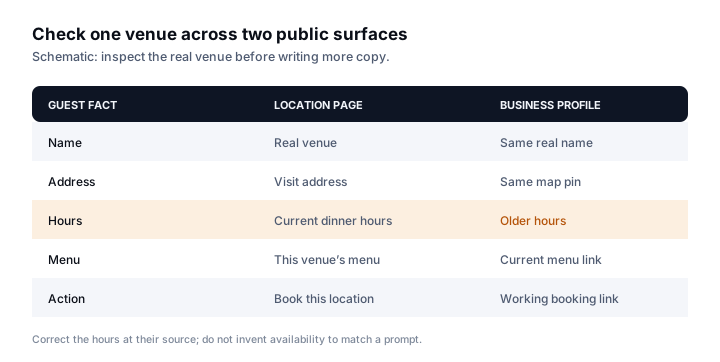
Menus and action links need a destination a diner can use
A menu image can help a visitor, but a readable page with dish names, relevant details and a working menu URL is easier to inspect and update. Do not add dietary or allergen claims unless the kitchen has confirmed them for the location. Google’s profile rules, read 23 October 2026, say a submitted menu should represent what is available and that a menu URL cannot lead directly to a third-party ordering or delivery service. Check the menu URL in a private browser window, on a phone, and after a seasonal change.
Google’s local business link help, read 23 October 2026, describes menu links and action links for reservations and food orders. It also notes that some third-party links may appear automatically and that local business links are not available through its Business Profile API or spreadsheet upload. Verify the live button for each branch instead of assuming a website edit updates the profile. If an action depends on a partner, test the destination and show the prerequisite before the diner reaches checkout.
On the site itself, Google’s LocalBusiness documentation, read 23 October 2026, supports the more specific Restaurant subtype and describes hours and other business facts. Markup must match the visible venue facts. A valid JSON-LD block does not create a reservation slot or repair a menu link. Put the direct answer in the page first, then test any structured data against what a guest can see.
A reachable page is only the beginning of an AI answer
Before blaming an assistant for missing the restaurant, confirm the intended URL returns a usable page with a self-referencing canonical and crawlable text. Google’s AI features guidance, read 23 October 2026, says a supporting link in AI Overviews or AI Mode must come from a page indexed and eligible for a Search snippet. Google requires no special AI markup. Check the location URL in Search Console and link it from the site’s locations or menu navigation if it is orphaned.
ChatGPT search has a separate discovery path. OpenAI’s crawler documentation, read 23 October 2026, distinguishes OAI-SearchBot for search from GPTBot for training. Review robots.txt for the search bot if ChatGPT visibility matters; do not infer that allowing a crawler guarantees a citation. If the page is accurate and accessible yet a result names a rival, read the answer’s actual cited sources before deciding what to change. The one-page ChatGPT answer method shows how to record that evidence.
Measure the answer and the guest action on separate lines
For each saved diner question, record the date, market, assistant, exact answer, venues named and URLs cited. A venue can be named without its own site being cited. A page can be cited without a reservation or order. Count a visit only when site analytics observes one, and a booking only when the booking system records it. Do not turn a mention into a conversion claim. Repeat the same question after one factual correction and annotate the date; assistant answers can vary, so one changed result is not proof of cause.
If you operate several branches, keep the worksheet separate by location. A correct downtown answer does not establish coverage for the airport branch. SearchLift’s AI visibility screen records tracked buyer questions, names and cited sources across the assistants included with a plan. It can shorten repeated observation, while the restaurant still owns menu accuracy, real availability and the booking path. When a guest question needs a deeper page rather than a corrected fact, the article studio can draft from that question for editorial review. The measurable goal is a guest reaching the right venue and action, not a dashboard score.
Common questions
- 01What is AI SEO for restaurants?
- It is the work of making each real restaurant location easy to verify online, then checking how search systems and AI assistants answer relevant diner questions. Start with accurate location pages, menus, hours and action links; measure mentions, citations and guest actions separately.
- 02Does Restaurant schema make ChatGPT recommend a venue?
- No. Restaurant structured data can describe facts on a page to search systems when it matches visible content. Neither Google nor OpenAI promises an AI recommendation from adding markup.
- 03Should every branch have its own Business Profile?
- Each eligible real location can have its own profile, but Google says not to create more than one profile for the same location. Keep the name, category and location details consistent with the real-world business and its own page.
- 04Is a menu PDF enough for restaurant AI search?
- Do not rely on one format alone. Give diners a working menu link and readable location-specific details on the site, then verify the Business Profile menu reflects the available food. A PDF may still be useful for guests, but it cannot repair an outdated profile or broken action link.
- 05Can Search Console show ChatGPT restaurant recommendations?
- No. Search Console reports Google Search data. Save a ChatGPT answer and its cited URLs separately, and use site analytics or booking records for visits and reservations.