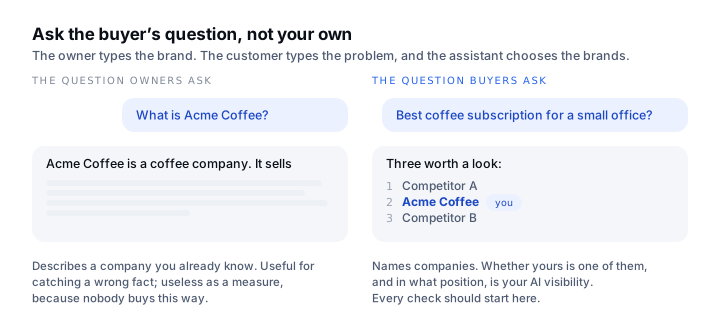
Most business owners have typed their own company name into ChatGPT once, read the answer, and drawn a conclusion. That is the wrong test. Nobody buys by asking an assistant about a company they already know. They ask about a problem, and the assistant names companies. The check that matters is whether you are one of the names. That is your AI visibility, and checking it is the first step of ChatGPT SEO.
Ask the buyer’s question, not yours
Write down five questions a customer would actually put to an assistant at the moment they are choosing. Not “what is Acme Coffee” but “best coffee subscription for a small office”, “where to buy single-origin espresso beans online”, “wholesale coffee supplier for cafés”. The question should have a category and an intent, and it should not contain your brand.
If you struggle to write them, your Google Search Console has hundreds: the queries people already use to find you are the raw material. SearchLift’s Search Console suite turns those into tracked questions automatically, but a spreadsheet works for a first pass.
Three reasons one check misleads
- 01Web search. The consumer assistants usually search the web before answering a shopping question, and the answer then depends on what the search returned that day. Ask with web search on, because that is what your customer gets. A bare model answer from memory is a different, older thing.
- 02Personalisation and memory. An assistant that knows you run a coffee business will answer coffee questions differently. Use a fresh session, or an account with no history, and do not lead with your brand.
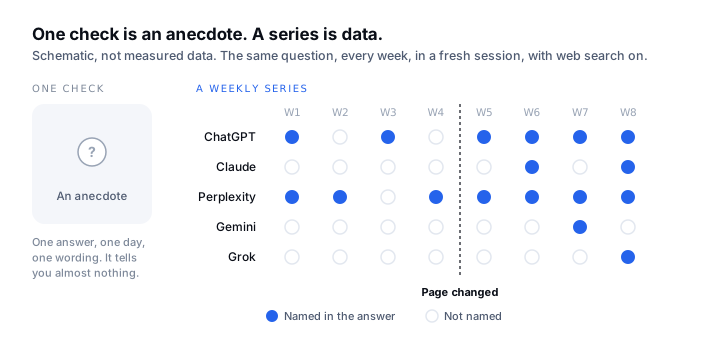
- 03Variance. The same question, asked twice, often returns different names. One answer is an anecdote. Five answers over a fortnight is data.
What to record, per assistant
For each question and each assistant, note the same six things every time, so the rows can be compared:
| Field | What to write down | Why it matters |
|---|---|---|
| Named | Yes or no | The only number that matters at first |
| Position | Where in the answer your name appeared, if at all | First-named is worth more than a footnote |
| Recommended or mentioned | Was it a recommendation or a passing mention | A mention in a list of ten is not a win |
| Named instead | The competitors it named | Tells you who owns the answer today |
| Sources | Every page the answer cited | Usually not a competitor’s homepage; often a directory or blog you could be on |
| Claims about you | Anything it said about your business | Assistants state stale prices and old addresses as fact |
Which assistants to include
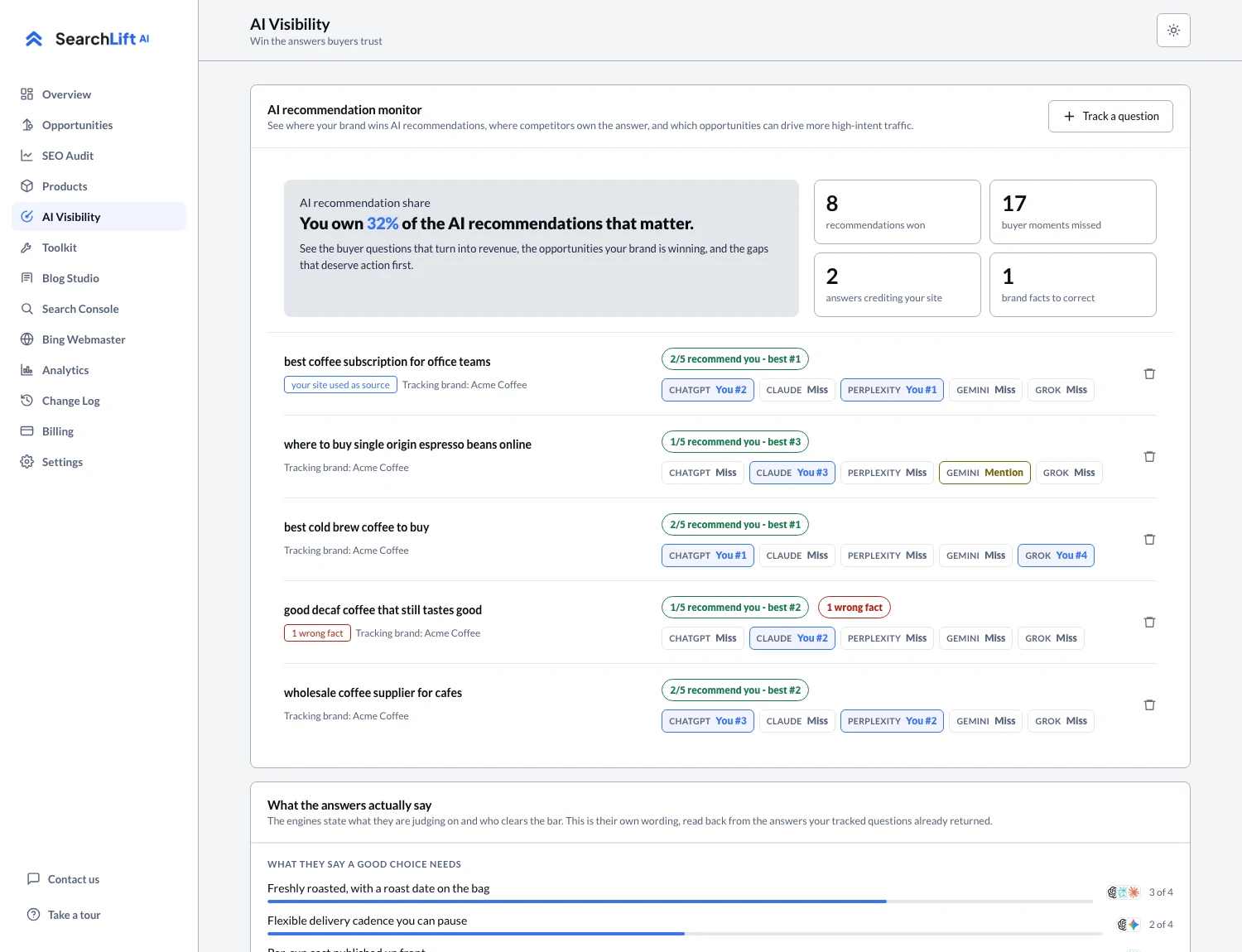
The five that customers actually use for buying questions are ChatGPT, Claude, Perplexity, Gemini and Grok. They do not agree with each other. In live SearchLift accounts it is common for a brand to be recommended first on Perplexity and absent on Gemini for the same question, because each assistant runs its own web search and its own crawler. Checking one assistant and extrapolating is the second most common mistake after asking about your own name.
Read the sources before you rewrite anything
The instinct after a bad result is to rewrite your homepage. Look at the sources column first. If the assistant built its answer from a trade blog’s “top ten” list, a marketplace category page and a Reddit thread, then your homepage was never in the running, and the highest-leverage move might be getting onto that list rather than polishing your own copy. When your own page was among the sources and you were still not named, the page is the problem, and that is where an audit of what the page actually states earns its keep.
Turn the check into a series
Run the same five questions across the five assistants once a week, in fresh sessions, with web search on, and keep the rows. After a month you have an AI visibility line you can put a date on. Mark the day you changed a page, published an article, or corrected a listing, and see whether the line moved after it. That before-and-after is the whole discipline; everything else is decoration.
Doing it by hand is about twenty-five answers a week to read and record. It is worth doing once so the data stops being abstract. After that it is exactly the kind of repetitive, comparable work software should do, which is what the AI visibility tracker is for: the same questions, the same six fields, every assistant, with the sources kept.
For the short version of this method, ten minutes rather than a full tracking setup, read does ChatGPT recommend your business.
Common questions
- 01Should I ask ChatGPT about my company by name?
- Only to check what it says about you, which is useful for catching wrong facts. To measure visibility, ask the category question a buyer would ask and see whether your name appears in the answer.
- 02Why does the answer change every time I ask?
- Assistants that search the web before answering depend on that day’s search results, and generation itself is not deterministic. Treat a single answer as an anecdote and a weekly series as data.
- 03Which assistant matters most?
- It depends on your customers, and the assistants disagree with each other. Check all five before deciding where to spend effort; the one you assume is dominant is often not the one recommending you.
- 04Does ChatGPT recommend my business?
- The only way to know is to ask it the question a buyer would ask, in a fresh session with web search on, and see whether your name is in the answer. Do it for five questions, across the five assistants, once a week, and you have a real answer instead of a guess. That weekly series is what AI visibility tracking automates.
- 05What if an assistant says something false about my business?
- Record it. Then make sure the correct fact is stated plainly on your own site and on the third-party pages the assistant cited, because those are what it will read next time. SearchLift’s accuracy guard checks every tracked answer against your stated facts and alerts you when they disagree.