AI SEO for local service businesses starts with one page that answers a buyer’s service-and-place question. If a homeowner asks who repairs a leaking roof in their town, an assistant needs to verify the service, the area served, and the conditions that decide whether the business is a fit. Write those facts on the page, keep the business record consistent, and measure whether the answer names you. None of this guarantees a recommendation.
This is a different task from asking an assistant to find your brand by name. A branded query tests recognition. A buying query tests whether the assistant can place you among relevant options. The manual check in does ChatGPT recommend your business explains how to word that first prompt without feeding it the answer.
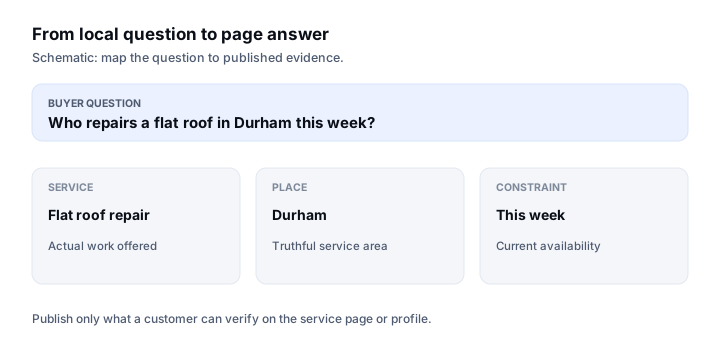
A local answer needs a service and a place
The location changes the answer. Google says its local results are mainly based on relevance, distance and popularity in its Business Profile ranking guidance, read 13 October 2026. That is a statement about Google’s local results, not a published formula for ChatGPT, Claude, Perplexity, Gemini or Grok. Do not assume one assistant uses the same ranking system as another.
Start with a real buying question: “Who can repair a flat roof in Durham this week?” Separate the service, place and constraint. If the business does not take emergency work, do not hint that it does. If it serves only a defined county, state that boundary. A page that is precise about its limits is more useful to the buyer than a page that claims every job in every nearby city.
| Part of the question | What the page should state | What to verify |
|---|---|---|
| Service | The exact work offered and work excluded | Does the page name the service in visible text? |
| Place | The actual service area or visit location | Does the page agree with the Business Profile? |
| Constraint | Availability, property type or other real limit | Can a customer confirm it before calling? |
| Proof | Licensing or credentials only when current and verifiable | Is the claim supported by a public source or record? |
The service page must state the buying facts
Use a dedicated page for a real service, and write the opening answer in plain text. Name what the team does, where it does it, how a customer starts, and one meaningful limitation. A photo gallery or a list of city names cannot substitute for an answer. If you operate in several areas, give each genuinely different location page the facts that differ there; copying one page and changing a town name gives the reader little new information.
Add a short table when your services have clear options: repair versus replacement, residential versus commercial, or visits versus remote estimates. Use the row labels a buyer would use. Link from the service page to the contact path and from a relevant overview page back to the service page. Google’s AI features guidance, read 13 October 2026, explicitly recommends findable internal links and important content in textual form. It says no special AI file or markup is required for AI Overviews or AI Mode.
When the service page is ready, a narrow article can answer the most common decision question without repeating the sales page. A page on when a repair is appropriate can link to the repair service and explain the cases it does not cover. The article studio works from a site’s own content and real demand, but the owner still has to check service facts before publishing.
Keep your Business Profile and site consistent
Google asks businesses to keep their Business Profile complete and accurate, including address where customers can visit, hours and category, in the same local ranking guidance. Compare that profile with the contact and service pages. If the profile says one service area and the site says another, correct the underlying business information before writing more copy. The page should not publish a street address that customers cannot visit merely to look local.
If the site uses LocalBusiness structured data, treat it as a machine-readable copy of facts already visible on the page. Google’s LocalBusiness documentation, read 13 October 2026, recommends the most specific business subtype and calls for a real name and address for eligible results. It also says search appearance is not guaranteed. Markup is useful for consistency checks; it is not a substitute for a service page that answers the question.
Make the page reachable to Google and ChatGPT
A page cannot support a Google AI feature link unless it is indexed and eligible for a snippet, according to Google’s AI features guide. Check the exact service URL in Search Console. Confirm it is served, linked internally, crawlable, and free of an unintended noindex. A valid sitemap entry helps discovery, but does not force indexing.
For ChatGPT search, OpenAI identifies OAI-SearchBot as the crawler used to surface sites in search results. Its crawler documentation, read 13 October 2026, says sites opting out of that crawler will not be shown in ChatGPT search answers, though navigational links may still appear. GPTBot is the training crawler and is a separate choice. The exact tokens and a robots.txt test are in AI crawlers and robots.txt. If a host firewall blocks OpenAI’s published searchbot IP ranges, that is an infrastructure fix, not a copy edit.
Record mentions, citations and visits separately
Ask one unbranded buyer question in each assistant, with a location and a real job constraint. Save the prompt, date, assistant, location context, the names it gave, and the URLs it cited. Repeat with the same wording after a page change. Answers can vary, so a single favorable answer is an observation, not proof that a change worked. Do not turn a handful of manual checks into a market share percentage.
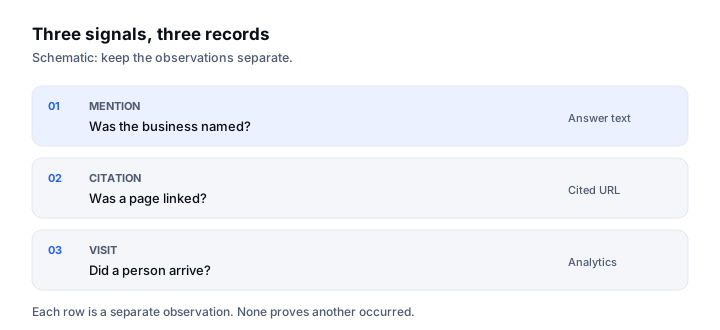
Record a mention even when the source cited is somebody else’s directory. Record a citation even when nobody clicks. Record a visit only when analytics attributes it to an assistant. Search Console’s web performance report includes Google AI features within overall search traffic, according to Google’s measurement section; it does not identify every assistant recommendation as a separate click.
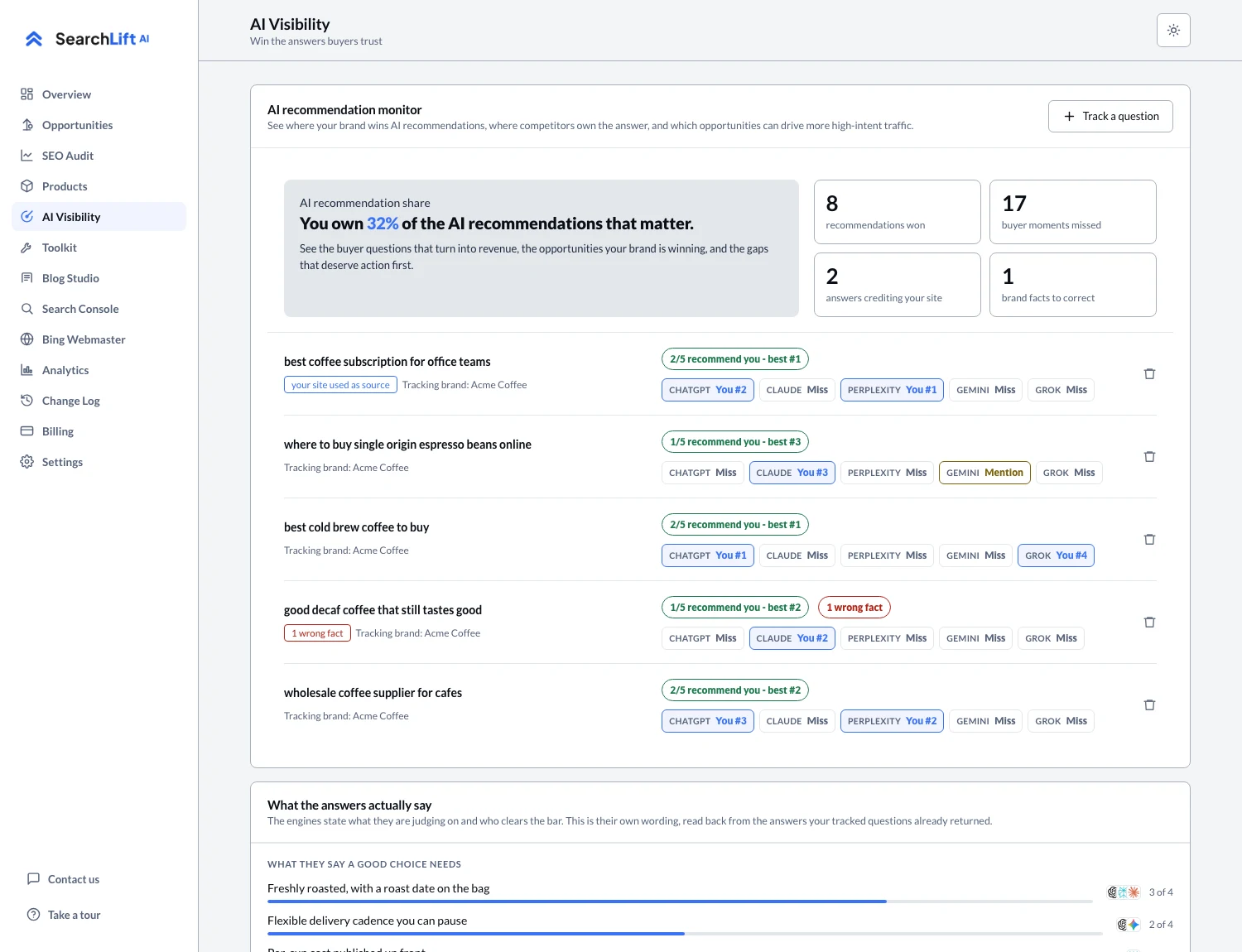
Once the manual sheet becomes repetitive, AI visibility tracking records buyer questions across the assistants included in a plan, whether the business was named, who appeared instead, and the sources used. The useful output is the missed question and the page you can improve, not a promise of placement. Fix that page, keep the prompt constant, and recheck the answer and the site visits separately.
Common questions
- 01What is AI SEO for local service businesses?
- It is the work of making a real local service easier for search systems and AI assistants to find, understand and verify. Start with an accurate service page, matching Business Profile facts, crawler access, and a repeatable check of buyer questions. No page or tool can guarantee a recommendation.
- 02Does a Google Business Profile make my business appear in ChatGPT?
- No public rule says it does. Google documents Business Profile as a source for its own local results. Check ChatGPT separately with an unbranded buyer question, and check whether your own site is reachable to OAI-SearchBot.
- 03Do I need LocalBusiness schema for Google AI Overviews?
- Google says there is no special markup requirement for AI Overviews or AI Mode. LocalBusiness structured data can describe facts already on a page, but the page still needs to be eligible for Google Search and a snippet. Structured data does not guarantee a rich result or AI citation.
- 04How do I measure local AI visibility without buying a tool?
- Ask the same unbranded service-and-place question in the assistants your customers use. Save the prompt, date, location context, names in the answer and cited URLs. Keep mentions, citations and analytics visits in separate columns, then repeat after a specific page change.