Does ChatGPT recommend your business? Probably not, and the way to find out is to ask it the question your buyer would ask rather than a question about you. Type your own business name into ChatGPT and it will describe you, because you named the entity. Type "who is the best commercial roofer in Tulsa" and it has to choose, and whether it chooses you is the thing you actually want to know. The whole check takes about ten minutes and needs no tool.
Why this stopped being a curiosity in 2026
Use of ChatGPT and similar generative AI tools for local business recommendations rose from 6% of consumers in 2025 to 45% in 2026, according to the BrightLocal Local Consumer Review Survey 2026, read on 13 September 2026. That makes AI the third most used source of business recommendations behind Google and Facebook. Over the same period Google’s share as a review source fell from 83% to 71%.
The same survey found 40% of consumers say they trust AI platforms to provide business recommendations, against 32% who disagree, and that 82% read AI-generated review summaries with 23% willing to decide on the summary alone. A quarter of the people reading about you through an assistant never see the underlying sources.
| Source of local business recommendations | 2025 | 2026 |
|---|---|---|
| 83% | 71% | |
| 40% | 49% | |
| ChatGPT or other generative AI tools | 6% | 45% |
| Apple Maps | 14% | 27% |
The ten-minute check: does ChatGPT recommend your business?
Run this as written. The value is in the discipline of the question, not in the tooling.
- 01Write down the question a buyer types when they do not know you exist. Not "tell me about Acme Roofing" but "who is the best commercial roofer in Tulsa". No brand name, no jargon, the buyer’s words, one geography if geography matters.
- 02Open a new ChatGPT conversation with web search on, and make sure you are logged out or in a temporary chat. A logged-in account carries memory and prior conversations, which will quietly bias the answer toward businesses you have already discussed.
- 03Ask the question exactly as written. Record the businesses named, in order, and note whether you appear at all.
- 04Ask the assistant which sources it used. Record the URLs. These are the pages that decided the answer, and they are almost never the businesses’ own home pages.
- 05Repeat the same question in a second temporary chat. The answers will differ, because the model samples and the live search results move. Two runs tell you whether your absence is consistent or incidental.
- 06Repeat the whole thing for the other four assistants your buyers use: Claude, Perplexity, Gemini and Grok. An answer in one is not an answer in all five, and the gaps between them are the most useful part of the exercise.
Record six fields per run: the assistant, the date, whether you were named, the position you held in the list, who was named instead, and the sources cited. The method and the recording sheet are covered in more detail in how to check what ChatGPT, Claude and Gemini say about your business.
Reading the result honestly
One run is an anecdote. The reason to do two runs per assistant is that generative answers vary between identical prompts, so a single absence proves very little and a single appearance proves less. What you are looking for is a pattern across runs and across assistants.
- Named in most runs, in most assistants. You are in the consideration set. The work now is accuracy: check that what they say about you is correct, because an assistant repeating an old price or a closed location costs more than not appearing.
- Named in one assistant only. Usually a source problem. Look at which sources that assistant cited and whether the others reach them at all.
- Never named, competitors consistently named. Go and read the pages the assistants cited. The question is not why they like your competitor, it is what that page states plainly that yours does not.
- Nobody consistently named. The category may be too broad for the assistant to answer, or your question is not one buyers actually ask. Narrow it and run again.
Resist the urge to explain a bad result by the model disliking you. In almost every case we have looked at, the cited page simply answered the buyer’s question in plain sentences and the absent business did not.
The three things that decide whether you are named
ChatGPT searches the web before answering a question like this, so the outcome comes down to reachability, extractability and corroboration, in that order.
- 01Can its crawlers reach you? OpenAI publishes its user agents at platform.openai.com/docs/bots. The one that matters for being cited in answers is
OAI-SearchBot, which is separate fromGPTBotfor training andChatGPT-Userfor user-initiated fetches. Blocking all three because you did not want to be training data also removes you from the answers. Our guide to AI crawlers in robots.txt lists every token with its job. - 02Does your page state an answer? An assistant quotes sentences, not vibes. A page that says "we have served Tulsa commercial clients since 2004 and carry a $5m liability policy" is quotable. A page that says "we pride ourselves on quality" is not. This is also why schema markup on its own does not fix AI visibility: markup that describes text the page does not contain adds nothing.
- 03Does anyone else say it? Assistants weight corroboration heavily and cite third-party pages far more often than vendor home pages. A claim only you make is a claim with one source. This is the slowest of the three to fix and the one that decides most contested categories.
What to do in the first week
In order, because the first item blocks the rest.
- Check robots.txt for
OAI-SearchBot. If it is disallowed, nothing else on this list matters. - Fix the page the assistants should be citing. One page, the one that answers the buying question, rewritten so the first paragraph answers it in plain sentences with specifics.
- Read the pages they cited instead. Not to copy them, to see which question they answered that you left implicit.
- Re-run the check in two weeks. Answers move, and a single after-reading is as weak as a single before-reading.
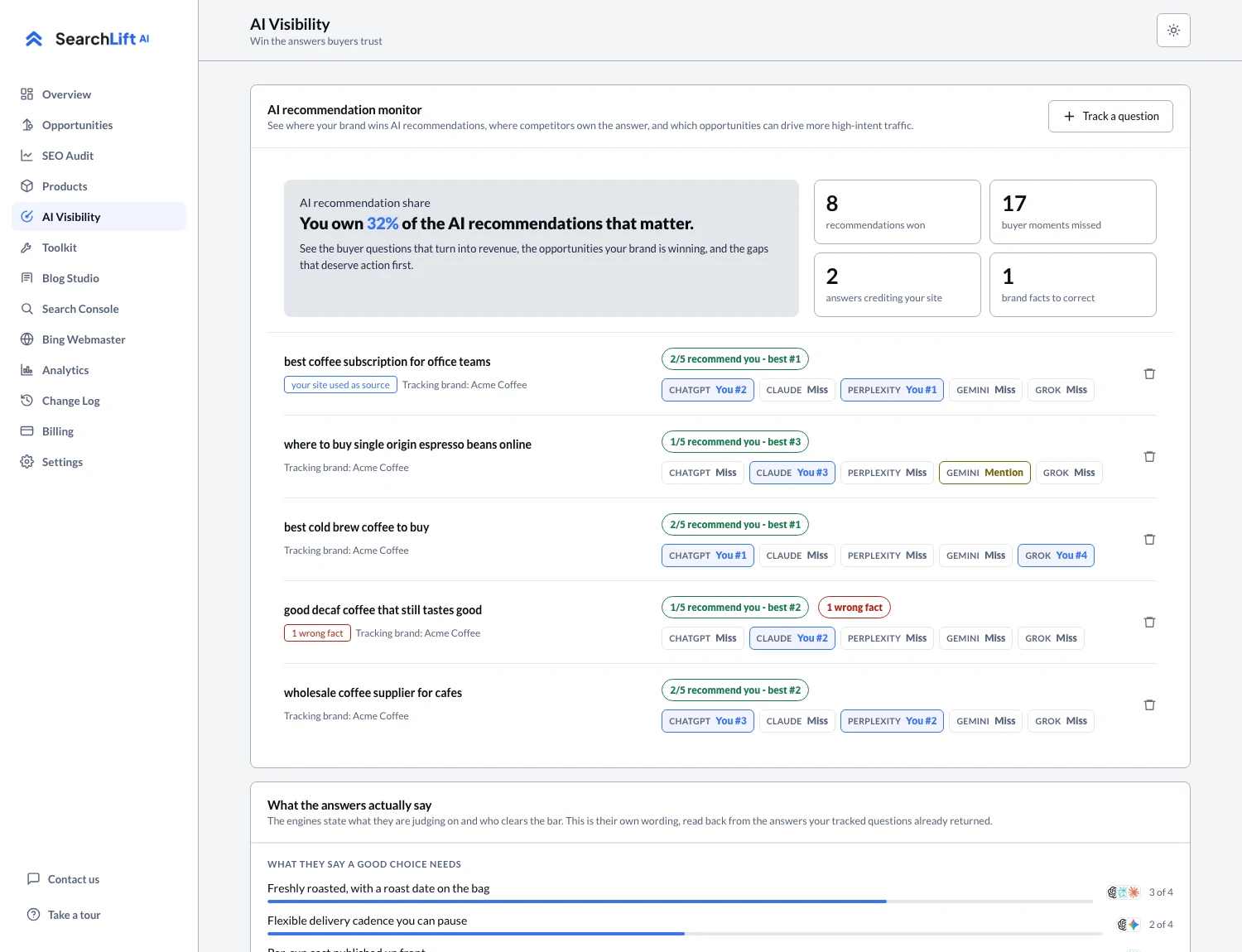
Running this by hand across five assistants and several buying questions, every fortnight, is where most people stop. That scheduled version is what AI visibility tracking in SearchLift does: the same questions put to ChatGPT, Claude, Perplexity, Gemini and Grok with web search on, with who was named instead and which sources each answer used recorded each time. The free plan tracks one question on Gemini and audits 10 pages, which is enough to establish whether you appear at all.
Common questions
- 01Does ChatGPT recommend my business?
- Find out by asking ChatGPT the buying question your customer asks, with no brand name in it, in a logged-out or temporary chat with web search on, then recording whether you were named and who was named instead. Asking about your business by name will always produce a description of you and tells you nothing about whether you get recommended.
- 02Why does ChatGPT name my competitor instead of me?
- Almost always because of the pages it cited rather than any judgement about the businesses. Ask the assistant which sources it used and read them. In most cases the cited page states a plain, specific answer to the buyer’s question and the absent business’s page states a general claim about quality. Corroboration matters too: assistants weight facts that appear on third-party pages more heavily than claims a business makes only about itself.
- 03How do I get ChatGPT to recommend my business?
- Three things in order. Make sure OAI-SearchBot, the crawler behind citations in answers, is not blocked in robots.txt. Rewrite the page that should answer the buying question so it answers it in plain sentences with specifics rather than adjectives. Then work on corroboration, because a claim only you make has one source. There is no submission form and no way to pay for placement.
- 04Will the answer be the same every time I ask?
- No. Generative answers vary between identical prompts because the model samples and the live search results move underneath it. Run each question at least twice per assistant and look for a pattern rather than treating one run as a verdict. This is also why a single check before and after a change cannot tell you whether the change worked.
- 05Should I check assistants other than ChatGPT?
- Yes. Being named by one assistant does not mean being named by the others, and the gaps between them are usually the most informative part of the exercise, because they point at which sources each one can reach. Claude, Perplexity, Gemini and Grok all answer these questions and all draw on different mixes of sources.