If you are looking for a Rankscale alternative, the first thing to understand is the unit you would be leaving. Read on 1 October 2026, Rankscale’s pricing page sells monthly credits, from 120 on Essentials to 12,000 on Enterprise, and spends them each time it asks an AI engine one of your prompts. The catch most comparisons miss is in its own calculator: an answer from ChatGPT, Gemini, Perplexity or Google AI Mode costs 0.25 credits, and an answer from Claude costs 2. Which assistants you track decides how far a plan goes, by a factor of up to eight.
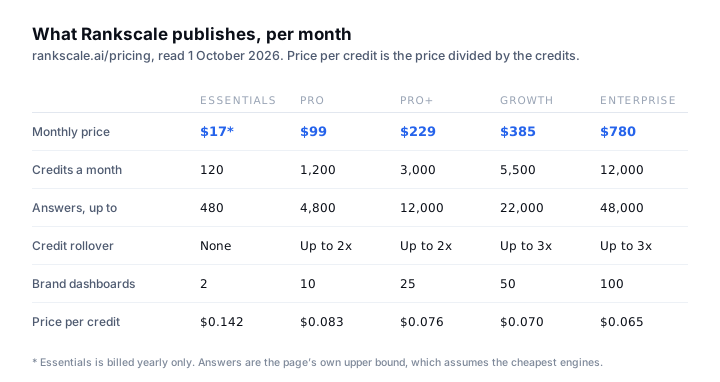
What Rankscale publishes today, plan by plan
The prices are on the page, and the page is more detailed than most in this category. Four tiers bill monthly or yearly, with 15 percent off yearly: Pro at $99, Pro+ at $229, Growth at $385 and Enterprise at $780. A fifth, Essentials, is shown at $17 a month and is yearly only. Search terms are unlimited on every tier, and the page describes them as “Creation unlimited · execution uses credits”, so the credit balance is the real limit.
| Line on the page | Essentials | Pro | Pro+ | Growth | Enterprise |
|---|---|---|---|---|---|
| Price a month | $17, yearly only | $99 | $229 | $385 | $780 |
| Credits a month | 120 | 1,200 | 3,000 | 5,500 | 12,000 |
| Answers from AI engines, up to | 480 | 4,800 | 12,000 | 22,000 | 48,000 |
| Credit rollover | None | Up to 2x | Up to 2x | Up to 3x | Up to 3x |
| Brand dashboards | 2 | 10 | 25 | 50 | 100 |
| Scheduling | Hourly to monthly | Hourly to monthly | Hourly to monthly | Hourly to monthly | Hourly to monthly |
The credit is the unit, and engines are not priced the same
The pricing FAQ explains the mechanism: “Each time Rankscale queries an AI engine on your behalf, it costs a fraction of a credit (typically 0.25 credits per engine per prompt).” The word typically is doing work. The credit calculator on the same page lists the cost per engine, and it is not flat.
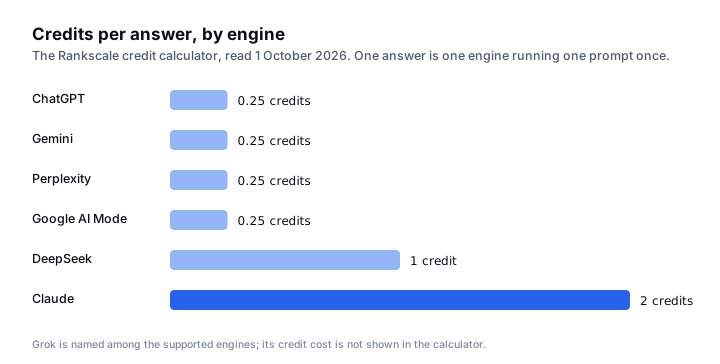
That matters because the “answers, up to” figure on every plan is simply the credits divided by 0.25. Pro’s 4,800 answers assume every answer comes from a quarter-credit engine. Spend the same 1,200 credits on Claude alone and they buy 600 answers. The page also lists Grok among the engines it supports, but the calculator does not show Grok’s credit cost, so that number is not public.
What ten prompts cost on Rankscale, worked through
Take a modest list: ten buying questions, checked once a day for a 30-day month. The arithmetic below uses the per-engine costs from the calculator and nothing else.
| Engines tracked | Credits per prompt run | Credits for 10 prompts daily, 30 days | Smallest tier that covers it |
|---|---|---|---|
| ChatGPT only | 0.25 | 75 | Essentials (120) |
| ChatGPT, Gemini, Perplexity, AI Mode | 1.00 | 300 | Pro (1,200) |
| The four above plus Claude | 3.00 | 900 | Pro (1,200) |
| The five above plus DeepSeek | 4.00 | 1,200 | Pro, with nothing left over |
Two things follow. A small business tracking ten questions on the four cheap engines fits comfortably inside Pro, and adding Claude does not move it to a higher tier. But Essentials, the only plan under $99, covers ten daily prompts on a single engine and not much more, and it carries no credit rollover. The step from Essentials to Pro is the one most small teams will actually make.
Where Rankscale is the better buy
An honest comparison says where the incumbent wins, and on breadth Rankscale wins clearly. The compare table lists 17 or more engines on every tier, scheduling from hourly to monthly, unlimited search terms, and rollover of unused credits up to two or three times the monthly allocation on the paid monthly tiers. It also lists query fanout, shopping and ad analytics for ChatGPT, Google AI Mode and Copilot, an MCP connection, and a REST API from Pro+ up, with white-labeled dashboard links for agencies.
- Many engines, few prompts. If you need DeepSeek, Mistral or the API versions of several models side by side, the engine list is the reason to pay.
- Flexible cadence. Hourly to monthly lets you spend credits where the answers change fastest and save them where they do not.
- Agencies. Brand dashboard counts from 10 to 100, white-label links and an agency programme make it a reseller’s tool as much as an owner’s.
- Credits that keep. Rollover on Pro and above softens the cost of a quiet month.
A report still needs somebody to change the page
Rankscale’s feature list includes page audits, citation analysis and Scout recommendations, described as “AI-powered suggestions to summarize massive amounts of data and improve your brand’s visibility”. That is diagnostic help. Nothing on the pricing page describes publishing an edit to your site, and that is the question worth asking of any alternative: when the report says a page should have been cited and was not, who rewrites it, and how is the rewrite undone if it makes things worse.
- 01Write the prompt list first, in your customers’ words. Count them, then decide how often each needs checking.
- 02Name the assistants your buyers open. On a credit-priced tracker, price those engines specifically rather than reading the headline answer count.
- 03Do the multiplication: prompts x credits per run x runs a month. Compare that to the allowance, not the price.
- 04Decide who acts on the output. If nobody will rewrite the pages, buy the cheapest measurement you can live with, or a product that does the rewriting.
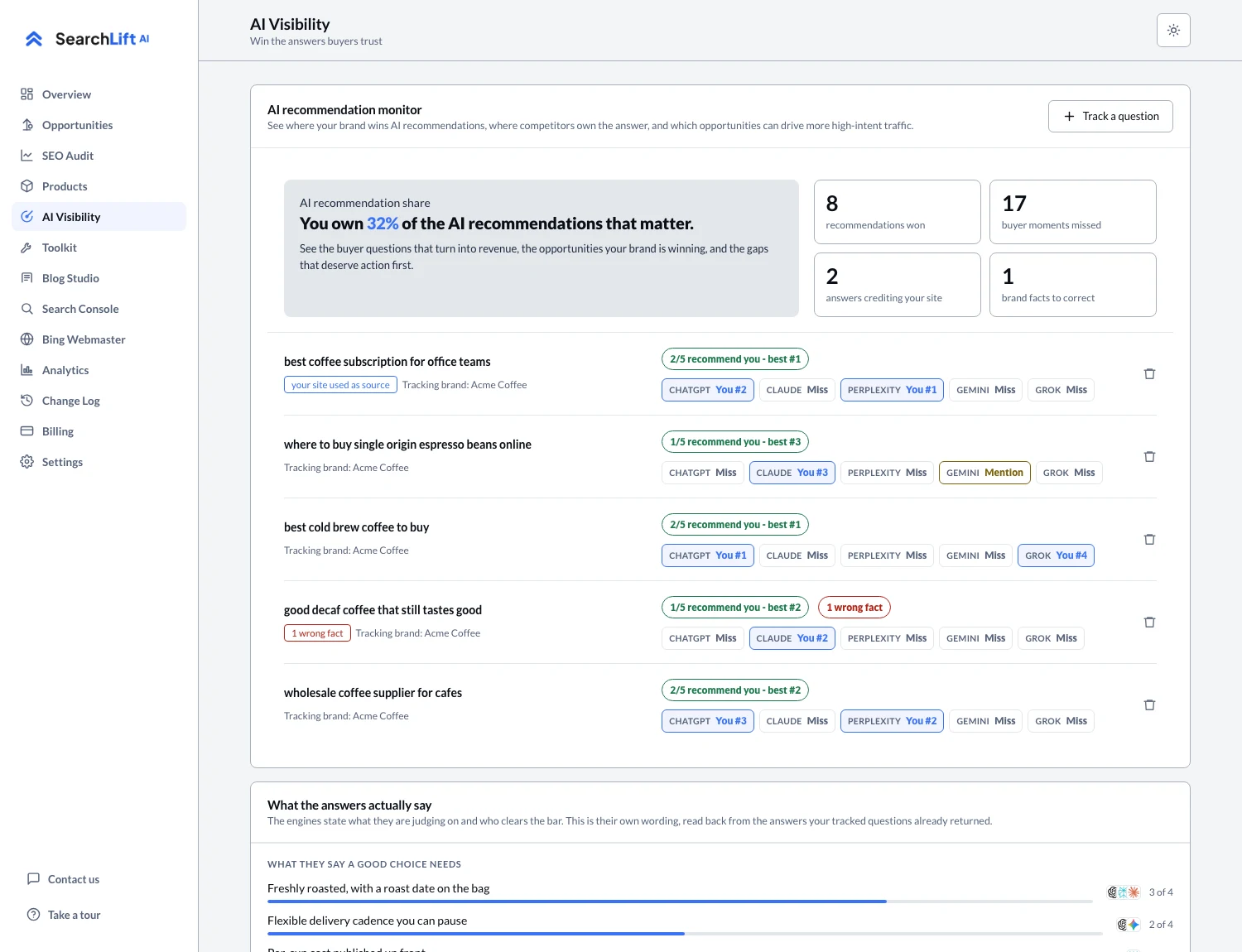
Where SearchLift sits in that split: it covers the change half as well as the measurement half, and it does not meter assistants against each other. From the Premium plan up, AI visibility tracking puts each tracked question to ChatGPT, Claude, Perplexity, Gemini and Grok alike. The AI SEO audit applies a fix on approval with the previous value saved, and the article studio writes the page. The trade runs the other way on volume: Free tracks 1 question, Plus at $8.99 a month tracks 2, Premium at $17.99 tracks 3, Enterprise at $59.99 tracks 4 and Platinum at $129.99 tracks 6, so a list of fifty prompts is an argument for Rankscale. The numbers are on the pricing page, and the same arithmetic applied to a prompt-metered tracker is in the Peec AI writeup.
Common questions
- 01What is the best Rankscale alternative?
- It depends on how many prompts you track and which assistants. Rankscale is strong for broad engine coverage and flexible scheduling, and its credits stretch furthest on ChatGPT, Gemini, Perplexity and Google AI Mode at 0.25 credits an answer. If Claude matters to your buyers, it costs 2 credits an answer, so price it specifically. If nobody will act on the report, look for a product that edits pages rather than one that only measures them.
- 02How much does Rankscale cost?
- Read on 1 October 2026, its pricing page lists Essentials at $17 a month billed yearly only with 120 credits, Pro at $99 with 1,200 credits, Pro+ at $229 with 3,000, Growth at $385 with 5,500 and Enterprise at $780 with 12,000. Yearly billing takes 15 percent off the monthly tiers. A custom plan is available on request.
- 03How do Rankscale credits work?
- Each time Rankscale asks an AI engine one of your prompts it spends credits. The calculator shows 0.25 credits for ChatGPT, Gemini, Perplexity and Google AI Mode, 1 for DeepSeek and 2 for Claude. Credits renew each billing cycle, roll over up to 2x or 3x on Pro and above, and can be topped up in the app.
- 04Why does Claude cost more on Rankscale?
- The pricing page does not give a reason, it only lists the cost: 2 credits for a Claude answer against 0.25 for ChatGPT. In practice that means one Claude answer uses the credits of eight ChatGPT answers, so a plan’s headline answer count shrinks quickly if Claude is in your tracked set.
- 05Is there a cheaper alternative to Rankscale?
- Several products publish lower entry prices, including SearchLift at $8.99 a month for Plus and a free plan that takes no card. Cheaper plans usually track fewer questions, so compare the cost of tracking your own prompt list on your own assistants, not the monthly figure. Prices here move often, so check each vendor’s page, including for the figures in this article.