If you are looking for a Peec AI alternative, start with the one line on its pricing page that decides more than the price does. Read on 30 September 2026, Peec AI’s pricing page publishes three monthly tiers, $95, $245 and $495, and every one of them says the same thing under the price: “Choose 3 models”. Which three you are allowed to choose, and which assistants are not on the menu at all below Enterprise, is the comparison most roundups skip.
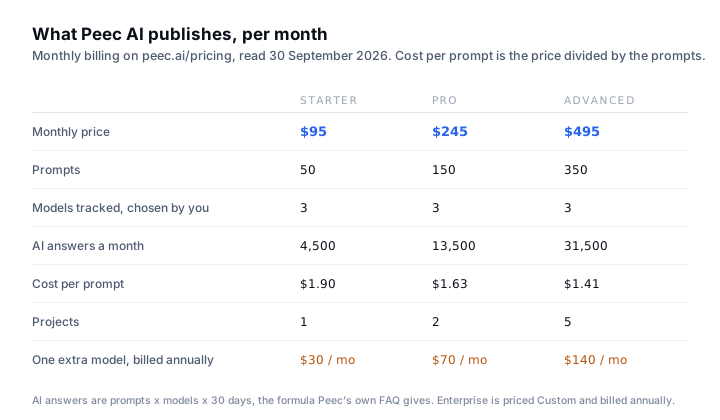
What Peec AI publishes today, plan by plan
The prices are on the page, which already puts Peec ahead of the part of this category that starts with a demo call. Starter is described as “For SEO and content managers getting started with AI Search visibility”, Pro as “For SEO teams that need sophisticated AI Search tracking and insights”, and Advanced as “For marketing teams managing multiple projects with deeper reporting”. A fourth tier, Enterprise, is priced Custom and billed annually.
Users are unlimited on every tier and tracking runs daily on every tier. The pricing FAQ says annual billing takes 15 percent off, and that tracking extra countries or languages costs nothing extra because “Pricing remains tied to usage of prompts, not the number of regions or languages.” Every line in the table below was read from that page on 30 September 2026.
| Line on the page | Starter | Pro | Advanced |
|---|---|---|---|
| Monthly price | $95 | $245 | $495 |
| Prompts | 50 | 150 | 350 |
| Models tracked | Choose 3 | Choose 3 | Choose 3 |
| AI answers a month | 4,500 | 13,500 | 31,500 |
| Projects | 1 | 2 | 5 |
| Tracking frequency | Daily | Daily | Daily |
| Users | Unlimited | Unlimited | Unlimited |
| One extra model, billed annually | $30 a month | $70 a month | $140 a month |
| Looker Studio integration | Not listed | Not listed | Listed |
“Choose 3 models” is the line to read first
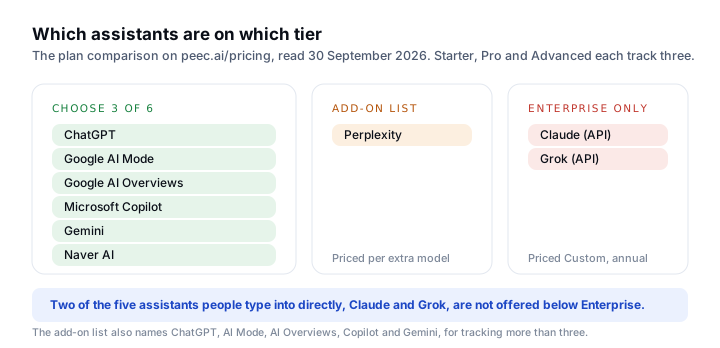
The plan comparison lists the models available on Starter, Pro and Advanced: ChatGPT, AI Mode, AI Overviews, Microsoft Copilot, Gemini and Naver AI. A plan tracks three of those six. Perplexity sits on the add-on list, priced per extra model. Claude and Grok appear only in the Enterprise column, each marked “API”, alongside the line “Up to 13 LLM models tracked”.
For a lot of teams that is a sensible menu. Two of the six are Google surfaces, and Google is where most search still happens. But two of the three slots spent on Google do not buy two separate problems, and Google says so in writing. AI features and your website, last updated 10 December 2025, puts it in one sentence.
There are no additional requirements to appear in AI Overviews or AI Mode, nor other special optimizations necessary.
So a Starter plan tracking ChatGPT, AI Overviews and AI Mode is tracking one chat assistant and one search engine’s two AI surfaces. That is a defensible choice for a brand whose buyers live in Google. It is a thin one for a business whose buyers ask Claude or Perplexity for a recommendation, and the only way to see Claude or Grok inside Peec is a sales call.
The AI answer is the unit you are really buying
Peec’s own FAQ defines the unit plainly: an AI answer is “one chat result per model”, and the example given is that 25 prompts across 3 models for 30 days is 25 x 3 x 30 = 2,250 answers. Run the same arithmetic on Starter and you get the 4,500 on the plan table: 50 prompts, 3 models, 30 days. That is about two cents an answer.
- Prompts are the list you write. Fifty is room for roughly a dozen buying questions asked properly, in the four or five variants a real buyer uses, across one market.
- Models multiply the prompts. A fourth model on Starter is listed at $30 a month, billed annually, and each extra model adds another 1,500 answers a month.
- Days multiply both. Daily tracking is the only frequency listed below Enterprise, so the answer count is fixed by the other two numbers.
- Countries do not. The FAQ says pricing is tied to prompts, not regions or languages, which is unusually generous for a product sold into multi-country teams.
Where Peec is the better buy
An honest comparison says where the incumbent wins, and on volume Peec wins clearly. Fifty prompts on the entry plan is a real working set. The plan comparison also lists things a small-business tool usually does not: SKU-level tracking for a product catalog fetched from Shopify or uploaded as a CSV, source classification of every cited domain, crawl insights from CDN and server logs across providers including Cloudflare, Vercel and AWS, and a crawlability audit of which AI bots a robots.txt allows “across 40+ bots”. Naver AI is on the menu too, which matters to anyone selling into Korea.
If you run a brand with a catalog, several markets and a team whose job is reporting AI visibility upward, those are reasons to pay $95 or more. None of that is marketing copy you have to take on trust: it is the feature table on the same page, read the same day.
A report still needs somebody to change the page
Peec’s feature table has an “Act” section listing gap analysis, recommended actions and agent actions “generated from your data”. That is real diagnostic work. Nothing on the pricing page describes publishing an edit to your site, and that is the question worth asking of any alternative: when the report says a page should have been quoted and was not, who rewrites it, and how is the rewrite undone if it makes things worse.
For a team with a content writer on staff, a good report is enough. For a business owner running the site alone, a report converts a question nobody could answer into a list nobody will work through. Decide which of those you are before you compare prices, because it changes which products are even in the comparison.
Four questions to answer before you pay for any of them
- 01Write the prompt list first, in your customers’ words, multiplied by markets and buyer types. That count decides whether you need 50 prompts or 5.
- 02Name the assistants your buyers open. If Claude or Grok is on the list, check which tier each product puts them on before comparing headline prices.
- 03Price the full configuration, not the entry card: extra models, extra projects and the annual commitment where one is required.
- 04Decide who acts on the output. If nobody will rewrite the pages, buy the cheapest measurement you can live with, or a product that does the rewriting.
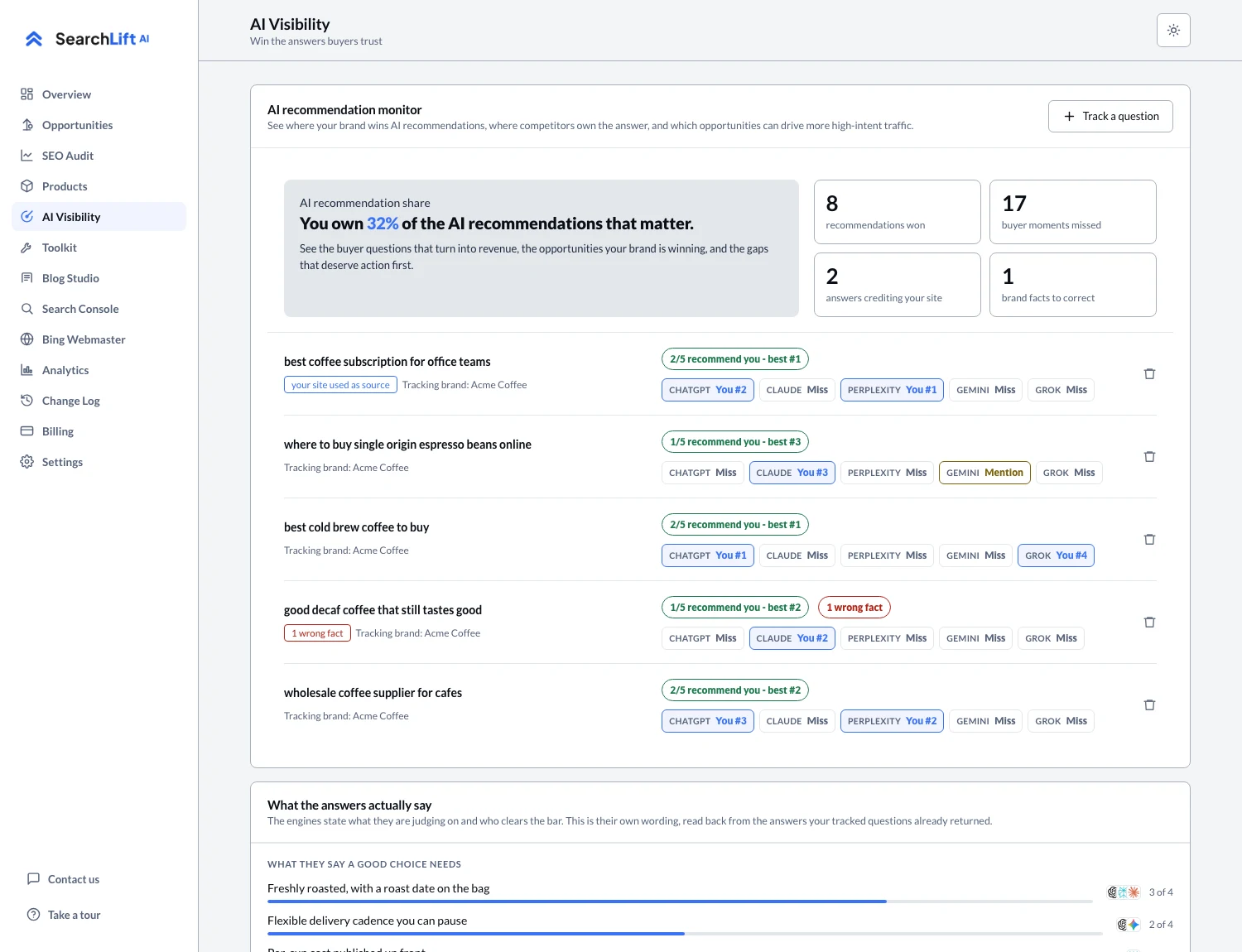
Where SearchLift sits in that split: it publishes every price and limit as a number, and it covers the change half as well as the measurement half. AI visibility tracking puts each tracked question to ChatGPT, Claude, Perplexity, Gemini and Grok from the Premium plan up, and records whether you were named, who was named instead and which sources each answer used. The AI SEO audit applies a fix on approval with the previous value saved, and the article studio writes the page rather than recommending that someone write it. The trade runs the other way on volume: Free tracks 1 question, Plus at $8.99 a month tracks 2, Premium at $17.99 tracks 3, Enterprise at $59.99 tracks 4 and Platinum at $129.99 tracks 6. If you need 50 tracked prompts, that is an argument for Peec, and the numbers are on the pricing page either way. The same arithmetic applied to a cheaper tracker is in the Otterly writeup, a credit-priced tracker that charges Claude at eight times ChatGPT is covered in the Rankscale writeup, and seven platforms are compared on entry price in the platform roundup.
Common questions
- 01What is the best Peec AI alternative?
- It depends on which assistants you need and how many prompts. Peec is a strong buy for a team that needs 50 or more prompts tracked daily on three models from ChatGPT, Google AI Mode, AI Overviews, Copilot, Gemini and Naver AI. If your buyers use Claude or Grok, note that Peec lists both only on Enterprise. If nobody will act on the report, look for a product that edits pages rather than one that only measures them.
- 02How much does Peec AI cost?
- Read on 30 September 2026, its pricing page publishes Starter at $95 a month for 50 prompts, Pro at $245 for 150 and Advanced at $495 for 350, each tracking 3 models daily. Annual billing takes 15 percent off. One extra model is listed at $30, $70 or $140 a month billed annually, depending on the plan. Enterprise is priced Custom and billed annually.
- 03Does Peec AI track Claude and Grok?
- Only on Enterprise. The plan comparison lists Claude Sonnet 4 and Grok in the Enterprise column, each marked API. Starter, Pro and Advanced choose three models from ChatGPT, AI Mode, AI Overviews, Microsoft Copilot, Gemini and Naver AI, with Perplexity on the add-on list.
- 04Is there a cheaper alternative to Peec AI?
- Several products publish lower entry prices, including SearchLift at $8.99 a month for Plus and a free plan that takes no card. Cheaper plans usually track far fewer questions, so compare cost per tracked question and the assistants included, not the monthly figure. Prices in this category have moved repeatedly through 2025 and 2026, so check each vendor’s own page, including for the figures in this article.
- 05What is an AI answer in Peec AI pricing?
- Peec’s FAQ defines it as one chat result per model. The monthly count is prompts multiplied by active models multiplied by days, so Starter’s 50 prompts on 3 models daily is 4,500 answers a month.