To show up in ChatGPT answers, make the page that answers your buyer’s question accessible to search and useful enough to support a specific recommendation. Start with an existing service page: state who it serves, what it does, its limits and the evidence behind its claims. This is an editorial method you can run yourself, not a published ChatGPT ranking formula or a promise of inclusion.
How to show up in ChatGPT answers starts with a buyer task
Choose a question someone asks before knowing your name. For a software vendor, it might be whether a scheduling product supports several locations. For a service business, it might be whether a contractor handles a particular job in a particular area. These are illustrative prompts, not observed customer searches. Use your own sales questions and search queries to replace them.
Write the buyer, task and constraint on separate lines. “Scheduling software” is a category; “scheduling software for a salon with separate staff calendars at each location” describes a decision. Do not add constraints solely because your product satisfies them. That manufactures an easy test which tells you little about how customers actually choose.
OpenAI’s web search documentation, read September 20, 2026, explains that search queries may be rewritten and that location or saved memories may affect them. Treat a prompt as the starting question, not an exact search keyword you can force a page to rank for.
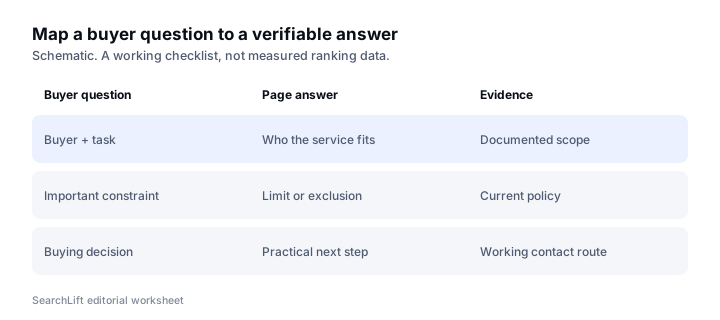
Rewrite the answer before adding another page
Find the existing page closest to that decision. A new blog post is useful when it teaches something the service page cannot cover cleanly. It is unnecessary when the information is simply missing from the page that already sells the service. Keep one clear destination for the offer, and link explanations to it.
- 01Write the unbranded buyer question, including the real constraint that makes the choice difficult.
- 02Choose the existing page that should answer it and save its current text as your baseline.
- 03Draft an opening answer naming the service, intended customer, relevant scope and meaningful limitation.
- 04Add a table only where the reader needs to compare the same fields across alternatives or service options.
- 05Attach a public source or an accountable internal owner to every factual claim. Remove claims nobody can verify.
- 06Publish the reviewed page, check its visible content and crawler access, and record the change in your measurement log.
| Page element | What to write | What to avoid |
|---|---|---|
| Opening answer | Service, buyer, job and boundary | A slogan that could describe any provider |
| Suitability | Who the service fits and who needs another option | An unsupported claim to suit everyone |
| Delivery | What the customer supplies and what they receive | A sequence the team has not agreed to deliver |
| Price | Published basis and exclusions, or explain the quotation process | A sample price presented as a real offer |
| Evidence | Documentation, a public policy or a permitted example | Invented results, badges or customer stories |
For example, replace “a flexible solution for every team” with the actual workflow and its boundary: which staff manage availability, how bookings are assigned, and what needs a manual handoff. Do not copy that wording if your product behaves differently. The point is to expose the decision, including the reasons a buyer might choose something else.
Give every claim a place to be checked
A useful evidence sheet has a claim, a source, an owner and a review trigger. A price points to the live pricing page. A service area points to your coverage policy. A compatibility claim points to current documentation. Review the statement when the underlying offer changes; changing a displayed date without checking the offer does not make it fresh.
Google’s people-first content guidance, read September 20, 2026, asks creators to provide original value, clear sourcing and evidence of expertise. That is Google guidance, not evidence that ChatGPT uses the same ranking system. It is also a useful editorial test: could a prospective customer verify why this page deserves their trust?
If the supporting information is private, say what can be shared during evaluation and do not invent a public result. If a directory has an outdated description, identify the specific correction through its normal process. Avoid buying a claim of being “best” and presenting it as independent proof. A relevant third-party reference can help a reader check your story without establishing why an assistant selected it.
Keep the working evidence sheet with the people who own the facts. If your team uses Notion for that material, the Notion publishing integration describes how shared databases can feed article drafts. The public website still needs to carry the reviewed answer; a private workspace is not a public source.
Publish a page the search crawler can reach
Before evaluating the rewrite, check the technical gate. OpenAI distinguishes OAI-SearchBot for search from GPTBot for potential training in its crawler documentation, read September 20, 2026. Permission for one is not a substitute for the other. Your developer should also check the host’s access controls and the actual response body.
OpenAI’s publisher FAQ, read September 20, 2026, says public sites can appear in search and explains the role of crawler access. It does not give you a guaranteed submission route. Use the existing ChatGPT SEO eligibility checklist for the technical checks, then verify that the published page contains the answer you approved.
Read the page on a phone as well as a desktop. Open the links that support the recommendation. Make sure a table keeps its labels attached to the right values and that the contact route works. Those checks establish a usable page. They cannot establish whether ChatGPT will cite it, or how soon a changed page will affect an answer.
Measure mentions, citations and visits separately
Save the prompt, date, search setting, answer and cited URLs before and after publishing. Record whether your business was named, whether your own URL was cited and whether the description was accurate. Open the citations rather than trusting a follow-up explanation of where the answer came from. OpenAI warns in its web search documentation that citations can be incomplete or incorrect.
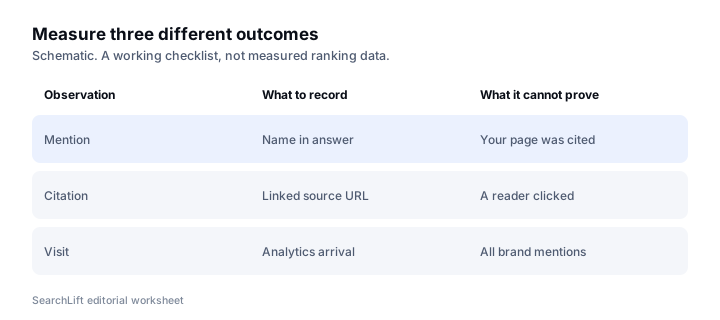
A log should preserve absence as well as success. Keep the same buyer task when comparing runs, and note when location or settings differ. A better result after a rewrite is an observation, not proof of causation: other pages and the search results may have changed too. Do not replace an honest mixed record with the one screenshot that looks best.
SearchLift’s article studio turns content gaps into drafts, while AI visibility tracking records answers and cited sources on a schedule. Automate after the manual record tells you what matters. More observations of a poorly chosen question do not make it a useful business measure.
Common questions
- 01How do I show up in ChatGPT answers?
- Start with a public page that answers a real buyer question using verifiable facts, and check that search crawlers can access it. Then record mentions, citations and accuracy over time. No page checklist guarantees inclusion.
- 02Should I write a new article or update my service page?
- Update the service page when the missing answer describes the offer itself. Write a separate article when the buyer needs a method or explanation that would distract from the service page, and link the two.
- 03Does being mentioned mean ChatGPT cited my website?
- No. An answer can name your business while linking to a directory or another publisher. Save the actual cited URL so you can distinguish a brand mention from a citation to your site.
- 04Can I measure this from website visits alone?
- No. Visits show arrivals, not every answer that named you. Keep an answer log alongside analytics and avoid treating an absence of visits as proof that you were never mentioned.