Search for whether schema markup helps you get cited by AI and you will find a great deal of confidence and very little sourcing. The honest position is more interesting than either the yes or the no, and Google has written it down.
What Google actually wrote
From Google’s AI optimization guide, in a section listing tactics to stop worrying about:
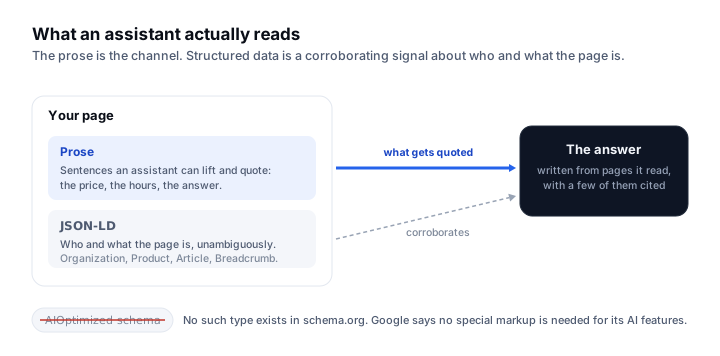
Overfocusing on structured data: Structured data isn’t required for generative AI search, and there’s no special schema.org markup you need to add. However, it’s a good idea to continue using it as part of your overall SEO strategy.
And, separately: “You don’t need to create new machine readable files, AI text files, markup, or Markdown to appear in Google Search (including its generative AI capabilities), as Google Search itself doesn’t use them.”
Read those together and the claim being denied is specific. There is no AIOptimized type, no markup that buys citation. The claim not being denied is that structured data is worthless; Google explicitly says keep using it.
The rule that matters more than the type
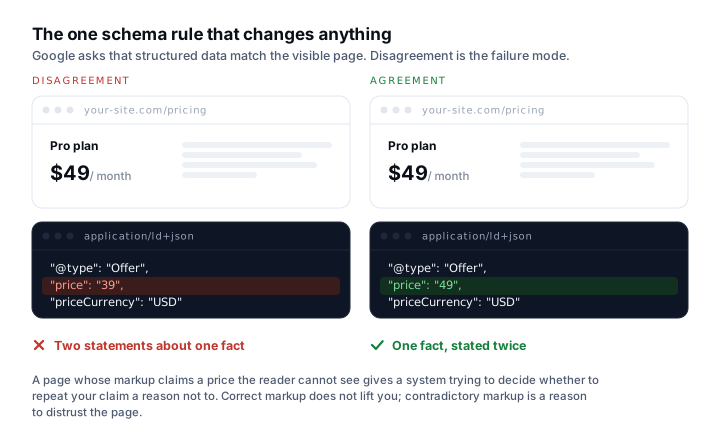
The instruction worth internalising is the one about agreement: make sure your structured data matches the visible content of the page. This is not a formality. A page whose markup claims a price, a rating or an availability the reader cannot see is making two contradictory statements about the same fact, and a system trying to decide whether to repeat your claim now has a reason not to.
That is the practical mechanism by which schema affects AI citation, and it is defensive rather than offensive. Correct, corroborated markup does not lift you. Incorrect markup gives a machine a reason to distrust the page.
| Claim you will read online | Status | What is actually true |
|---|---|---|
| Adding FAQPage schema gets you into AI Overviews | False | Google states no special schema is required. FAQ markup has a narrow, separate rich-result role |
| Schema is how LLMs understand your page | Mostly false | Assistants read the page. Markup is one corroborating signal, not the channel |
| Structured data is pointless now | False | Google explicitly advises continuing to use it as part of ordinary SEO |
| Mismatched markup is harmless | False | Google asks that structured data match visible content. Mismatch is a quality problem, and for some types a manual-action risk |
| More schema types is better | False | Types that do not describe the page add noise and more surface area to contradict yourself on |
What to do instead
- Mark up what the page genuinely is: Organization, Product, Article, BreadcrumbList. Then stop. Accuracy beats coverage.
- Audit for disagreement. Every price, rating, date and availability in your JSON-LD should be visible on the page. This is the check almost nobody runs and the one with a real downside.
- Put the facts in the prose. An assistant quoting you is quoting sentences. A price that exists only in JSON-LD is a price it cannot comfortably repeat.
- Keep the entity consistent. Same organisation name, same URL, same identifiers across every page. This is where structured data genuinely helps a machine resolve who you are.
- Ignore anything selling a schema type as an AI ranking factor. Google named this pattern specifically as a thing to stop doing.
| Type | What it should state | What to check |
|---|---|---|
| Organization | Who you are: name, logo, the profiles that are yours | The same name and URL on every page |
| Product | Name, price, currency, availability | Every value visible on the page, and current |
| Article or BlogPosting | Headline, author, published and modified dates | Dates that match what the page shows |
| BreadcrumbList | Where the page sits in the site | Matches the visible breadcrumb |
| FAQPage | Questions and answers that appear on the page | A narrow rich-result role in ordinary Search; never a question the page does not show |
| LocalBusiness | Address, hours, phone | The same as your listings elsewhere |
SearchLift’s audit checks structured data against the rendered page rather than in isolation, because a valid JSON-LD block that disagrees with the visible text passes every validator and still fails the test that matters. If the page is client-rendered, read what AI crawlers actually see first: markup describing content the fetcher never received is the worst version of this problem. The same principle applies to llms.txt, which Google has also said it ignores.
Common questions
- 01Does schema markup help you get cited in AI search?
- Not directly. Google states that structured data is not required for generative AI search and that there is no special schema.org markup to add. Structured data remains worth maintaining as part of ordinary SEO, and accurate markup that agrees with the visible page avoids giving a machine a reason to distrust your claims.
- 02Does FAQPage schema get me into AI Overviews?
- No. Google says no special schema is needed to appear in its generative AI features. FAQ markup has its own narrow rich-result eligibility in ordinary Search, which is a separate matter.
- 03Should I remove my structured data then?
- No. Google advises continuing to use structured data as part of your overall SEO strategy. The advice is to stop treating it as an AI visibility lever, not to delete it.
- 04What happens if my schema does not match my page?
- Google asks that structured data match the visible content. A mismatch is a quality problem: for some rich-result types it risks a manual action, and more generally it means your page states a fact two different ways, which is a poor position from which to be quoted.
- 05Is there a schema type specifically for AI or LLMs?
- No. No such type exists in schema.org, and Google has explicitly said there is no special markup required for its generative AI features. Anything marketed as AI schema is not a recognised standard.