There are two ways a product gets into ChatGPT shopping, and which one applies to you depends on where you sell. If your store runs on Shopify or Etsy, your catalog is already in. Every other store applies to share a product feed with OpenAI, and that feed has to carry nine required fields. Everything below is read off OpenAI’s own documentation on 22 September 2026 and linked so you can check it.
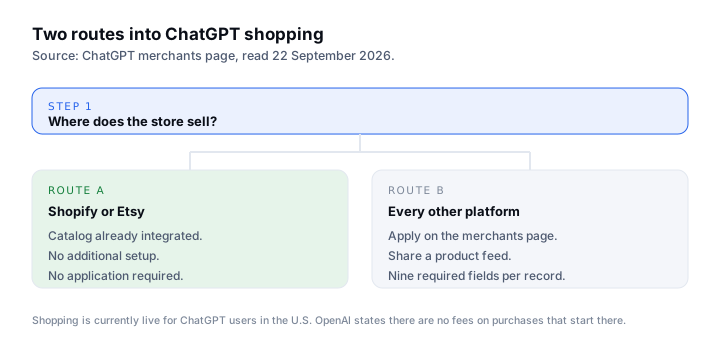
Two routes in, and only one needs an application
The ChatGPT merchants page, read 22 September 2026, says that merchants can apply to share product data and take part in shopping experiences in ChatGPT, including integrating a feed so products can appear in results. The same page says that if you sell through Shopify or Etsy, your catalog is already integrated, and no additional setup or application is required.
That is the whole decision for most small stores. A Shopify merchant has nothing to submit. A WooCommerce, BigCommerce, Magento or custom store has an application to complete and a feed to produce. OpenAI says it supports common formats and integrations, including SFTP, APIs and leading commerce platforms, and that a self-serve merchant portal is planned rather than live.
Two limits matter before you spend a week on this. Shopping is currently live for ChatGPT users in the United States, so a store selling only elsewhere is building for a market the feature does not serve yet. And OpenAI states there are no fees on purchases that start in ChatGPT, so the cost of being there is the engineering, not a commission.
What the product feed spec actually requires
OpenAI publishes a product feed specification. Read on 22 September 2026, it names nine required fields. A record missing any of them is incomplete, so this is the checklist to run your catalog export against before you apply.
| Required field | What it holds |
|---|---|
item_id | Your stable identifier for the item. It is the key everything else hangs off |
title | The product name as a shopper would recognize it |
description | What the product is and what it does |
url | The product page. The spec asks you to keep it stable |
brand | The brand the product is sold under |
seller_name | Who is selling it, which is not always the brand |
image_url | The product image |
availability | Whether it can be bought right now |
price | The current price |
The spec also lists recommended fields that carry variant and attribute detail: group_id, listing_has_variations, variant_dict, condition, product_category, color, size and gtin. These are not optional in practice if you sell anything with sizes or colors, because a feed that collapses six variants into one record cannot answer a question about the one variant a shopper wants.
On format, the spec accepts JSONL in OpenAI’s own format, and a Google-compatible format as tab-delimited .txt or .tsv, or comma-delimited .csv, with gzip compression supported. If you already produce a Google Merchant Center feed, the second route is the shorter one. Two flags govern eligibility: is_eligible_search defaults to true, and setting it to false disables both search and checkout eligibility.
{"item_id":"SKU-1182","title":"Merino base layer, long sleeve","description":"A 190gsm merino wool base layer for cold weather running.","url":"https://example.com/products/merino-base-layer","brand":"Example Wool Co","seller_name":"Example Wool Co","image_url":"https://example.com/img/sku-1182.jpg","availability":"in_stock","price":"89.00 USD","group_id":"BASE-LAYER-LS","color":"Charcoal","size":"M","gtin":"00012345678905"}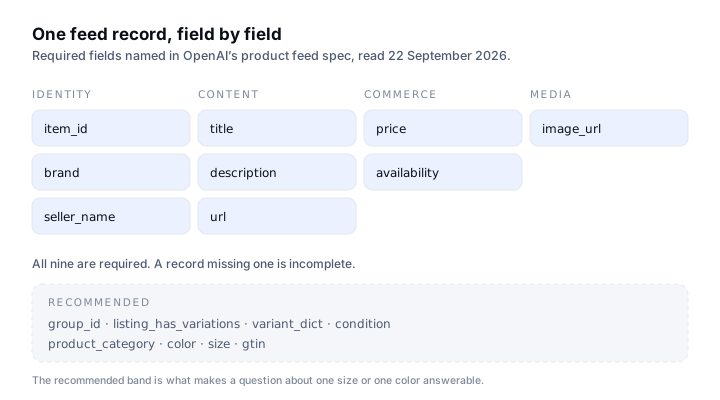
What OpenAI says decides which product appears
This is where most advice becomes invention, so it is worth staying with the documentation. OpenAI’s shopping help article, read 22 September 2026, says a product appears in the carousel when ChatGPT perceives it to be relevant to the user’s intent, judged against the query and context such as memory or custom instructions, and considering price, reviews and ease of use.
Product results are selected independently by ChatGPT and are not ads, nor influenced by any OpenAI partnerships. Ads are separate from product results.
The same article says merchants appear based on factors including availability, price, quality, and whether they are the maker or primary seller of that item. That last clause is the one resellers should read twice. If you are the fifth store listing someone else’s product at a similar price, the documentation tells you plainly that being the primary seller is a factor working against you.
It also names the data sources: structured metadata from first-party and third-party providers, Shopify Catalog for Shopify merchants, and a direct feed from the merchant to keep information current. A direct feed is described as the way to ensure ChatGPT reflects the most up-to-date information, which is an accuracy argument rather than a ranking promise.
The product page still has to stand up on its own
A feed is a second copy of your catalog, not a replacement for the page it points at. The url field sends a shopper, and an assistant, to a live page, and OpenAI’s agentic commerce key concepts, read 22 September 2026, describes recommended attributes such as rich media, reviews and performance signals as improving ranking, relevance and user trust inside the shopping experience. A thin page undercuts a good feed record.
- Price and availability agree. The feed and the page should say the same thing at the same moment. The spec asks you to update current prices and availability when they change.
- The URL is stable. The spec asks you to keep product URLs stable. A store that rewrites its product paths at every redesign breaks its own feed.
- Variants are real pages or real records. If a shopper asks for a medium in charcoal, something in your data has to hold that answer.
- You are identifiable as the seller.
brandandseller_nameare separate fields for a reason.
Product structured data is the other half of this, and it is a separate question from the feed: it is what a crawler reads off the page rather than what you submit. The evidence for what it does in AI answers is narrower than most guides suggest, which is covered in whether schema markup helps you get cited. For a field-by-field check of the page, Google feed and markup, use the one-product ecommerce AI SEO audit. One practical note for Shopify stores: the platform does not expose structured data for editing through its Admin API, so that work stays in the theme.
How to check whether ChatGPT names your products today
Before changing anything, get a baseline. Ask the assistants the question a shopper would ask, in the shopper’s words, without your brand name in it: the category, the constraint and the budget. Save the date, the prompt, the answer, whether your store was named, and which URLs were cited. The method, and the reasons a single check misleads, are in how to check what ChatGPT, Claude and Gemini say about your business.
Run the same prompts again after the feed goes in. A change is an observation, not proof: your competitors, your prices and the assistants all move between runs. Keep the record honest about the runs where nothing improved, because those are the ones that tell you the feed was not the constraint.
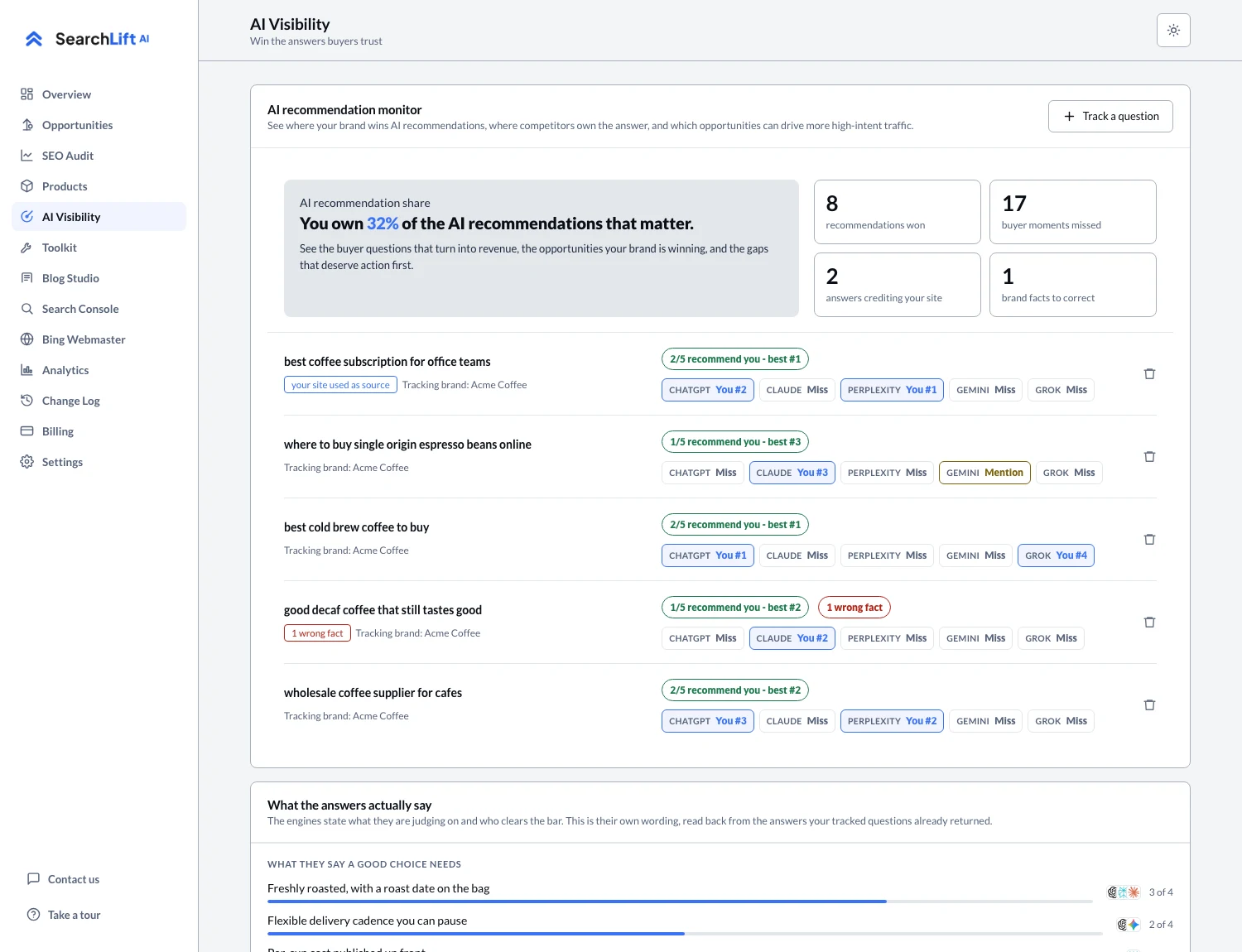
Where SearchLift automates this: AI visibility tracking puts the same buyer questions to ChatGPT, Claude, Perplexity, Gemini and Grok on a schedule and records what came back, and the Shopify app audits products from the live storefront and writes product titles and descriptions through Shopify’s Admin API.
Common questions
- 01How do I get my products into ChatGPT shopping?
- If you sell on Shopify or Etsy, your catalog is already integrated and there is nothing to submit. Every other store applies through the ChatGPT merchants page to share a product feed carrying the nine fields OpenAI’s feed spec requires.
- 02What fields does the ChatGPT product feed require?
- Nine: item_id, title, description, url, brand, seller_name, image_url, availability and price. Variant and attribute fields such as group_id, condition, product_category, color, size and gtin are recommended rather than required.
- 03Can I pay to rank higher in ChatGPT shopping?
- OpenAI states that product results are selected independently by ChatGPT, are not ads, and are not influenced by OpenAI partnerships, and that ads are separate from product results. No documented paid route into the product carousel exists.
- 04Do I need Instant Checkout to appear in shopping results?
- No. OpenAI describes building with the Agentic Commerce Protocol as open to all, while Instant Checkout in ChatGPT is currently available to approved partners. Appearing in results and selling through Instant Checkout are separate steps.
- 05Does this work outside the United States?
- Not yet. The ChatGPT merchants page says shopping is currently live for ChatGPT users in the U.S. A store selling only into other markets can prepare a feed, but the shopping surface does not serve those buyers today.