






This AI SEO guide shows the owner of a business website how to be named when a customer asks ChatGPT, Claude, Perplexity, Gemini or Grok for a recommendation. The same work is also called generative engine optimization (GEO). It has six steps, and the first two take an afternoon.
More customers now ask an AI assistant where to buy. In BrightLocal’s Local Consumer Review Survey 2026, the share of consumers who use ChatGPT and similar tools for local business recommendations rose from 6% to 45% in one year. For the background on the term, read what AI SEO and GEO mean.
What AI SEO and GEO mean, and what Google says
The term comes from a research paper, “GEO: Generative Engine Optimization”, published at KDD 2024. Its authors tested edits to web pages against a benchmark of queries and reported that the right edits “can boost visibility by up to 40% in generative engine responses”, and that the effect “varies across domains”.
Google has published its own view. Its guide to generative AI features in Search, last updated 10 July 2026, treats GEO as part of SEO.
From Google Search’s perspective, optimizing for generative AI search is optimizing for the search experience, and thus still SEO.
Google’s guide covers AI Overviews and AI Mode, which draw on its search index. ChatGPT, Claude, Perplexity and Grok run their own crawlers and their own retrieval. An AI SEO plan needs to cover all of them, so the steps below start with access.
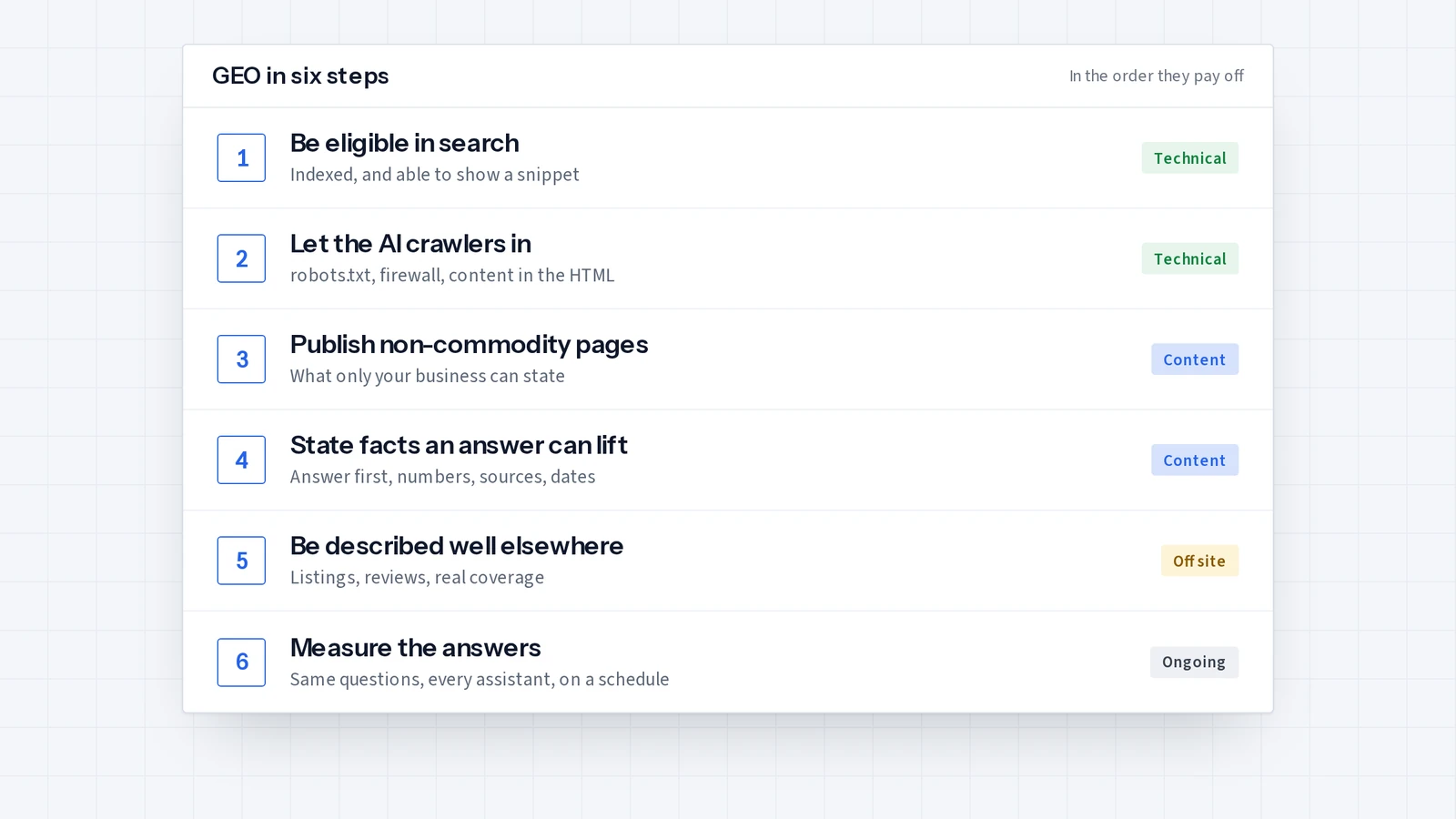
The AI SEO guide in six steps
- 01Be eligible in search. Get the pages you care about indexed and able to show a snippet. Google states that a page must meet this bar to appear in its generative AI features.
- 02Let the AI crawlers in. Check robots.txt and your firewall for the assistants’ own crawlers, and make sure the main content is in the HTML they receive.
- 03Publish non-commodity pages. Write from what your business knows first hand: prices, process, results, comparisons you can defend.
- 04State facts an answer can lift. Put the direct answer first, then numbers, named sources and dated statements.
- 05Be described well on other sites. Keep listings, review profiles and directory entries accurate, and earn real coverage.
- 06Measure the answers on a schedule. Track a fixed set of buyer questions across the assistants, and read Google’s Generative AI performance report.
Steps 1 and 2: can the assistants reach your pages?
Start in Search Console. Google says that “to be eligible to be shown in generative AI features on Google Search, a page must be indexed and eligible to be shown in Google Search with a snippet”. Check that each page you care about is indexed and has no nosnippet rule.
Next, check the crawlers that belong to the other assistants. OpenAI documents the three that matter here: OAI-SearchBot for ChatGPT search, GPTBot for training and ChatGPT-User for visits a user triggers. Anthropic and Perplexity publish their own lists. A blanket bot rule or a security plugin can block all of them by accident. The full list, with a robots.txt you can copy, is in AI crawlers and robots.txt.
- Indexed and snippet-eligible. URL Inspection in Search Console shows both.
- Not blocked. Read robots.txt for the tokens above, and ask your host whether a firewall rule challenges them.
- Content in the HTML. If the page builds itself in the browser, check what a crawler receives.
- One clear version. Fix duplicates and broken canonicals so the page an assistant reads is the page you maintain.
Steps 3 and 4: write the page an assistant can quote
What AI search actually cites
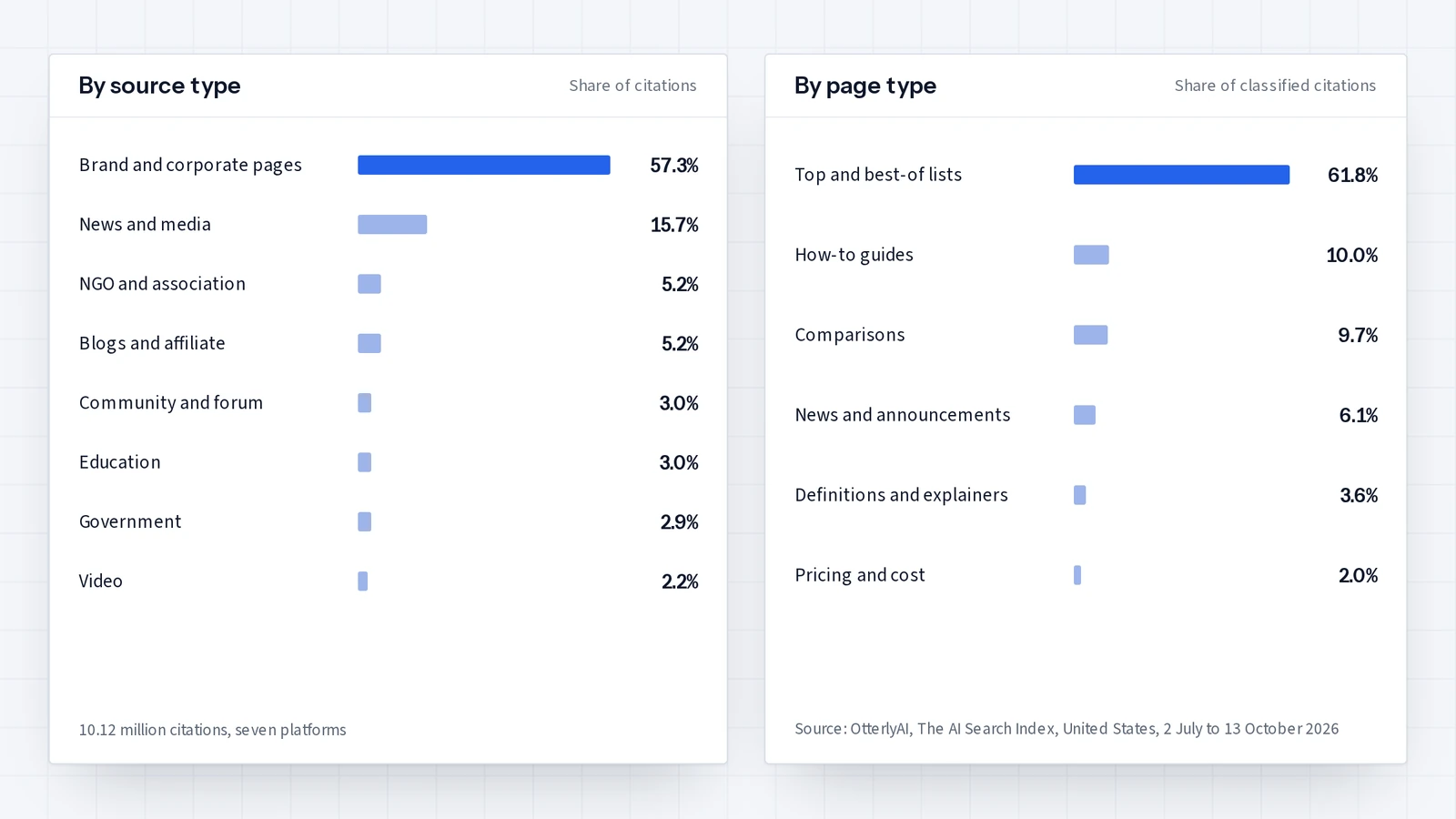
OtterlyAI’s AI Search Index is the largest public dataset on this question. It covers 10.12 million citations from 1,750 prompts, run daily on seven AI search platforms across 17 US industries from 2 July to 13 October 2026.
More than half of all citations (57.3%) go to pages a company publishes on its own site. Your own pages are where most of the work pays off. The index also found that each assistant cites a different set of sites, with very little overlap between them.
| Platform | Most cited domain | Share of that platform’s citations |
|---|---|---|
| ChatGPT | reddit.com | 1.92% |
| Claude | en.wikipedia.org | 1.40% |
| Perplexity | reddit.com | 1.95% |
| Google AI Overviews | youtube.com | 7.03% |
| Google AI Mode | youtube.com | 4.99% |
| Microsoft Copilot | amazon.com | 2.64% |
One note on the page-type figures. In this dataset, 82.3% of the prompts carry commercial intent and about two thirds are “best of” questions, so list pages lead. For a business the lesson is simple. When a buyer asks a comparison question, the answer draws on comparison, list, how-to and pricing pages, so publish those pages for your own product.
What to put on the page
Google’s guide explains the kind of content that earns a place in an AI answer with two examples. “7 Tips for First-Time Homebuyers” is commodity content that anyone could write. “Why We Waived the Inspection & Saved Money: A Look Inside the Sewer Line” is first-hand experience. Assistants already hold the common knowledge, so give them what your business knows first hand.
The KDD 2024 study found the same thing about form. Pages gained visibility in generated answers when they added quotations, statistics and citations. Keyword stuffing gave no gain. In practice:
- Answer first. The opening paragraph answers the question in the title, in plain words.
- Numbers with a source and a date. A price, a turnaround time, a measured result. “Read on 16 November 2026” is a sentence an answer can trust.
- One page per buyer question. Pricing, a comparison with the alternatives, how it works, who it is for.
- Name things exactly. Product names, plan names, locations and limits, the same way everywhere.
- Keep it current. Update the page when the fact changes and show the date.
Step 5, and the tactics you can skip
Assistants also cite other sites. News and media took 15.7% of citations in the same index, and forums and communities took 3.0%. Keep your Google Business Profile, review profiles and directory listings accurate, and earn coverage with something worth covering. Google advises against shortcuts: “seeking inauthentic ‘mentions’ across the web isn’t as helpful as it might seem”.
| Tactic | What Google’s guide says | What to do |
|---|---|---|
| llms.txt files | “Google Search ignores them.” Creating one will “neither harm nor help” visibility in Google Search. | Optional. Other services may read it. |
| “Chunking” content | “There’s no requirement to break your content into tiny pieces.” | Write for readers, with clear headings. |
| Rewriting for AI | “You don’t need to write in a specific way just for generative AI search.” | Keep one good page per question. |
| A page per query variation | Doing this to manipulate rankings or AI responses violates the scaled content abuse policy. | Do not mass-produce variations. |
| Extra structured data | “Structured data isn’t required for generative AI search.” | Keep the markup that earns rich results. |
Step 6: measure whether the assistants name you
For Google, use the Generative AI performance report in Search Console. It shows impressions in AI Overviews and AI Mode by page, country, date and device. Google’s guide adds: “No third-party tool has access to our internal ranking or AI systems.”
The other assistants have no console, so you measure the answers themselves. Pick the questions a buyer would ask, in their words. Ask the same questions on a schedule, on each assistant. Record whether you are named, what is said and which pages are cited. Answers vary from run to run, so repeat the check before you draw a conclusion. The manual method is in how to check what ChatGPT says about your business.
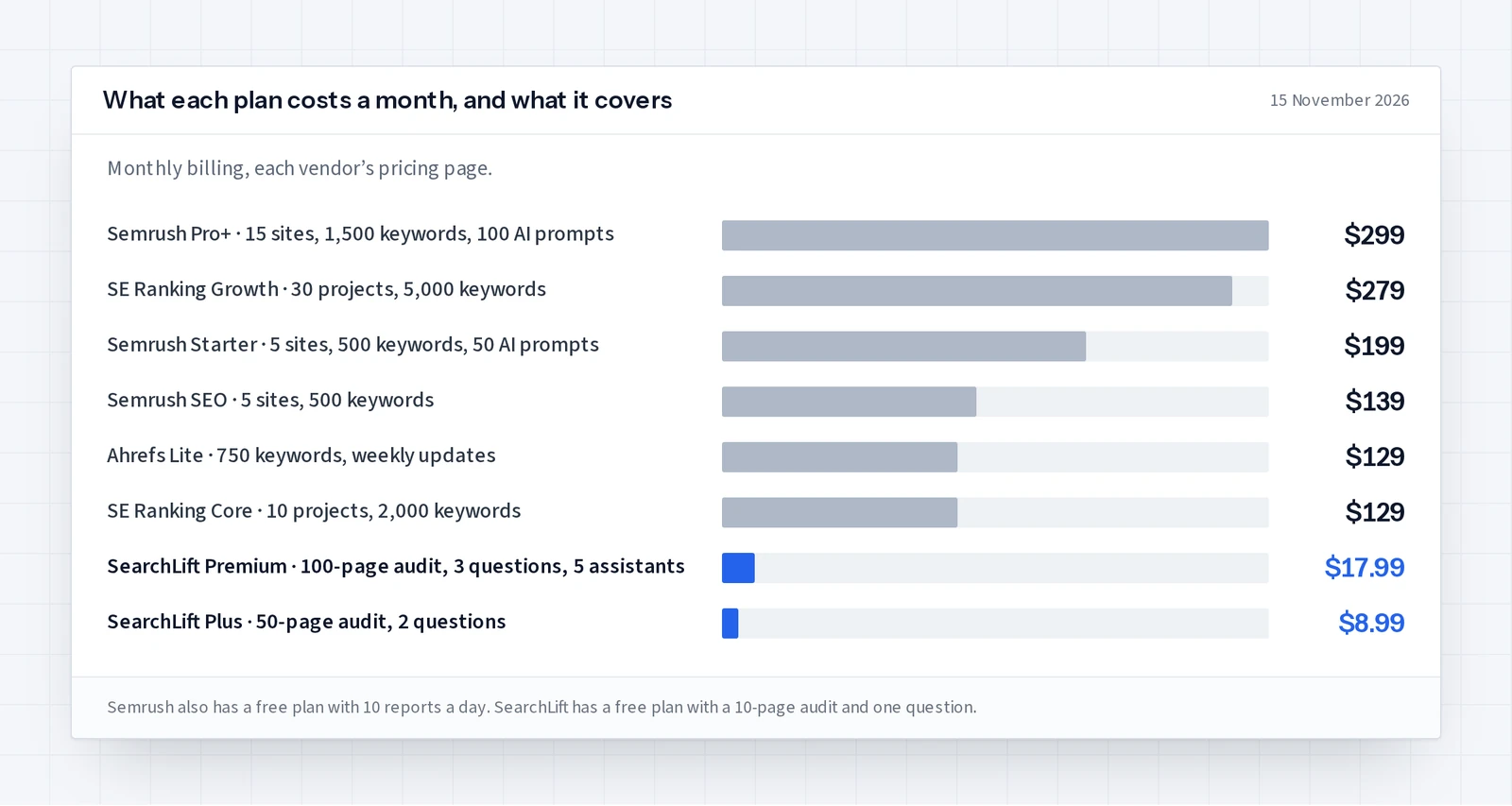
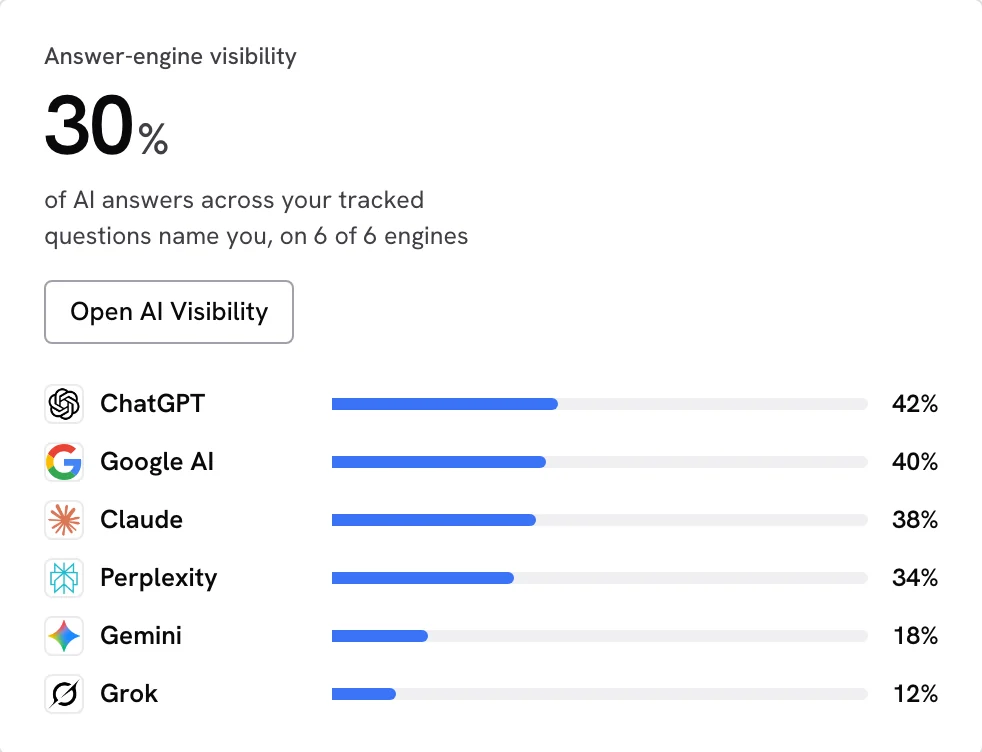
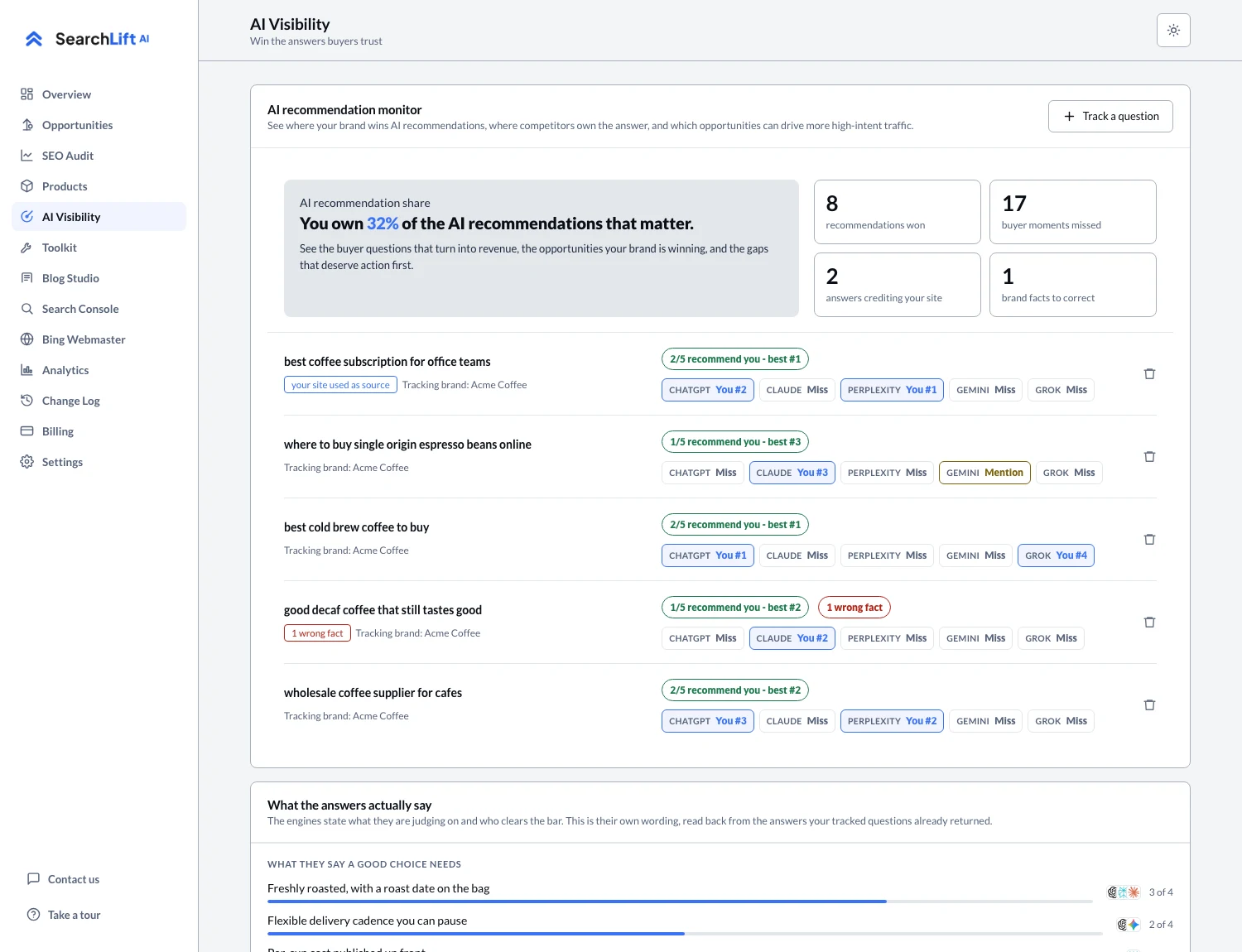
SearchLift does this for you. AI visibility tracking asks your questions on ChatGPT, Claude, Perplexity, Gemini and Grok on a schedule and keeps each answer with its cited sources. The AI SEO audit finds the page problems from steps 1 to 4 and applies the fixes you approve. The free plan includes an audit and one tracked question.
Common questions
- 01What is an AI SEO guide, and is it the same as a GEO guide?
- An AI SEO guide is a method for making a business more likely to be named and cited in AI-written answers. The same work is called generative engine optimization, or GEO. This one has six steps: be eligible in search, let AI crawlers in, publish non-commodity pages, state quotable facts, be described well on other sites, and measure the answers on a schedule.
- 02Is GEO different from SEO?
- Google says optimizing for its generative AI features is “still SEO”, because those features draw on its search index. ChatGPT, Claude, Perplexity and Grok use their own crawlers and cite different sources, so GEO adds two jobs to SEO: giving those crawlers access and measuring their answers.
- 03How long does GEO take to work?
- No reliable figure has been published. Access fixes take effect the next time a crawler reads the page. After that, results depend on the question and on what else is published, so measure on a schedule.
- 04Do I need an llms.txt file for GEO?
- Google’s guide says Google Search ignores llms.txt and that the file neither helps nor harms visibility there. Other services may read one, so it is optional.
- 05Which pages should I write first?
- The ones a buyer’s question needs: pricing, a comparison with your alternatives, how the product or service works, and who it suits. In OtterlyAI’s index of 10.12 million citations, list, how-to and comparison pages made up most of the cited page types on commercial prompts.
- 06How do I know whether ChatGPT mentions my business?
- Ask it the questions your buyers ask, more than once, and record the answers and cited sources. Repeat on a schedule and on the other assistants. SearchLift’s AI visibility tracking does this on ChatGPT, Claude, Perplexity, Gemini and Grok.