



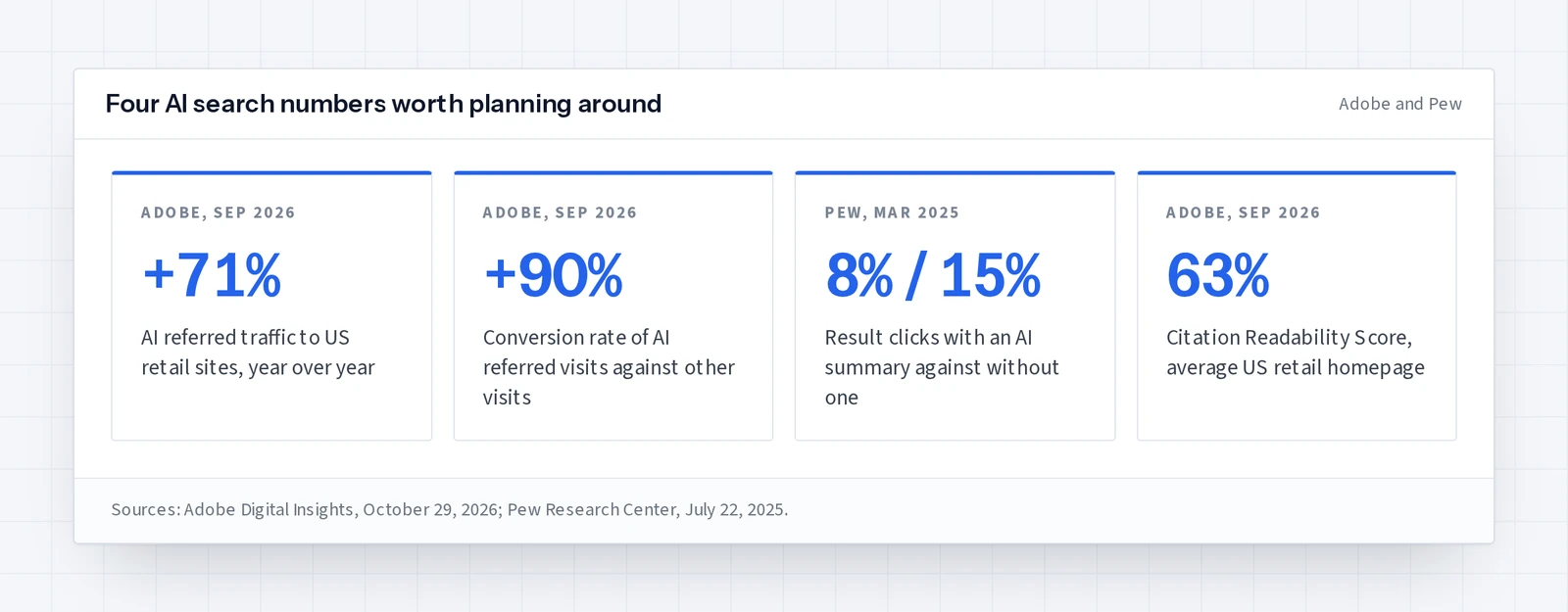
AI search statistics going into 2027 make a practical case for measuring how buyers find you through AI answers. Google reports more than 2.5 billion monthly active users for AI Overviews and more than one billion for AI Mode. Adobe found that visitors referred by AI to US retail sites in September converted 90% better than other visitors. Those are different measurements from different populations. Together, they tell a business owner to make AI discovery measurable rather than leave it to chance.
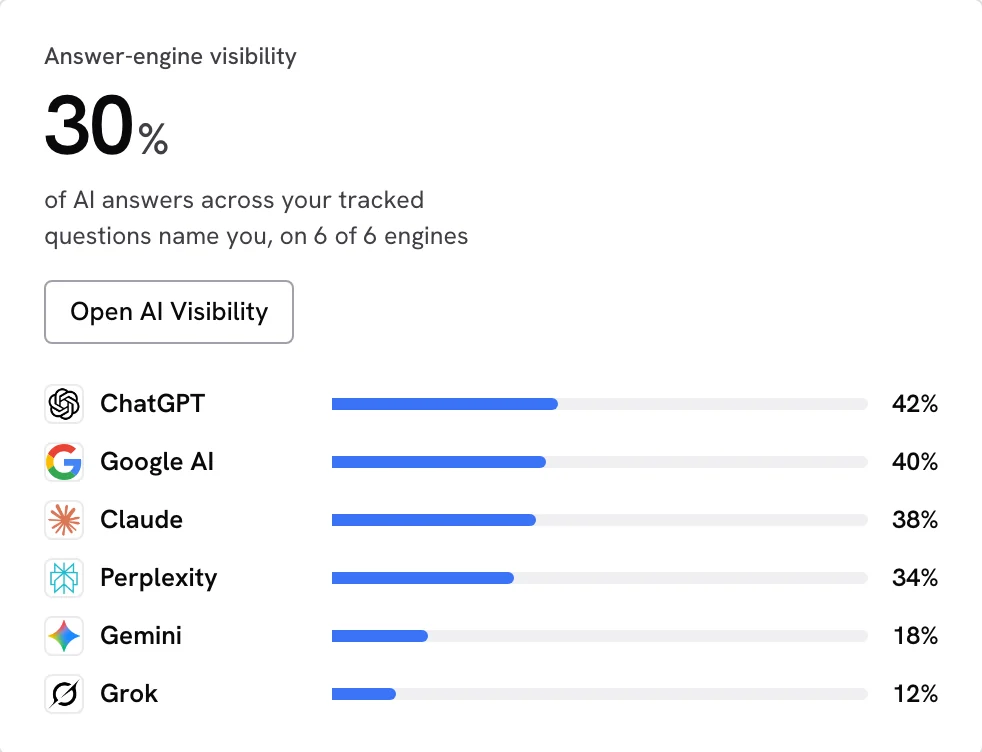
The useful starting question is simple: when a buyer asks ChatGPT, Claude, Perplexity, Gemini or Grok for a product like yours, does your brand appear, which page gets cited and what happens after a visitor arrives? An AI visibility tool can save the answer and cited sources. Your analytics and Google Search Console can tell you what happened on the site and in Google Search.
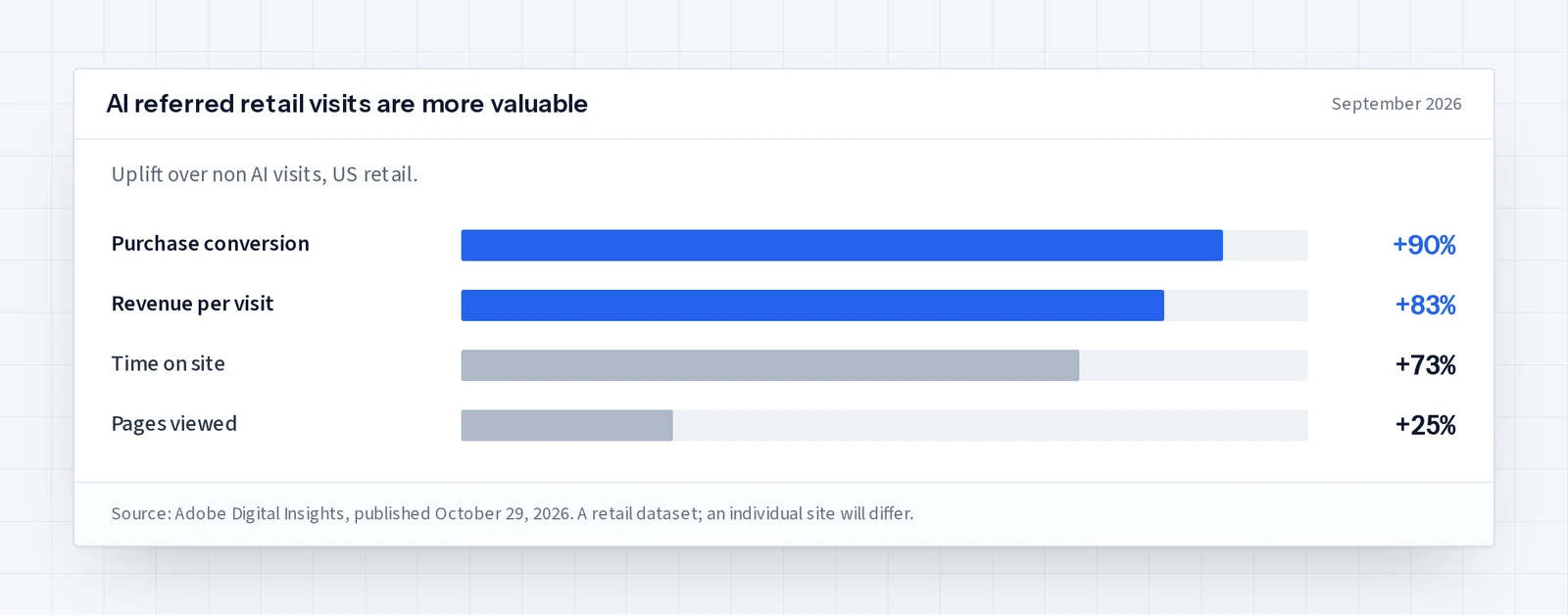
Source: Adobe Digital Insights, published October 29, 2026. The figures compare visits referred by AI with visits referred by other sources to the US retailers in its dataset.
AI search statistics show a larger discovery surface
Google’s June 2026 website-owner update, revised in August, reports more than 2.5 billion monthly active users for AI Overviews and more than one billion for AI Mode. These are feature audience counts, not visits to any particular website. They show why a search strategy now needs to account for answers that place links beside a generated explanation.
The same Google update says website owners can see AI feature impressions and page and country information in Search Console as its new reporting rolls out. Start there if your property has the report. Keep ordinary query and page performance beside it. A rise in AI feature impressions is useful, but the page that earned the exposure and the buyer question behind it matter more for deciding what to improve.
Google’s AI features guidance says its established SEO best practices still apply to AI Overviews and AI Mode. That puts crawl access, indexable pages, clear product information and useful answers ahead of a special file or a new acronym. SearchLift’s AI SEO audit helps find page issues that make those fundamentals harder to deliver.
What happens when an AI summary appears above search results?
Pew Research Center studied the browsing activity of 900 US adults in March 2025. On Google search pages with an AI summary, users clicked a traditional result in 8% of visits. On pages without a summary, they did so in 15% of visits. This is observed behaviour in one sample, and it makes the result page itself an important place to earn attention.
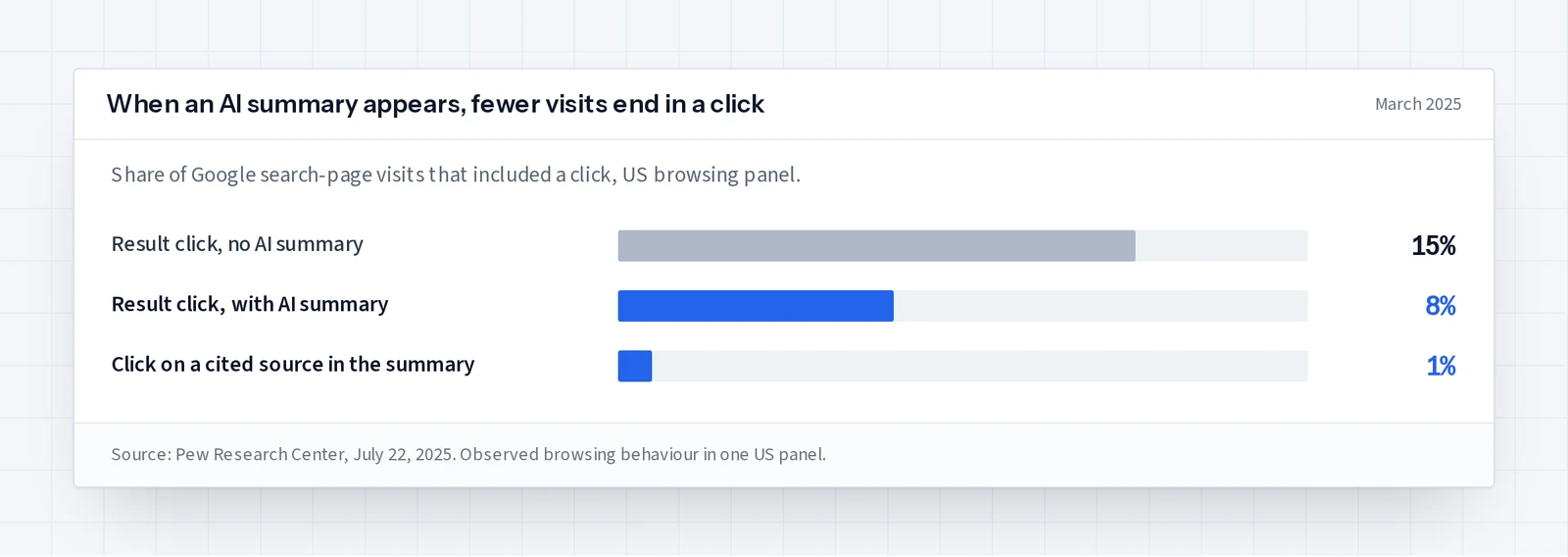
Source: Pew Research Center, July 22, 2025. Pew also found that 1% of visits to pages with an AI summary included a click on a link inside that summary, and that browsing sessions ended on 26% of pages carrying a summary against 16% of pages without one. A citation can still be valuable for awareness and later visits, but the click itself is a small share of the observed searches.
For a buyer-focused site, this changes the brief for a landing page. Make the product name, use case, key limits and next step easy to extract from the page. Then check the exact question in the assistant you care about. If a competitor is cited for a question that your page answers, inspect the competitor source and improve the missing detail on your own page. SearchLift keeps those answer and citation records in AI visibility tracking so that a page update starts with a real example.
Which searches actually produce an AI summary
The same Pew study measured when summaries appear, and the pattern is useful for planning pages. Short searches rarely triggered one: 8% of searches of one or two words produced a summary. Long and question-shaped searches did so far more often, which is exactly the language a buyer uses when comparing options rather than looking up a brand they already know.
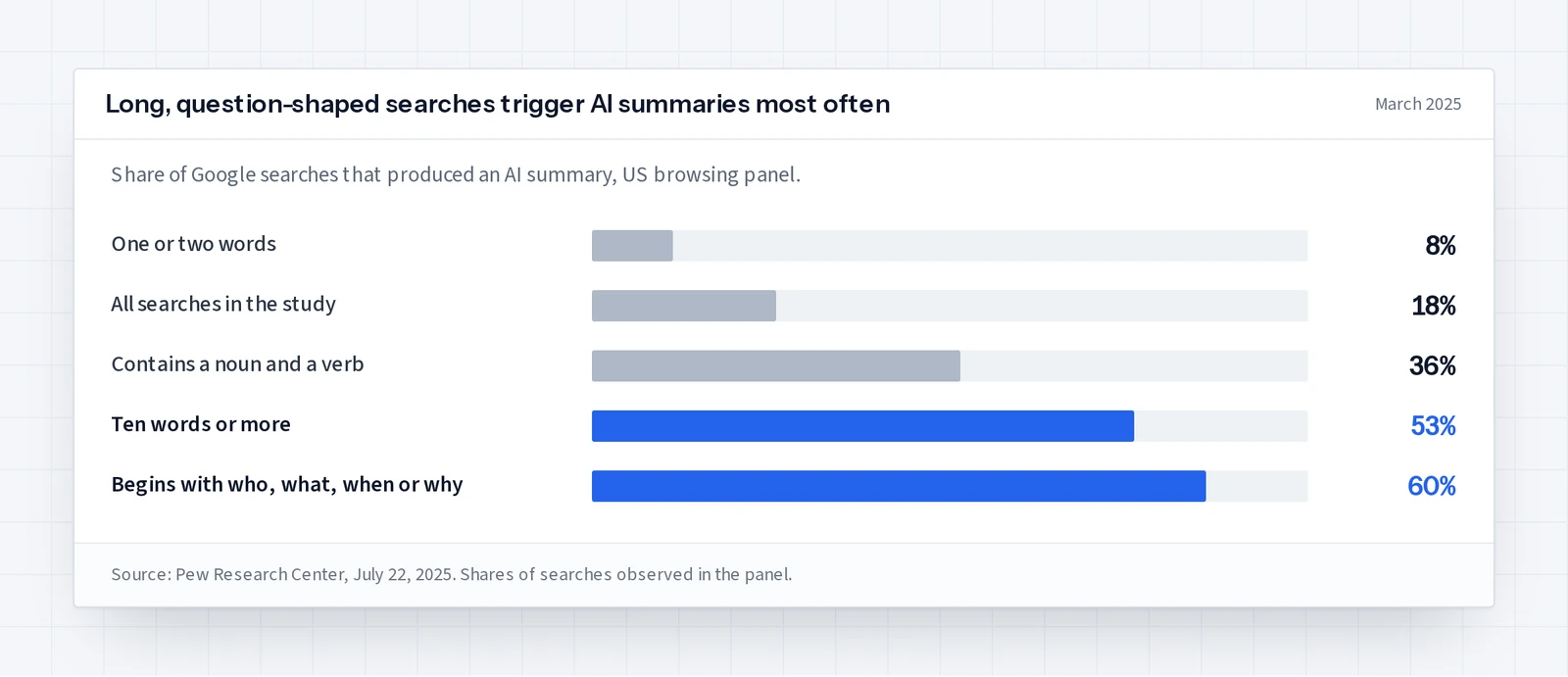
Source: Pew Research Center, July 22, 2025. Across the whole panel, 18% of Google searches produced an AI summary, and 88% of those summaries cited three or more sources. The median summary ran to 67 words.
That makes the practical brief concrete. Write the page so a specific question is answered in the first screen, in a sentence a machine can lift without the surrounding paragraph. Keep the product name, the use case, the constraint and the price path near that answer. This is the part of artificial intelligence search engine optimization that pays for itself quickly, because the same clarity also helps the human who lands on the page.
AI referred retail visits are becoming more valuable
Adobe Digital Insights reported on October 29, 2026 that AI referred traffic to US retail sites grew 71% year over year in September. Its analysis covers transactions across more than one trillion visits to US retail sites, 100 million products and 18 product categories. Adobe defines an AI visit as a user clicking through from an AI source. The report is about retail, so use it as a market signal if you sell another kind of service.
| September 2026 US retail measure | AI referred visits compared with non AI visits |
|---|---|
| Conversion to purchase | 90% higher |
| Revenue per visit | 83% higher |
| Time on site | 73% higher |
| Pages viewed per visit | 25% higher |
| Add to cart rate | 53% higher |
Figures from Adobe Digital Insights, October 29, 2026.
Read the full Adobe retail analysis for its product-category scope and month-by-month context. A useful internal follow-up is to segment your own AI referral traffic by landing page and completed action. Compare product enquiry pages with product enquiry pages, and keep organic search, email and social visits in separate groups.
What makes this worth acting on now is how fast it turned. Adobe reports that in August 2025, AI referred traffic converted 9% worse than other traffic. Thirteen months later the same measure was 90% better. In its words, AI traffic has gone from being worth less than half of a typical visit to nearly twice as much. Adobe also forecasts AI traffic rising 159% year over year on Thanksgiving, 95% on Black Friday and 88% on Cyber Monday.
The visit quality matters because it changes what to inspect first. If a buyer arrives after an assistant has compared options, a vague homepage forces them to repeat that research. A product page with the actual specifications, use cases, setup steps and pricing path lets them continue.
Most pages are only half readable to the systems doing the recommending
Adobe’s Citation Readability Score measures how much of a page an AI system can understand and cite. The average US retail homepage scored 63% in September 2026, meaning more than a third of homepage content was not visible to the systems sending those valuable visitors. The spread by category is the more useful part of the finding.
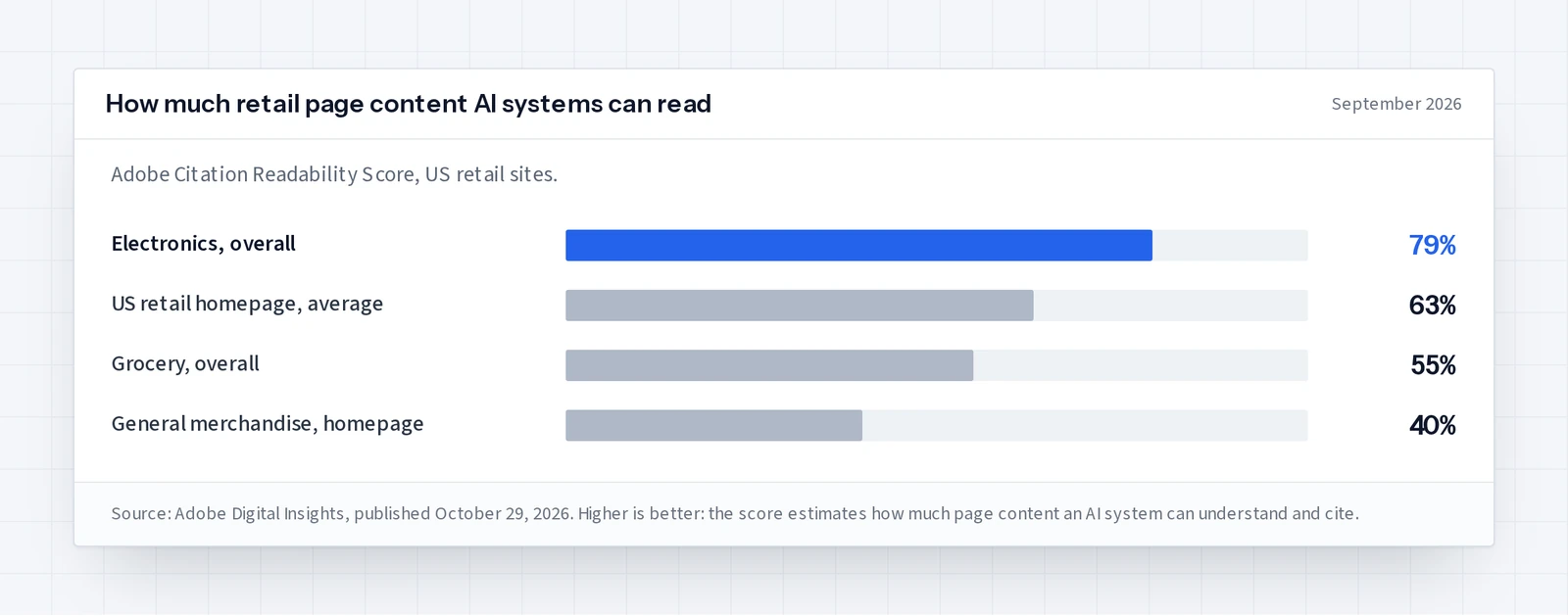
Source: Adobe Digital Insights, October 29, 2026. Electronics led all categories at 79%, carried by category pages at 79% and customer service pages at 78%. General merchandise homepages scored 40%, where Adobe attributes the gap to navigation-heavy promotional layouts that give an AI system little to work with.
Read that as a content brief rather than a score to chase. The pages that answer a question, product detail, buying guides, FAQs and return policies, are the ones Adobe found AI can find, understand and recommend. Among the best AI SEO tools, the ones worth paying for are those that tell you which of your pages fail that test and prepare the fix, rather than only reporting a number.
An AI SEO tool should connect visibility to a page action
A useful AI SEO tool keeps three records together: the buyer question, the answer and source URLs, and the page you can improve. Start with unbranded questions that mention a category and a real constraint. For a retailer, that might be a size, delivery area or compatibility requirement. For a service business, it might be location, timeframe or expertise. Keep each question unchanged between checks so a later answer can be compared with the earlier one.
SearchLift saves tracked assistant answers, brand mentions, positions and citations in its AI visibility screen. Its Search Console suite shows the Google queries and pages already earning attention, while the audit prepares page fixes for approval. Use the shared evidence to pick one commercial page at a time. This turns a visibility report into a content or technical task your team can finish.
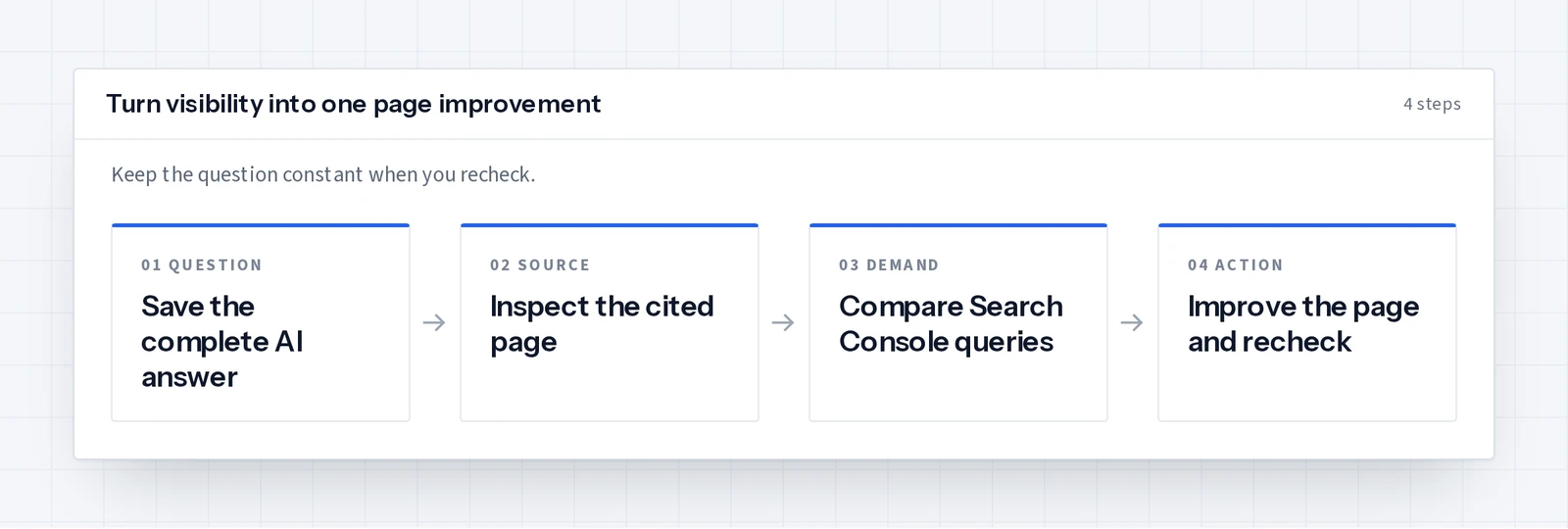
The measurement loop works best when a team owns the follow-up. Give the marketing lead the buyer question and its saved answer. Give the page owner the missing fact, title or link. Recheck after the update has been crawled and after enough visits have accumulated to make the analytics useful. Keep a short change log next to the answer history so a later improvement has a traceable cause.
Measure the result with four separate numbers
Track AI visibility by assistant and question. Track AI referral visits and outcomes in your analytics. Track Google Search impressions and clicks in Search Console. Track whether the page issue you selected was actually fixed. Each number describes a different stage, so do not turn them into one score. If the answer names you but no one visits, read the answer and citation. If visits arrive but do not convert, inspect the landing page and the next step it offers.
- AI answer presence: Which saved buyer questions name your brand, and which sources appear beside it?
- Referral visits: Which AI sources sent visitors to which landing pages?
- Google demand: Which related queries and pages already earn impressions or clicks?
- Completed fixes: Which page changed, when, and what does the next check show?
For a tool selection workflow, see our AI visibility monitoring and SEO automation comparison. To see the specific checks behind the work, use the AI SEO audit guide. SearchLift can bring the visibility record, search demand and page task into one working view, then let you review a prepared fix before it goes live.
A weekly scorecard your team can actually keep
| Question | What to record | What it changes |
|---|---|---|
| Are we named for buyer questions? | The same unbranded questions, assistant, country and date | Shows where a product page needs a clearer answer |
| Which pages are cited? | Your cited URL and the other cited sources | Shows where product proof and page detail can improve |
| Do visitors continue to the site? | AI referral landing page, visit and enquiry in analytics | Shows whether the cited page gives buyers a useful next step |
| Are Google queries moving? | Search Console query, page, clicks and impressions | Shows whether the page also serves established search demand |
For a quick first scorecard, use five buyer questions and one commercial page. Save the raw answer as well as the brand mention, because the surrounding sentence often explains why a buyer would choose a result. Add the cited URL even when it belongs to another site. Then review the page with the SearchLift audit and confirm that the answer, page title and call to action all describe the same offer.
Start with the page a buyer would actually choose
Pick a product or service page that matters to revenue. Write five unbranded buyer questions about that page, with the market and constraints your customers use. Track the answers, inspect the cited URLs, and compare the Google queries the page already receives. Then fix the most concrete gap: a missing answer, unclear detail, inaccessible content, weak title or absent internal link. Recheck the same questions after the page is live.
The same figures are set out as charts in our report on AI search in retail.
Common questions
- 01What do AI search statistics say about business traffic going into 2027?
- Adobe found that AI referred visits to US retail sites grew 71% year over year in September 2026. Those visits converted 90% better and generated 83% higher revenue per visit than non AI visits in its retail dataset.
- 02How can I see whether ChatGPT recommends my business?
- Track a consistent, unbranded buyer question and save the full answer, date, brand mention and source URLs. SearchLift’s AI visibility screen keeps those records together across supported assistants.
- 03Is an AI SEO tool different from a normal SEO tool?
- An AI SEO tool can connect traditional page and Search Console work with saved assistant answers and citations. SearchLift uses those signals to help you select a page issue, prepare a fix and compare later checks.
- 04Do AI Overviews need special optimization?
- Google Search Central says its established SEO best practices remain relevant for AI Overviews and AI Mode, with no additional technical requirements to appear. Make important pages accessible, useful and easy to understand.
- 05Which searches are most likely to show an AI summary?
- Long, question-shaped searches. Pew found that 60% of searches beginning with a question word and 53% of searches of ten words or more produced an AI summary, against 8% of one or two word searches. Those long searches are the ones buyers type while they are still choosing.
- 06What are the best AI SEO tools supposed to do?
- Connect three records that usually sit apart: the buyer question and the assistant’s answer, the page that was cited, and the Google demand that page already has. SearchLift keeps those together and prepares a reviewable page fix from them, so a visibility report becomes a task rather than a number.