






Useful SEO statistics put a number beside a decision: whether to improve a page, how long to observe it and which search results to compare. Start with the benchmarks below, then open the pages that sell your service. A large industry sample can set expectations; your own query and page data tells you where to spend the next hour.
The SEO statistics worth keeping beside your plan
Three useful questions organize this overview: how many sampled pages receive search traffic, how often new URLs reach the first page, and how old ranking pages are. These are historical observations with different populations. Keep them in separate columns when discussing a content plan with your team.
| Question | Population | Publication |
|---|---|---|
| Traffic distribution | About 14 billion Content Explorer pages | Ahrefs, December 1, 2023 |
| New URLs reaching the top 10 | Two separate cohorts: 1 million and 2 million URLs | Ahrefs, May 15, 2025 |
| Age of top-10 pages | Results for 1.3 million US keywords | Ahrefs, May 15, 2025 |
For a small team, the practical comparison starts with capacity. List the pages you can improve this month and the missing customer question each one could answer. A service page with an unclear booking process needs different work from a useful guide that buyers cannot find. Give each proposed edit a reason before assigning a target number of articles.
Most sampled pages received no estimated Google traffic
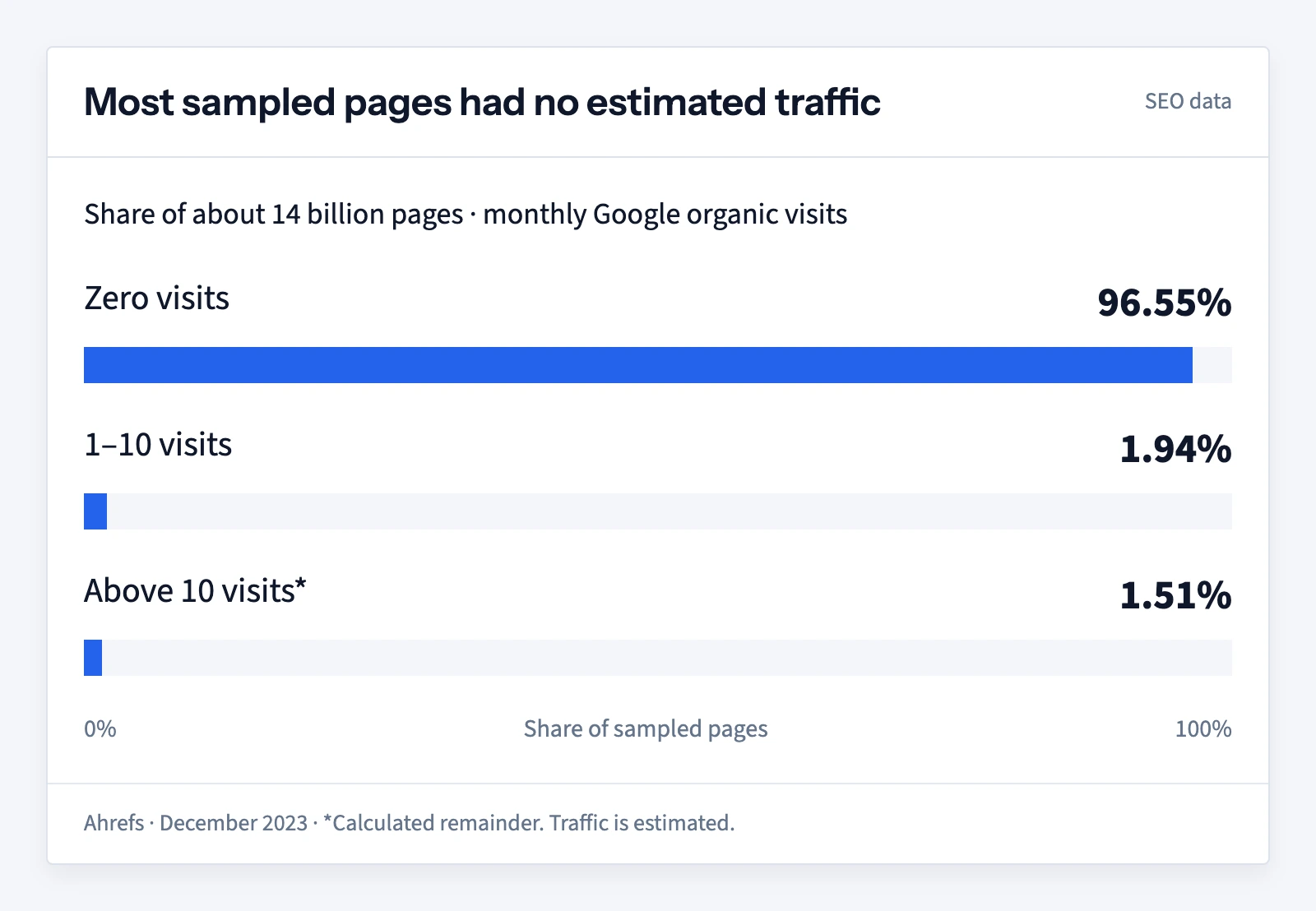
In Ahrefs’ December 2023 traffic study, 96.55% of sampled pages had zero estimated monthly Google organic traffic; 1.94% had one to ten visits. The remaining 1.51% is calculated by subtraction. The sample came from Content Explorer and the traffic figures were estimates, with coverage limits for long-tail searches.
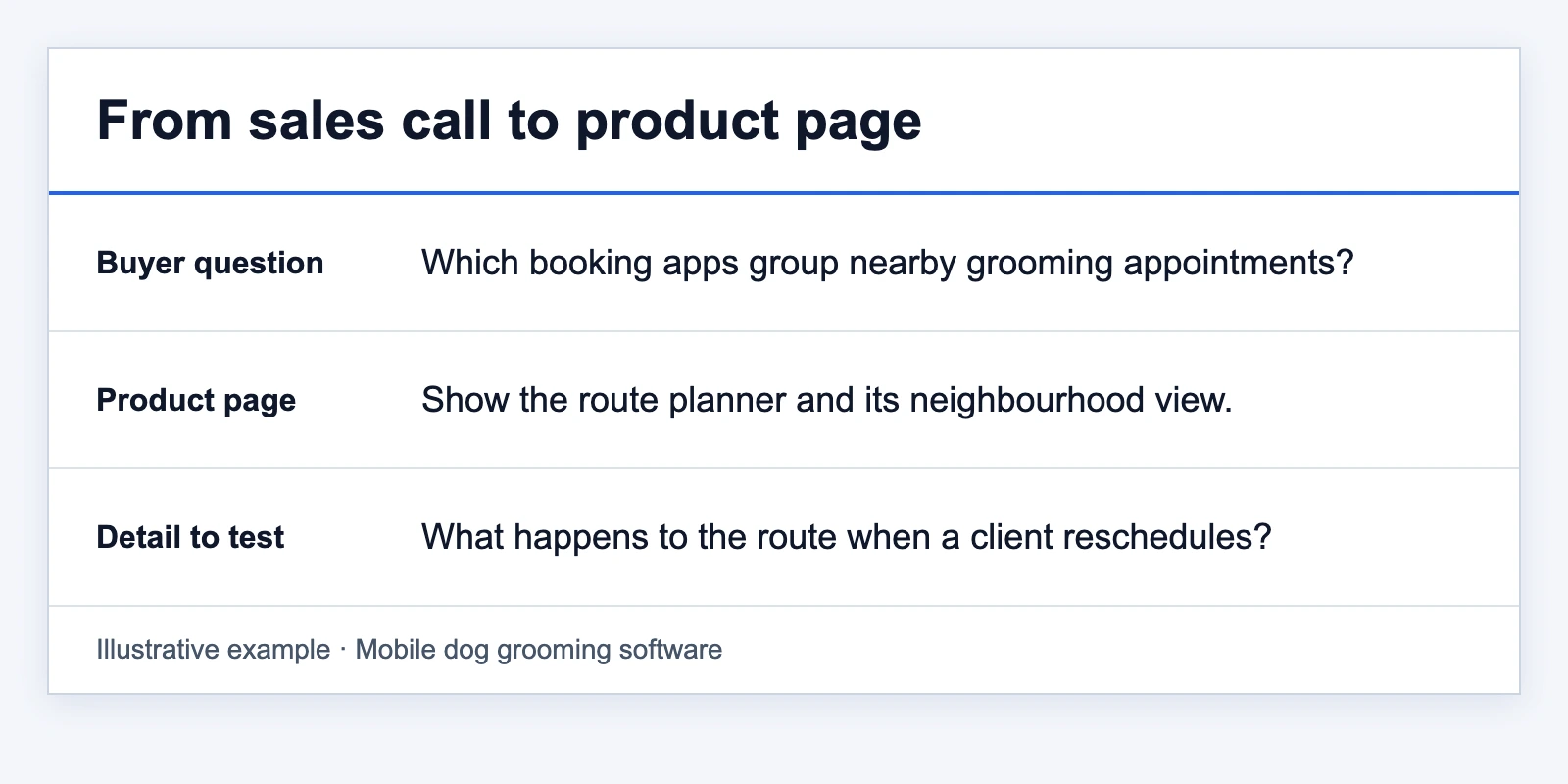
Use that observation to ask what each planned page adds. A guide can resolve a recurring sales question, demonstrate a working feature or explain a comparison your customers already make. Save the specific question with the brief. That gives the editor a concrete standard for deciding whether the finished page is useful enough to publish.
When an existing article attracts few visits, open the page and its search data together. Check whether it answers the query visible in the report, whether important details are still accurate and whether the next action is easy to find on a phone. Record the problem you found. Replacing a page simply because it is old can discard a useful answer without addressing why people pass it by.
Ranking timelines change with the sample
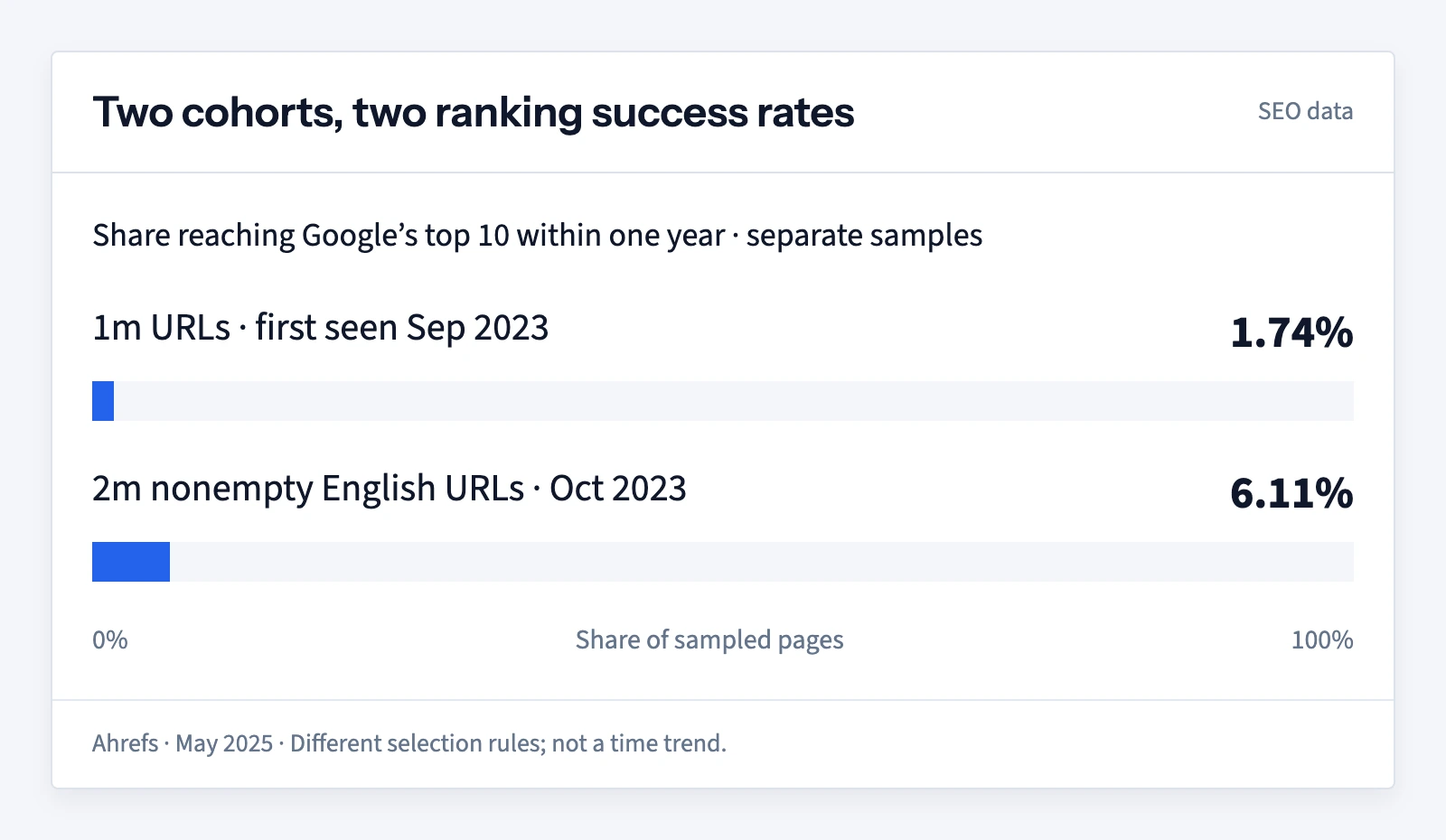
The May 2025 Ahrefs ranking study reports two separate cohorts. Of one million URLs first seen in September 2023, 1.74% reached the top 10 within a year. A different sample of two million nonempty English URLs created in October 2023 produced 6.11%. Their selection rules differ, so the comparison does not measure an improvement over time.
Build your review schedule around observations you can actually collect. Save the publication date, the intended query, the relevant country and the URL. At each review, note whether the page has impressions, which searches generated them and what visitors can do after landing. A blank report and a page receiving impressions with few clicks lead to different investigations.
Agree on a useful early milestone with whoever owns the page. For a product comparison, that could be confirming that the relevant product details are accurate and that the query mix matches the intended buyer. Keep eventual signups or enquiries in the same review record. A position target alone cannot show whether the article helped someone choose your service.
What older ranking pages tell a small team
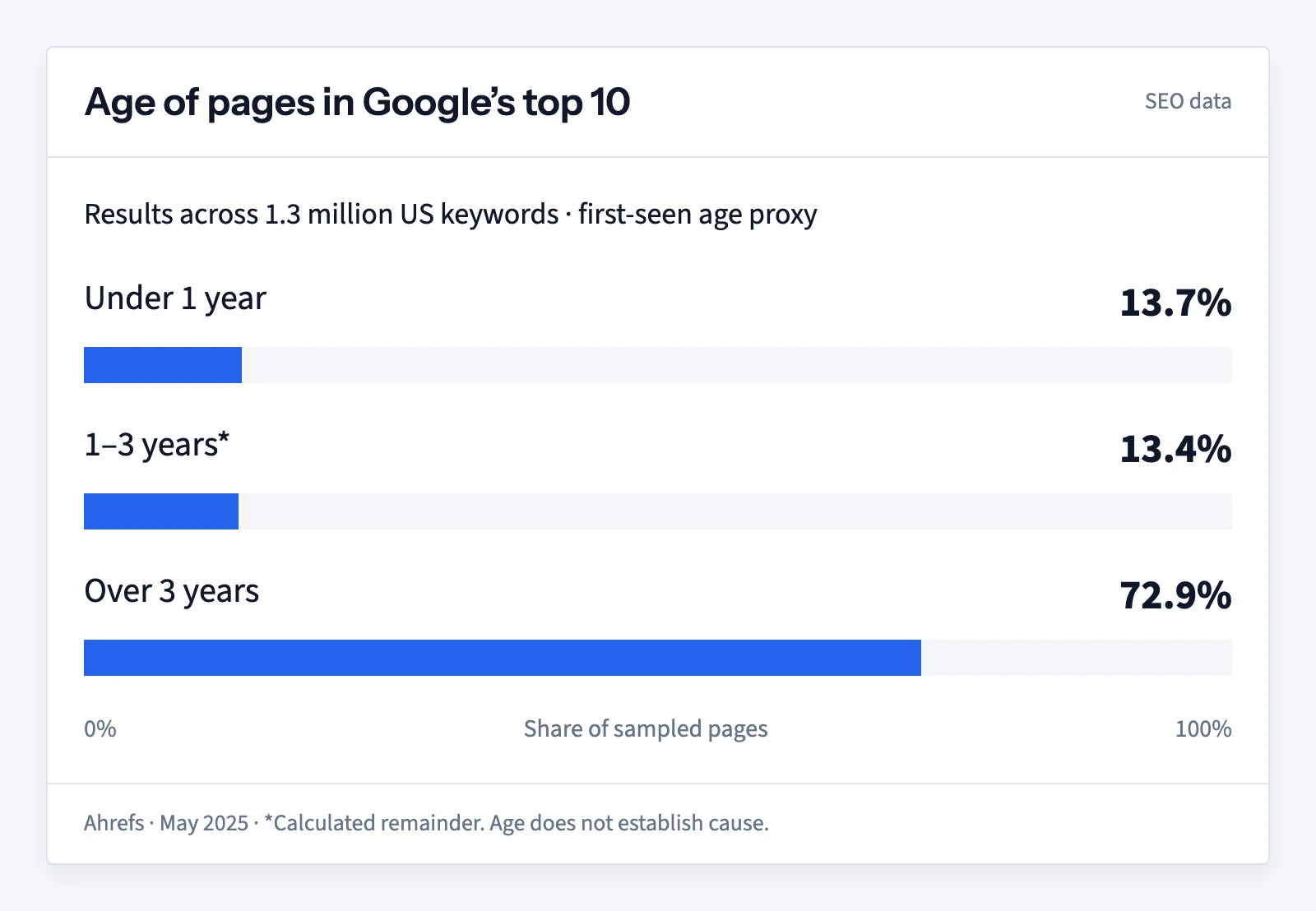
In the same 2025 study’s top-10 results, 72.9% of pages were over three years old and 13.7% were under one year old. The calculated middle group is 13.4%. Age used a crawler first-seen proxy. This association does not show that leaving a page unchanged causes higher rankings.
Give useful pages an owner after launch. When a product limit changes, update the explanation and the screenshot that demonstrates it. When customers repeatedly ask a missing question, add the answer where they need it. Keep a change record so the next person can distinguish a factual correction from a new section or a revised offer.
This also helps you decide between a new URL and an update. If the existing page already serves the same buyer question, improve its answer and preserve a stable destination for internal links. A distinct customer decision can justify its own article. Review related pages together so that your team can explain what each one is meant to help a reader do.
Compare your own pages before choosing the next fix
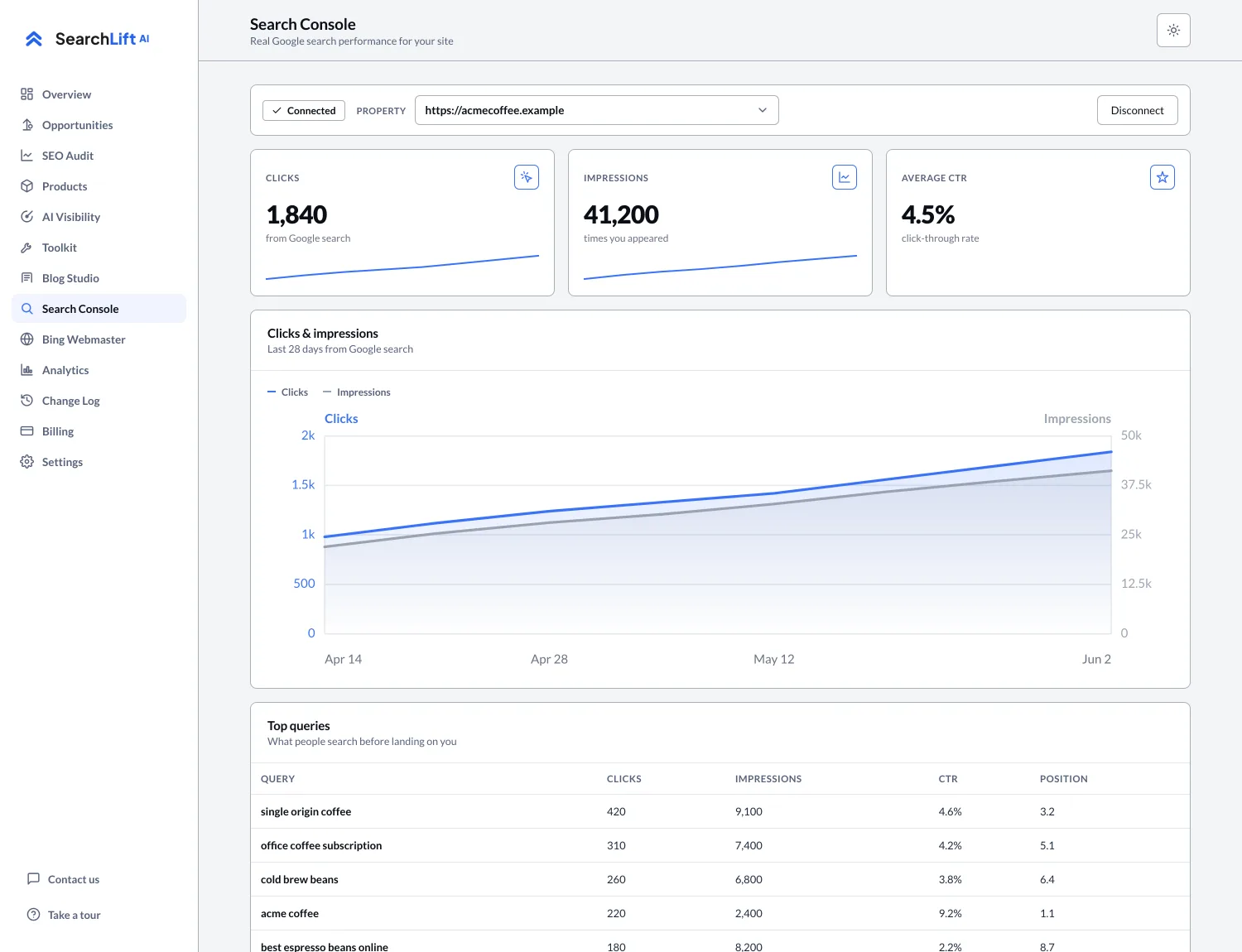
SearchLift’s Search Console suite brings query and page performance into the workflow. In the approved coffee-shop example below, “acme coffee” has a 9.2% CTR at average position 1.1, while “best espresso” has a 2.2% CTR at 8.7. Those rows belong to a demonstration workspace. They show why a branded query and a broader product search deserve separate review.
| Page evidence | Useful next check |
|---|---|
| Impressions for an unrelated buyer question | Read the query beside the landing-page answer |
| Relevant impressions, few clicks | Review title, snippet and the result the buyer expects |
| Clicks without a meaningful next action | Check the offer, explanation and conversion path |
| Recently changed page | Compare the same URL over matching periods |
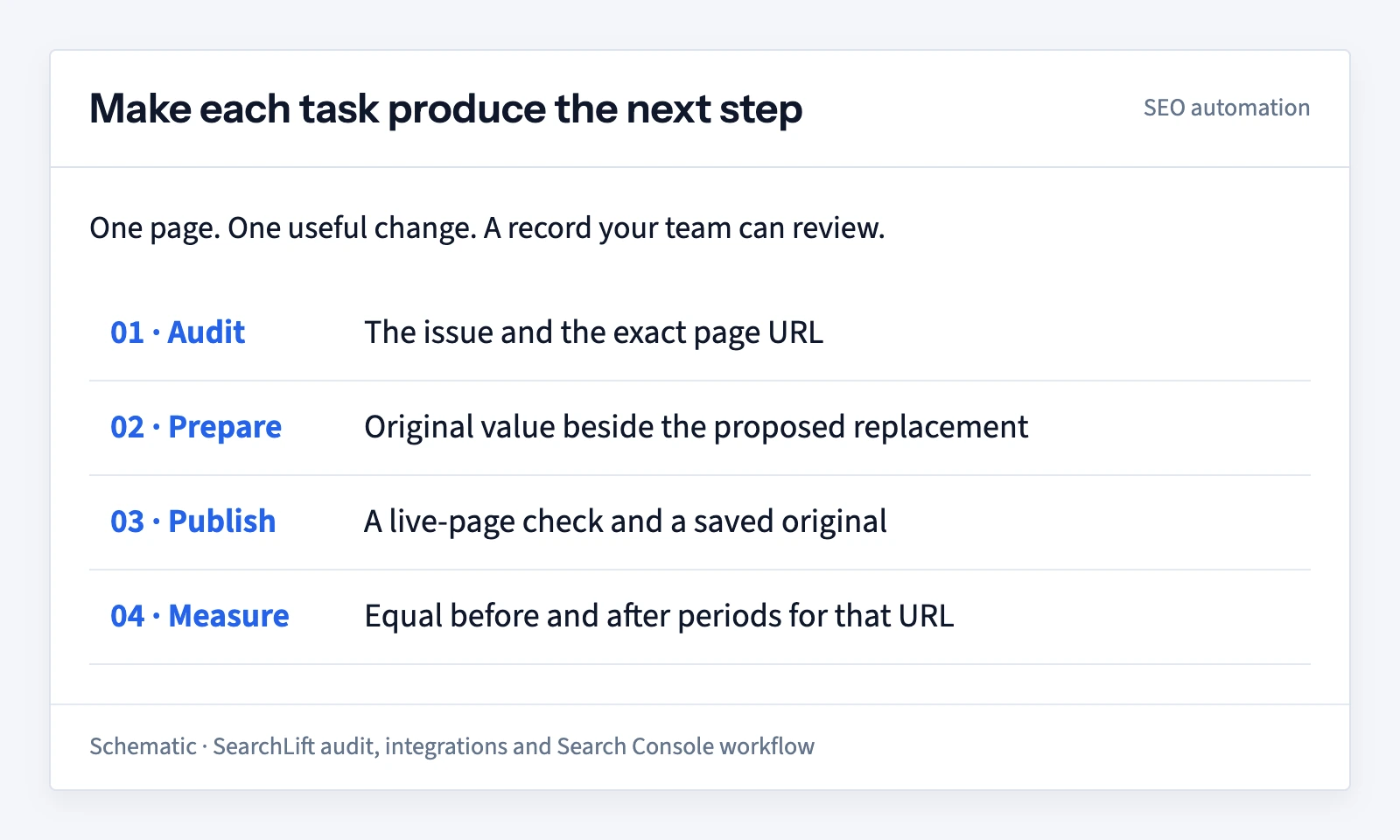
Choose one relevant page and use the SEO audit to examine the issue before preparing a fix. SearchLift can compare clicks, impressions and average position over matching 14-day or 28-day windows for a changed page. Keep promotions, seasonal demand and other edits in the review notes because a before-and-after difference can have several explanations.
The SEO automation workflow connects that finding to a proposed change, a live check and a later review. Start with one customer question your site should answer well. Keep Google traffic figures alongside the separate measures in our AI search statistics guide when planning visibility across search and assistants.
Common questions
- 01Which SEO statistics should a small business track?
- Use industry studies to frame expectations, then track your own page impressions, clicks, CTR and average position alongside meaningful customer actions. Keep the country, query and measurement period with each comparison.
- 02Does zero estimated traffic mean a page has no visitors?
- No. A third-party Google organic estimate does not measure every visit or traffic source. Review your own Search Console and analytics data before deciding what to change.
- 03How long should I wait before reviewing a new article?
- Record a baseline and schedule regular checks of indexing, query relevance and customer actions. Use matching observation periods; an industry ranking study cannot promise a deadline for your URL.
- 04Should I update an existing article or publish a new one?
- Improve the existing page when it already answers the same buyer question. Consider a new article when it serves a distinct decision and you can explain how it differs from related pages.